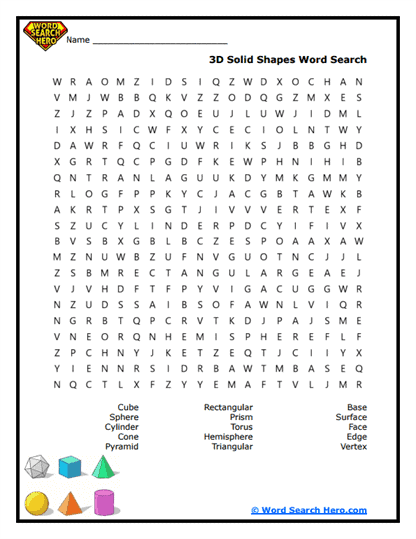
About Our Basic Shape Word Searches
Basic Shape word searches help students become familiar with the vocabulary used to describe the shapes they see in math and in everyday life. These printable puzzles introduce and reinforce terms connected to common two-dimensional and three-dimensional shapes, geometric features, and shape recognition. Before students begin sorting, drawing, or comparing shapes, it often helps to first recognize the language used to talk about them.
For young learners especially, geometry begins with noticing and naming the world around them. Students encounter words like circle, square, triangle, rectangle, oval, cube, and sphere as they learn to identify shapes and describe their features. A word search offers a simple and engaging way to build familiarity with these terms before students use them in lessons, discussions, and hands-on activities.
Because the activity feels like a puzzle instead of a traditional worksheet, it can increase participation and make geometry practice feel more approachable. Teachers often use these printables as warm-ups, center activities, review pages, early finisher work, or quiet independent practice. Parents and homeschool educators can also add them to lessons as an easy way to reinforce shape vocabulary while keeping learning fun and low-pressure.
As students search for words in the puzzle, they are also practicing concentration, visual scanning, and pattern recognition. At the same time, they are building the vocabulary foundation that helps them describe shapes with more confidence and accuracy.
Building Early Geometry Vocabulary
Learning basic shapes is one of the first steps in understanding geometry. Students need to recognize the names of common shapes and begin noticing what makes them different from one another. Words like side, corner, curve, flat, and round often become part of those early conversations.
When students know the vocabulary, they are better able to describe what they see. Instead of saying a shape “looks like a box,” they can say it is a rectangle or a cube. Instead of pointing to a shape and saying “that one,” they can name it clearly and talk about its features. This kind of vocabulary growth supports not just geometry, but also speaking, listening, reading, and writing in math.
Word searches help by giving students repeated exposure to shape names in a relaxed format. As they look for each word, they become more familiar with how the terms look and sound. That repeated recognition makes it easier to remember the words later during lessons and activities.
These puzzles can be especially helpful before students begin sorting shapes, drawing them, or comparing their features. When the names already feel familiar, the learning process becomes much smoother.
Paul’s Pro-Tip
A high-value follow-up is to turn the puzzle into a “find it, name it, explain it” routine. After students complete the word search, ask them to choose several shape words and do three things for each one: find an example in the room or home, name the shape, and explain how they know.
For example, a student might point to a clock and say it is a circle because it is round, or identify a book as a rectangle because it has straight sides and corners. This simple routine adds real depth because it moves students from memorizing shape names to applying them in the world around them.
For teachers and homeschoolers, this is especially useful because it gives quick insight into what students actually understand. A child may be able to find the word triangle in the puzzle, but asking them to locate one in real life and describe its features shows whether the concept has really clicked. It is easy to do, requires almost no prep, and makes the vocabulary immediately more meaningful.
Helping Students See Shapes Everywhere
Basic shapes are all around us. Students see them in signs, toys, buildings, books, dishes, windows, and classroom materials. Learning shape vocabulary helps them notice patterns and structure in the world they already know.
That real-world connection is one of the reasons shape study is so important in early math. When students understand the names and features of shapes, they begin to sort objects more carefully, compare what they notice, and describe their surroundings with more precision. Geometry becomes something they can see, touch, and talk about, not just something that appears on a worksheet.
A word search can be a great starting point for this kind of observation. After the puzzle, educators can invite students to look around and spot examples of the shapes they found. Even a short shape hunt can turn a simple printable into a meaningful geometry lesson.
When students become comfortable with the language of basic shapes, they are better prepared for future work in geometry and more confident using math vocabulary in everyday situations.
Frequently Asked Questions
When are basic shape word searches most useful?
They are especially helpful when introducing shape names, reviewing geometry vocabulary, or adding a quiet activity to centers, morning work, or early finisher time.
What grade levels are these puzzles best for?
They work especially well for preschool, kindergarten, and early elementary students, though older learners reviewing foundational geometry terms can benefit too.
Can homeschool educators use these printables in lessons?
Yes. They are easy to print and pair well with shape hunts, drawing activities, sorting games, and hands-on geometry practice at home.
Do these puzzles help students learn shape vocabulary?
They can. Repeated exposure to shape names helps students recognize the words more quickly and use them more confidently during lessons and discussions.
What is a good follow-up activity after completing the puzzle?
A strong next step is to have students find real-life examples of the shapes, draw them, or sort objects by shape while using the vocabulary from the puzzle.