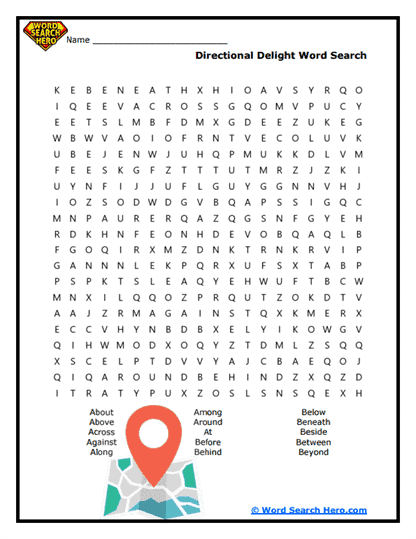
About Our Prepositions Word Searches
Prepositions are small words that play an important role in everyday language. Words such as above, below, across, through, and between help show relationships between people, places, and objects. Our Prepositions Word Searches turn this important grammar topic into a fun, interactive learning activity that students actually enjoy.
These printable puzzles give teachers, parents, and homeschoolers an easy way to reinforce grammar skills without adding extra pressure to a lesson. Instead of simply memorizing lists of words, learners actively search for prepositions hidden in the puzzle grid. This encourages students to slow down, read carefully, and recognize these words more easily when they appear in real sentences.
Many educators use these puzzles during literacy centers, morning work, or as a quick grammar review activity. Because the puzzles are simple to print and distribute, they also work well as early finisher activities that keep students engaged and focused while others complete their assignments.
Parents and homeschool educators also appreciate how flexible these activities can be. A word search can become a quick warm-up before a writing lesson or a relaxed activity after reading practice. Children often see puzzles as a game rather than a grammar exercise, which makes them more willing to participate.
Another benefit is the boost to vocabulary development and visual scanning skills. As students search across rows, columns, and diagonals, they strengthen concentration and pattern recognition. At the same time, they become more familiar with prepositions that frequently appear in reading and writing.
Our Prepositions Word Searches make grammar approachable, interactive, and enjoyable-helping learners build confidence with language while solving a puzzle that feels like play.
Strengthening Grammar Through Discovery
Grammar concepts often stick better when students encounter them in multiple ways. Word search puzzles provide a gentle introduction to prepositions because learners discover the words on their own rather than being asked to memorize them immediately.
One effective approach is to introduce a few prepositions before students begin the puzzle. Words such as under, beside, across, and through can be discussed briefly so learners understand how they function in sentences. Once students begin searching for these words in the puzzle grid, they reinforce both the spelling and recognition of the vocabulary.
After the puzzle is complete, educators can extend the learning with a short follow-up activity. Students might write a sentence using three or four of the words they found. For example, they could write, “The bird flew over the tree,” or “The backpack is under the desk.” This step helps bridge the gap between identifying the words and applying them in real language.
Teachers sometimes turn the activity into a collaborative challenge. Students can compare the words they found first, or work in small groups to locate the trickiest ones. These moments of teamwork make the experience feel more like a game than a grammar lesson.
Word searches also provide repeated exposure to key vocabulary. The more often students see and recognize prepositions, the easier it becomes for them to understand how these words connect ideas within sentences.
By combining discovery, repetition, and simple writing practice, these puzzles help learners develop stronger grammar skills in an engaging and stress-free way.
Paul’s Pro-Tip
When students finish a word search, that’s the perfect moment to turn the puzzle into a quick learning boost.
Try asking learners to pick three or four words they found and use them in simple sentences. For example, they might write something like, “The dog ran around the yard,” or “The pencil rolled under the table.” This small step helps them move from recognizing a word to actually understanding how it works.
Another fun idea is to ask students to look around the room and describe where objects are using the words they discovered. Suddenly those little grammar words start showing up everywhere.
A puzzle becomes much more powerful when learners connect the words they found to the world around them.
Finding Prepositions in Everyday Situations
One of the best ways to reinforce grammar is to help students notice how often it appears in everyday language. Prepositions show up constantly in directions, conversations, and stories. Once learners become familiar with these words through a puzzle activity, they begin spotting them almost everywhere.
In the classroom, teachers can encourage students to listen for prepositions during daily instructions. Phrases like “Put your paper on the desk” or “Stand behind the line” contain the same vocabulary students may have discovered in their word search.
Reading time is another excellent opportunity. While working through a short story or chapter book, students can keep track of the prepositions they notice in sentences. This turns reading into a small scavenger hunt where learners identify familiar words from their puzzle activity.
Students can also practice describing objects in the room using prepositions. For example, they might say, “The clock is above the whiteboard,” or “The backpack is next to the chair.” These simple descriptions help students see how prepositions clarify the position or movement of objects.
Parents can reinforce the same idea at home. During dinner, a child might describe where things are located on the table or around the kitchen. Everyday conversations become opportunities to practice grammar naturally.
When learners begin recognizing these words in real situations, the vocabulary from a word search puzzle quickly transforms into practical language skills.
Frequently Asked Questions
What are prepositions word searches used for?
These puzzles help students recognize and become familiar with common prepositions while strengthening reading and spelling skills. They turn grammar practice into a fun puzzle activity.
Can teachers use these puzzles during grammar lessons?
Yes. Many teachers use them as review activities, literacy center tasks, or early finisher work to reinforce grammar concepts in an engaging way.
Are these puzzles helpful for homeschool learning?
Absolutely. Printable word searches provide a simple and flexible activity that fits easily into reading, writing, or language arts lessons at home.
Do word searches help students remember vocabulary?
They can. Repeated exposure to words improves recognition and spelling, and the puzzle format encourages students to focus on each word more carefully.
What can students do after finishing the puzzle?
A great follow-up activity is asking students to write sentences using the prepositions they found or to describe objects around them using those words. This helps reinforce how the vocabulary works in real language.