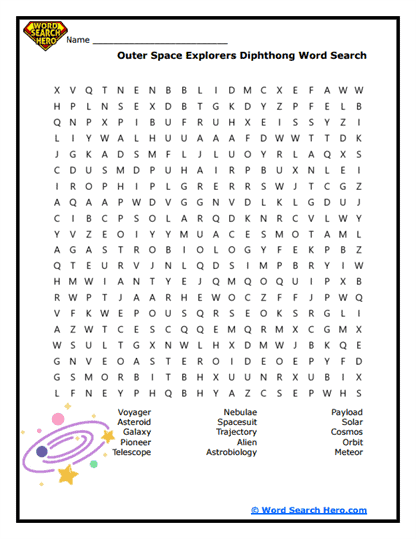
About Our Diphthongs Word Searches
Diphthongs word searches help students become more familiar with vowel sound patterns where the sound glides from one vowel sound to another within the same syllable. These printable puzzles introduce and reinforce vocabulary connected to vowel sounds, phonics patterns, and word decoding. Before students begin identifying diphthongs while reading or spelling unfamiliar words, it often helps to first recognize the language used to describe these sound changes.
Diphthongs appear in many everyday English words. Examples include vowel combinations such as oi, oy, ou, and ow, which create sounds heard in words like coin, boy, cloud, and cow. Students often encounter terms such as diphthong, vowel sound, syllable, blend, and sound pattern when learning about these phonics concepts. A word search provides a simple and engaging way to build familiarity with these terms before students begin applying them during reading practice.
Because the activity feels like a puzzle rather than a traditional worksheet, it can make phonics practice feel more enjoyable and less repetitive. Teachers often use these printables as literacy warm-ups, reading center activities, early finisher work, or review pages during phonics lessons. Parents and homeschool educators can also include them easily in lessons as a way to reinforce diphthong vocabulary while keeping learning interactive.
As students search for the words in the puzzle grid, they strengthen concentration, visual scanning skills, and pattern recognition. At the same time, they are building the vocabulary foundation that helps them recognize changing vowel sounds within words.
Understanding How Diphthongs Work
A diphthong occurs when two vowel sounds blend together within the same syllable, creating a sound that glides from one vowel position to another. Instead of producing a single steady sound, the mouth moves slightly as the vowel sound changes.
For example, the oi sound in coin begins with one vowel sound and shifts into another as the word is spoken. Similarly, the ou sound in cloud changes as the vowel sound moves during pronunciation.
Recognizing these patterns helps students decode unfamiliar words more effectively. When students understand that certain vowel combinations create unique sound patterns, they can approach new words with greater confidence.
Learning the vocabulary connected to diphthongs also helps students follow phonics instruction more easily. Words like vowel sound, syllable, diphthong, and sound pattern help students describe what they hear when reading words aloud.
Word searches support this learning by giving students repeated exposure to these phonics-related terms while they practice identifying words that contain diphthongs.
Paul’s Pro-Tip
A highly effective way to extend this puzzle is to follow it with a “sound glide” activity. After students complete the word search, choose several diphthong words and ask students to pronounce the vowel sound slowly so they can hear the change within the sound.
Encourage students to exaggerate the sound slightly while saying the word so they can notice how the vowel moves from one sound to another. For example, they can slowly pronounce a word like boy or cow to hear the shifting vowel sound.
This activity adds strong instructional value because it helps students focus on the sound movement that defines diphthongs. For teachers and homeschool educators, it also acts as a quick check for phonics awareness. If students can hear and describe the sound change, they are developing stronger listening and decoding skills.
Helping Students Recognize Changing Vowel Sounds
Diphthongs are an important part of English pronunciation and appear in many frequently used words. When students learn to recognize these sound patterns, they gain tools that help them read unfamiliar words more accurately.
Understanding diphthongs also supports spelling development because students become more aware of vowel combinations that produce specific sounds. Recognizing these patterns helps students connect spelling with pronunciation.
A word search can serve as a helpful introduction to these ideas. After completing the puzzle, educators can encourage students to listen for diphthong sounds in the words they read during the day. Even a short activity where students highlight diphthong patterns in books or word lists can reinforce how common these sound changes are.
When students become comfortable with the language of diphthongs, they are better prepared to decode unfamiliar words, improve pronunciation, and strengthen their overall reading fluency.
Frequently Asked Questions
When are diphthong word searches most useful?
They are especially helpful during phonics lessons that focus on vowel sound combinations and advanced decoding strategies.
What grade levels benefit most from these puzzles?
They work well for early elementary students who are learning vowel sound patterns and expanding their phonics knowledge.
Can homeschool educators include these puzzles in lessons?
Yes. They are easy to print and pair well with pronunciation practice, reading activities, and phonics games.
Do word searches help students recognize diphthong sounds?
They can. Repeated exposure to words that contain diphthongs helps students become more comfortable recognizing these vowel sound patterns.
What is a good follow-up activity after completing the puzzle?
A helpful next step is asking students to read diphthong words aloud slowly and identify how the vowel sound changes within the word.