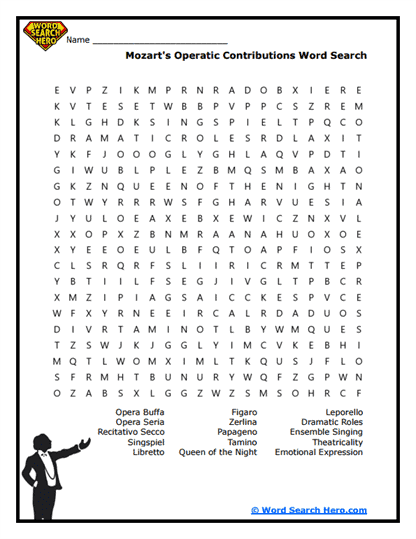
About Our Famous Composer Word Searches
Our Famous Composer Word Searches celebrate the brilliant minds behind some of the most powerful and influential music ever created. These printable puzzles are perfect for classrooms, homeschool settings, or music-focused learning, offering an engaging way to build vocabulary while exploring the composers who shaped music history.
Students will search for words like “composer,” “symphony,” “concerto,” “orchestra,” “melody,” and names of legendary figures such as Mozart, Beethoven, and Bach. As they work through the puzzles, they strengthen spelling, reading fluency, and concentration while connecting directly to the foundations of music. Because composers are the creators of music itself, these puzzles emphasize how ideas turn into sound through structure, notation, and performance.
These printables are easy to use with no preparation required and can be adapted for different age levels. Younger learners can focus on basic musical terms, while older students explore more advanced vocabulary related to composition and musical form.
Beyond literacy skills, these puzzles help students understand that every piece of music begins with a composer’s vision. They highlight how creativity, structure, and emotion come together to form the music we hear and enjoy.
The Language of Composition and Musical Creation
Famous composer themes introduce students to the vocabulary behind how music is written and structured. Words like “notation,” “harmony,” “tempo,” “dynamics,” and “movement” help learners understand how composers organize sound into meaningful pieces. These terms are essential for understanding how music is built from the ground up.
A helpful classroom strategy is to have students group words into categories such as musical structure, instruments, and composer roles. For example, they might separate “symphony” and “sonata” from words like “violin” or “piano.” This helps students see how composers write for different instruments and arrange music into forms.
You can extend the activity by asking students to imagine they are composers and describe a piece of music using several of the words from the puzzle. Would it be fast or slow? Loud or soft? This reinforces vocabulary while encouraging musical creativity.
Because composers shape every aspect of a piece, these puzzles help students see how music is carefully crafted. It’s not just about playing notes-it’s about designing sound to create emotion and meaning.
Paul’s Pro-Tip

I always found that when students realized composers were the “authors” of music, it clicked in a whole new way. I’d start by asking, “If you could create your own song, what would it sound like?” That question got them thinking like composers right away and made the puzzle feel more personal.
After they finished, I liked to have students pick one word and use it to describe a piece of music they imagined. Maybe it’s a fast tempo with strong dynamics or a soft melody played on piano. That extra step helped them connect vocabulary to actual sound. And if someone got stuck, I’d remind them to look for familiar composer names first-they’re often easier to find and build confidence quickly.
Connecting Composers to Music and Creativity
Famous Composer Word Searches offer strong connections to music education and creative expression. In music lessons, they support understanding of how compositions are structured, from melody and harmony to rhythm and dynamics. Students can explore how different composers used these elements to create unique styles.
In history, these puzzles can introduce students to different time periods of music, such as classical, baroque, and romantic eras. This helps them understand how music evolved and how composers influenced each other over time.
Creative extensions are especially effective with this theme. Students might try writing a simple melody, describing a musical scene, or even creating a “composer profile” using words from the puzzle. These activities reinforce vocabulary while encouraging imagination and musical thinking.
These puzzles also highlight how music connects across cultures and generations. By focusing heavily on the role of composers, students gain a deeper appreciation for how music is created, shared, and remembered.
Frequently Asked Questions
What are famous composer word searches?
Famous composer word searches are printable puzzles that include vocabulary related to music composition, structure, and well-known composers. They help students explore the foundations of music while improving spelling and reading skills.
How do these word searches help students understand music?
They introduce key musical concepts like tempo, harmony, and dynamics, helping students understand how music is created and organized. When paired with listening or creative activities, they deepen appreciation for how composers shape sound.
Are composer-themed word searches good for classroom use?
Yes, they are highly effective in music classrooms and can also be used in general education settings. Teachers can adapt them for different grade levels while keeping the focus on music and creativity.
Can these puzzles be used in music history lessons?
Absolutely, they are a great addition to lessons about different composers and musical eras. They provide an interactive way for students to learn about important figures and their contributions to music.
Why do students enjoy composer-themed activities?
Students enjoy learning how music is created, especially when they can imagine themselves as composers. When learning connects creativity with real-world music, it becomes more engaging and memorable.