


Advanced Mathematics
You’ll be elbow-deep in grids hunting for “Eigenvalue,” “Riemann,” and “Biconditional” like you’re on a very nerdy safari, dodging logic traps and imaginary numbers along the way.
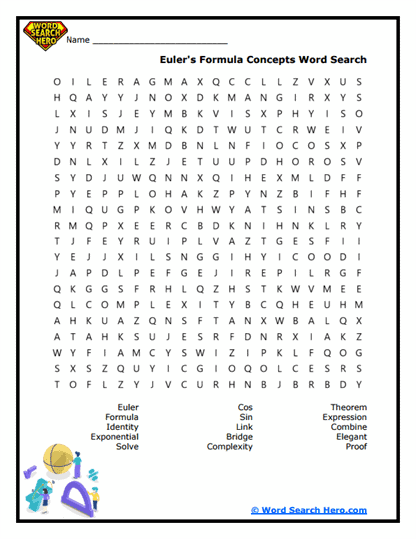
You’ll be elbow-deep in grids hunting for “Eigenvalue,” “Riemann,” and “Biconditional” like you’re on a very nerdy safari, dodging logic traps and imaginary numbers along the way.

Get ready to chase down algebraic expressions and mathematical relationships like a caffeinated detective at a numbers convention-these word searches turn intimidating math lingo into a hilariously addictive hunt for terms like “coefficient” and “inequality.”

Dive headfirst into a delightfully nerdy adventure where numbers, charts, and mathy buzzwords hide in plain sight, daring you to find them faster than your last attempt at calculating a tip under pressure.

Whether you’re a mathlete, a curious kid, or someone who once cried during a trigonometry test, these free printables will make you fall in love with lines, angles, and shapes in ways your high school teacher never could.

Get ready to flex your brain and tickle your funny bone with this collection of number property word searches that turn math into a laugh-out-loud logic party; because nothing says “fun” like chasing down prime numbers and fractions hiding in a grid like sneaky little math ninjas.

Sharpen your pencils and your wits, because this collection of word searches turns everyday math into a laugh-out-loud letter hunt where decimals, percentages, and place values come out to play.

It’s like algebra and a crossword had a love child, and now it wants you to find hidden words faster than you can say “Pythagorean who?”
Our Math Word Searches are a fun and engaging way to reinforce important classroom vocabulary while giving students a relaxing mental challenge. These printable puzzles are designed for teachers, parents, and homeschoolers who want to add a little excitement to math learning while still supporting real academic skills.
Math often comes with a lot of new terminology-words like addition, fraction, equation, and geometry. Word search activities help students become more familiar with these terms by encouraging repeated visual recognition. As learners scan the puzzle grid for vocabulary, they naturally strengthen spelling, pattern recognition, and reading confidence. For younger students especially, this can make math feel less intimidating and more approachable.
Teachers often use these puzzles as morning work, early finisher activities, or light review during math units. Because they’re printable and easy to distribute, they’re also perfect for substitute teacher plans or quiet independent work. Many educators like to pair them with a quick vocabulary discussion before or after students complete the puzzle.
At home, math-themed puzzles give families a playful way to keep learning going outside the classroom. Parents often use them during homework time, on road trips, or as part of a weekly learning routine. Since word searches encourage patience and focus, they can also help students build the persistence needed for solving more complex math problems.
Whether you’re introducing new vocabulary or reviewing concepts students have already learned, these printable activities provide a low-pressure way to reinforce math language while keeping kids engaged.
One of the best things about math-themed word puzzles is that students often don’t realize how much they’re learning while completing them. Educators sometimes call this “stealth learning”-when a fun activity secretly strengthens academic skills.
When students search for words like multiply, denominator, or polygon, they repeatedly scan the letters and mentally rehearse the vocabulary connected to those concepts. That repetition helps the brain store the terms more effectively. Over time, those once-confusing words begin to feel familiar.
The activity also strengthens visual scanning and pattern recognition. Students move their eyes carefully across rows, columns, and diagonals while identifying letter combinations. These same skills support reading fluency and attention to detail-both of which are extremely helpful when working through math problems.
Another benefit is confidence. Many students experience anxiety when they see numbers and equations. A vocabulary-based puzzle gives them a chance to engage with math language in a low-stress environment. Instead of worrying about right or wrong answers, they focus on finding words and enjoying the challenge.
Teachers often notice that students who complete vocabulary puzzles become more comfortable using math terms during discussions. Suddenly phrases like “I found the numerator!” or “This reminds me of geometry!” start appearing in the classroom.
It’s a simple activity, but it quietly builds familiarity with the language that students need to succeed in math.

Paul here – retired teacher and longtime puzzle enthusiast.
If you want to squeeze extra learning out of a math word search, have students circle the words and then explain them to a partner. I used to call it the “Find It, Define It” rule.
Once a student finds fraction or area, they have to give a quick explanation or example. Nothing fancy-just a sentence or two.
You’ll be amazed how quickly vocabulary sticks when kids actually say the word out loud. Plus, students love being the “expert” for a moment. And if nobody knows the word yet? Perfect! That means you just discovered tomorrow’s mini-lesson.
Math vocabulary isn’t just something students see in textbooks-it appears everywhere in daily life. A great way to extend the learning from these puzzles is to help students spot math concepts in the real world.
For example, the word measurement shows up when baking cookies or building a model. Words like angle and triangle appear in architecture, sports fields, and playground equipment. Even shopping trips involve terms such as total, price, and percentage when calculating discounts.
Teachers sometimes challenge students to find real-world examples of the words they discovered in the puzzle. If a student finds the word graph, they might look for graphs in newspapers, weather reports, or sports statistics. If the puzzle includes fraction, they could point out how pizza slices or measuring cups demonstrate the idea.
This kind of connection helps students realize that math is not just a subject in school-it’s a language used to understand the world around us.
Parents can join in the fun too. After completing a puzzle at home, families might look around the house for shapes, patterns, or measurements that match the vocabulary. Suddenly the word rectangle describes a window, and perimeter relates to the fence around the yard.
By linking vocabulary puzzles with real-life observations, students begin to see math not as an abstract subject, but as a practical tool they use every day.
Yes! They reinforce vocabulary recognition, spelling, and familiarity with key math terms. Teachers often use them for review, early finisher work, or warm-up activities.
Math word searches can work for many grade levels. Younger students focus on basic vocabulary like add or count, while older students can explore terms from algebra, geometry, or statistics.
Absolutely. They’re easy to print and work well as part of math lessons, quiet work time, or weekly learning activities at home.
Yes. Repeated visual exposure helps students recognize and remember important terms, making it easier to understand math lessons later.
They’re perfect for independent learning. Students can complete them quietly while practicing focus, pattern recognition, and vocabulary skills.