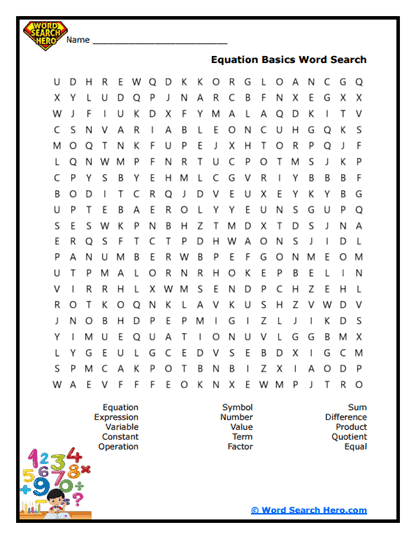
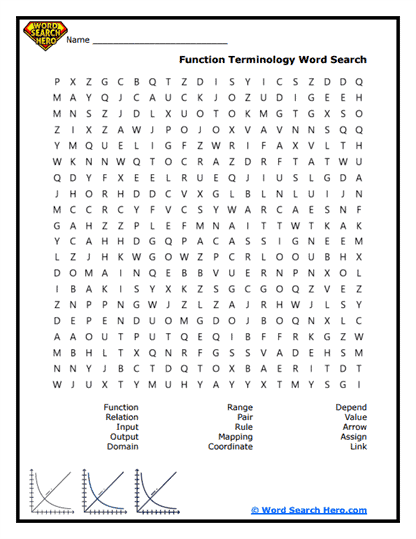
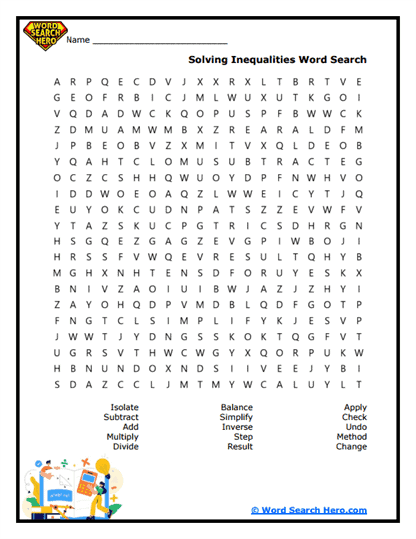
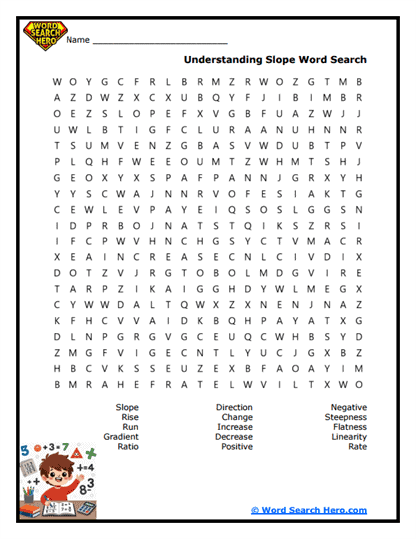
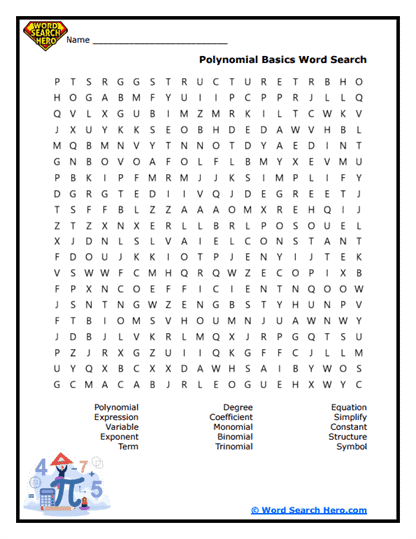
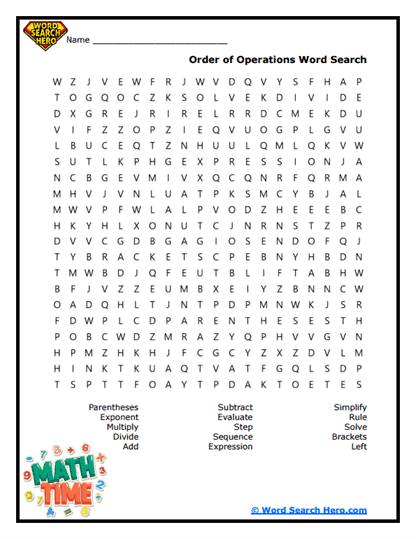
About Our Expressions and Relationships Word Searches
Expressions and Relationships word searches introduce students to the language used to describe how numbers, variables, and operations interact in mathematics. These printable puzzles help learners become familiar with important terms connected to algebraic expressions, patterns, equations, and the relationships between quantities. Instead of immediately focusing on solving problems, students begin by recognizing the vocabulary that explains how math works.
For many learners, algebra becomes easier once the terminology starts to make sense. Words like variable, coefficient, expression, term, and relationship appear frequently in math lessons, textbooks, and assignments. When students recognize these words quickly, they can focus more energy on understanding the concepts behind them rather than trying to decode unfamiliar language.
Word searches provide a relaxed way to build this familiarity. Students scan for words, notice patterns, and become comfortable with spelling and structure. Because the activity feels like a puzzle rather than traditional practice, it can help reduce stress for students who feel uncertain about math topics.
Teachers often include these printables as warm-ups, review activities, or quick practice during algebra units. Parents and homeschool educators can also use them to reinforce vocabulary while keeping learning engaging and approachable. A simple puzzle can become a valuable stepping stone toward deeper mathematical understanding.
Strengthening Algebra Vocabulary Through Repetition
Expressions and relationships form the foundation of algebra. Before students can solve equations or analyze patterns, they need to understand the words used to describe mathematical ideas. Vocabulary such as evaluate, simplify, factor, relationship, and pattern appears repeatedly throughout algebra lessons.
Repeated exposure to these terms helps students become comfortable with the language of math. Word searches naturally create that repetition. As students search for each term, they slow down and pay attention to letter patterns, spelling, and word structure. This process helps the words become familiar, even before students fully master the concepts.
Teachers can use these puzzles to preview vocabulary before introducing new material. When students later encounter the same words during lessons, they already recognize them. That familiarity reduces confusion and helps students engage more confidently with the mathematical ideas being taught.
These activities can also support students who struggle with reading-heavy assignments. By presenting vocabulary in a visual puzzle format, word searches offer a different path to understanding the language of math.
Paul’s Pro-Tip
One effective strategy is to turn vocabulary into a “math translation” exercise. After students complete the word search, select a few words and challenge students to translate them into everyday language.
For example:
- Expression might become “a math phrase made of numbers and variables.”
- Coefficient could be explained as “the number attached to a variable.”
- Relationship might be described as “how two quantities affect each other.”
Encouraging students to explain the ideas in their own words strengthens comprehension and helps them retain the meaning behind the terms. This approach works especially well in classrooms and homeschool settings because it builds conceptual understanding without requiring a full lesson or long explanation.
Helping Students See Patterns and Connections
Expressions and relationships are closely tied to pattern recognition and logical thinking. Students begin to notice how numbers behave, how variables represent unknown values, and how different quantities connect to each other within equations and formulas.
A word search can be the starting point for these discoveries. After completing the puzzle, educators can briefly discuss how the vocabulary relates to real math situations. For example, a pattern might appear in a growing number sequence, while a relationship might describe how distance changes with speed and time.
Even small discussions like these help students see that algebra is not just about manipulating symbols. It is about understanding connections, predicting outcomes, and describing how quantities interact.
When vocabulary becomes familiar, students are better prepared to explore these ideas with confidence. What begins as a simple puzzle can lead to deeper curiosity about how math works.
Frequently Asked Questions
When are expressions and relationships word searches most useful?
They are especially helpful when introducing algebra vocabulary or reviewing terms before starting a new unit. Teachers often use them as warm-ups, early finisher activities, or quick review tools.
What grade levels benefit most from these puzzles?
These puzzles are often useful for upper elementary and middle school students who are beginning algebra concepts, though they can also support older students reviewing foundational vocabulary.
Can homeschool educators include these puzzles in lessons?
Yes. They are easy to print and can be paired with short discussions, simple examples, or notebook activities that help students connect vocabulary with real math ideas.
Do word searches actually support math learning?
They do. Recognizing and understanding math vocabulary helps students follow instructions, read problems more easily, and participate confidently in discussions about mathematical concepts.
What can students do after completing the puzzle?
A great follow-up is asking students to choose a few words and explain what they mean, draw a simple example, or show how the concept appears in a math problem. This helps move from word recognition to deeper understanding.