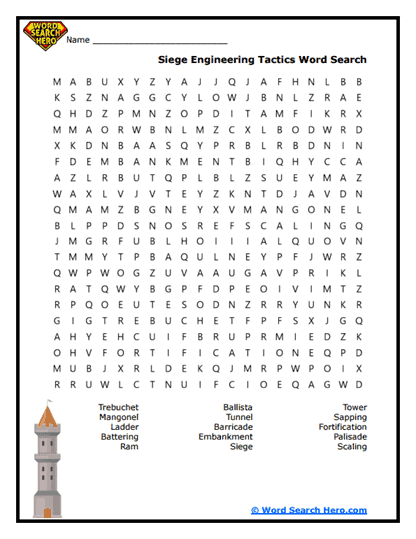
About Our The Siege of Jerusalem Word Searches
Our The Siege of Jerusalem Word Searches introduce students to an important and dramatic event in medieval history while strengthening vocabulary, spelling, and concentration skills. These printable puzzles highlight key people, places, and ideas connected to the famous siege that took place during the First Crusade in 1099.
Teachers often look for engaging ways to reinforce historical vocabulary without overwhelming students with long readings. Word searches provide a helpful solution because they allow learners to interact with important terms in a relaxed and enjoyable way. As students search for names of cities, leaders, armies, and historical concepts, they become more familiar with vocabulary they may encounter in world history lessons.
Parents and homeschool educators also appreciate printable puzzles that combine learning with entertainment. Word searches encourage patience, visual scanning, and attention to detail. At the same time, students interact with meaningful historical terms related to the medieval conflicts between European crusaders and forces in the Middle East.
The Siege of Jerusalem is often studied because it represents a key turning point during the First Crusade. Words connected to crusaders, fortifications, medieval warfare, and religious history may appear in the puzzle. Encountering these terms helps students become more comfortable with the language used when discussing the Crusades.
Whether used in classrooms, homeschool lessons, or independent learning time, these puzzles provide an engaging entry point into learning about the events and historical significance of the Siege of Jerusalem.
A Key Event of the First Crusade
The Siege of Jerusalem occurred in 1099 during the First Crusade, a military campaign launched by European Christian forces who aimed to capture the city of Jerusalem. At the time, Jerusalem was controlled by the Fatimid Caliphate, and it held deep religious importance for Christians, Muslims, and Jews.
After years of traveling and fighting across the eastern Mediterranean, crusader armies reached the heavily fortified city. Jerusalem’s walls and defensive structures made it a difficult target, and the attacking forces had to rely on siege tactics to attempt to capture the city.
Crusader forces constructed siege towers, ladders, and other equipment to try to breach the city’s defenses. For weeks, the attackers searched for ways to overcome the walls while defenders attempted to hold their positions and protect the city.
Eventually, the crusaders succeeded in breaking through the defenses and capturing Jerusalem. The event marked a major turning point in the First Crusade and led to the establishment of a Crusader-controlled kingdom in the region.
Students studying this event often learn about the strategies used during medieval sieges, the motivations behind the Crusades, and the cultural and religious importance of Jerusalem throughout history. Encountering these terms in a word search puzzle helps reinforce the vocabulary connected to this significant historical event.
Paul’s Pro-Tip
When we covered medieval sieges in class, I liked to turn the puzzle into a strategy challenge.
After students finish the word search, ask them to find three words connected to siege warfare-maybe wall, tower, or ladder.
Then ask: If you were trying to capture a walled city, how would you use these things?
Students start thinking about defenses, equipment, and tactics. Suddenly they’re discussing medieval strategy instead of just memorizing facts.
It’s a quick way to turn a quiet puzzle into an engaging history conversation.
Understanding Why Jerusalem Was So Important
Jerusalem has long been one of the most significant cities in world history because of its deep religious importance to multiple faiths. For centuries, it has been a center of spiritual tradition and pilgrimage for Christianity, Islam, and Judaism.
During the medieval period, the city became a focal point of political and religious conflict. The Crusades were partly motivated by the desire of European Christian leaders to control holy sites connected to the life of Jesus. At the same time, Jerusalem was an important city within the Islamic world, governed by Muslim rulers.
Because of this significance, control of Jerusalem carried both political and symbolic importance. Whoever held the city often gained influence, prestige, and strategic advantages within the region.
For students, learning about Jerusalem’s importance helps them understand why the city appears so frequently in historical discussions. It also highlights how religion, politics, and geography can intersect to shape major historical events.
Word searches that include vocabulary related to the city, the Crusades, and medieval warfare help reinforce these ideas. As students encounter these terms repeatedly, they gain a clearer picture of why Jerusalem has played such an important role throughout history.
Frequently Asked Questions
How can teachers use Siege of Jerusalem word searches in class?
Teachers often use them as warm-up activities, vocabulary reinforcement exercises, or early finisher tasks during units on the Crusades or medieval history.
What grade levels are these puzzles best for?
They work well for upper elementary and middle school students studying world history, though older students may also enjoy them as review activities.
Can word searches help students learn about historical events?
Yes. Repeated exposure to names, places, and concepts helps students recognize and remember important vocabulary connected to historical topics.
Are these puzzles useful for homeschool history lessons?
Absolutely. Homeschool educators often use printable puzzles as independent learning activities that reinforce vocabulary and keep students engaged.
What extension activity works well after completing the puzzle?
Students can choose a few words from the puzzle and research how those terms connect to the events of the First Crusade or the Siege of Jerusalem. This encourages deeper exploration of the historical topic.