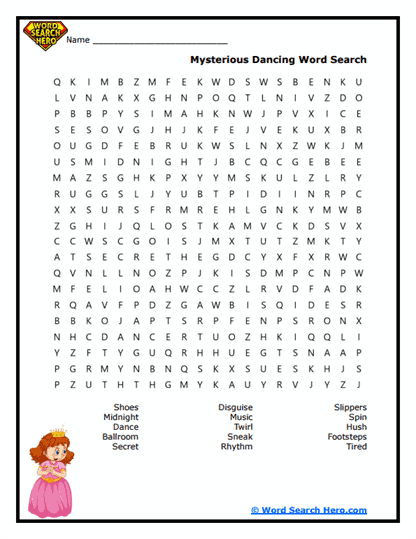
About Our The Twelve Dancing Princesses Word Searches
Our The Twelve Dancing Princesses Word Searches collection brings the mystery and magic of a classic fairy tale into a fun printable puzzle activity. Inspired by the famous story recorded by the Brothers Grimm, these puzzles help students explore the characters, settings, and magical elements from the tale of twelve royal sisters who secretly disappear each night to dance in an enchanted world.
Word searches are a popular learning activity for teachers, parents, and homeschool families because they combine entertainment with valuable literacy practice. As students search the puzzle grid for words related to the story-such as princess, castle, dance, kingdom, soldier, and secret-they strengthen spelling recognition, expand vocabulary, and improve reading confidence. The fairy-tale theme also keeps students engaged because the story itself is filled with mystery and adventure.
These printable puzzles work well in many educational settings. Teachers often include them as morning warm-ups, literacy center activities, or early-finisher tasks during fairy-tale units. Homeschool educators may use them as part of literature studies focused on classic European folklore. Families also enjoy them as quiet activities during reading time or on rainy afternoons.
Word searches also help develop focus and visual scanning skills. Students must carefully examine rows, columns, and diagonals while searching for hidden words, strengthening the same attention skills used when reading longer texts.
Because The Twelve Dancing Princesses includes hidden doors, magical kingdoms, and secret nightly adventures, students often become curious about the story while solving the puzzle. This curiosity helps turn a simple word search into an engaging literacy activity connected to classic storytelling.
The Mystery Behind the Dancing Princesses
The story of The Twelve Dancing Princesses begins with a puzzling mystery. Every morning, the king discovers that his daughters’ dancing shoes are worn out, even though their bedroom door is locked each night. No one can explain where the princesses go or how their shoes become so damaged.
Determined to solve the mystery, the king announces that anyone who can discover the secret within three nights may marry one of the princesses. However, those who fail the challenge face serious consequences.
Eventually, a clever soldier accepts the task. With the help of a magical cloak that makes him invisible, he secretly follows the princesses through a hidden door beneath their beds. The sisters travel through enchanted forests of silver, gold, and diamond trees before arriving at a magical underground castle where they dance all night with twelve princes.
This unusual story is full of memorable images and vocabulary that appear in word searches based on the tale. Words like dance, shoes, castle, princess, soldier, forest, and secret all connect directly to important moments in the story.
Teachers often enjoy using this fairy tale to discuss mystery elements in storytelling. Students can think about clues, hidden passages, and how the soldier solves the puzzle.
When students discover these words in the puzzle grid, they are also revisiting the magical mystery that makes this fairy tale so memorable.
Paul’s Pro-Tip
Here’s something I learned after many years in the classroom: mysteries hook students instantly.
So when we do a Twelve Dancing Princesses puzzle, I start by asking one simple question: “Where do you think the princesses went every night?”
Students come up with some wild ideas-secret tunnels, flying carpets, even dragon dance parties.
After the puzzle, I ask them to use one word they found to describe their own version of the secret kingdom. Suddenly you’ve got vocabulary practice, imagination, and storytelling all rolled into one activity.
And let me tell you-kids can invent some pretty amazing dance floors.
The Cognitive Benefits of Mystery-Themed Word Searches
Word searches connected to mysterious stories like The Twelve Dancing Princesses can be especially engaging for students. The story itself invites curiosity, which naturally motivates learners to interact with the vocabulary connected to the tale.
When students search for words such as dance, princess, castle, secret, soldier, and forest, they repeatedly encounter the key ideas from the story. This repetition strengthens spelling recognition and helps students remember important story elements.
Word searches also help develop pattern recognition. Students must carefully scan lines of letters to locate hidden words that may appear forward, backward, or diagonally. This process strengthens visual tracking skills, which are closely related to reading fluency and comprehension.
Another benefit is the sense of achievement students experience when they uncover each hidden word. Each discovery builds confidence and encourages persistence, especially for learners who enjoy solving puzzles.
Mystery-themed stories add an extra layer of engagement because students naturally want to uncover secrets and solve problems. As they search through the puzzle grid, they are not just finding words-they are also reconnecting with the intriguing plot of the story.
This combination of curiosity, problem-solving, and literacy practice makes fairy-tale word searches a powerful tool for both classrooms and home learning.
Frequently Asked Questions
What words appear in The Twelve Dancing Princesses word searches?
Common words include princess, dance, castle, shoes, soldier, forest, kingdom, and secret-vocabulary connected to the famous fairy tale.
Are these puzzles helpful when teaching The Twelve Dancing Princesses story?
Yes. They are often used as follow-up activities after reading the story to reinforce key characters and plot elements.
Are The Twelve Dancing Princesses word searches appropriate for elementary students?
Most puzzles are designed for elementary grades, though simpler versions can also work for younger readers.
Do the puzzles include references to the princesses’ dancing shoes?
Yes. Many puzzles include words like shoes, dance, and ballroom because these details are central to the story.
When is the best time to use these puzzles during a lesson?
Teachers often use them after reading the fairy tale, during literacy centers, or as an engaging activity within a larger fairy-tale unit.