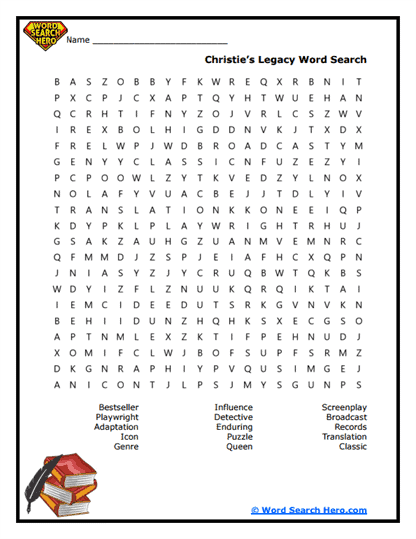
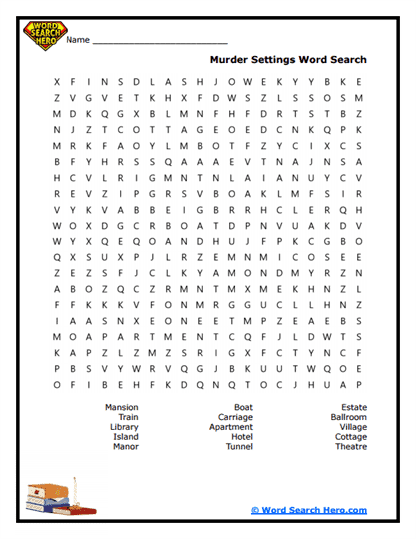
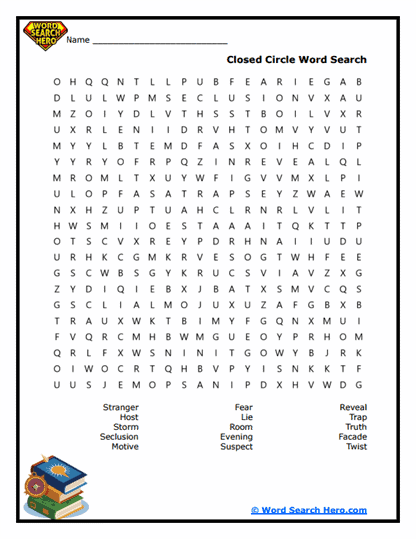
About Our Agatha Christie Word Searches
Our Agatha Christie Word Searches help students explore the life and works of one of the most famous mystery writers in literary history while strengthening vocabulary, spelling, and concentration skills. These printable puzzles introduce learners to the characters, stories, and themes connected to Christie’s classic detective novels.
Teachers often look for engaging ways to reinforce literary knowledge, and word searches provide a simple and effective option. As students search for words related to Agatha Christie’s novels, detectives, and mystery elements, they become more familiar with the vocabulary associated with classic crime fiction. Repeated exposure to these terms helps learners recognize them more easily when reading or discussing mystery stories.
Parents and homeschool educators also appreciate activities that combine learning with entertainment. Word searches encourage visual scanning, patience, and attention to detail while quietly reinforcing literary concepts. Students interact with meaningful vocabulary connected to detectives, clues, suspects, and plot twists.
Agatha Christie is especially fascinating because her stories helped define the mystery genre. Through these puzzles, students gain an engaging introduction to the vocabulary associated with one of the most successful and widely read authors of all time.
The Queen of Mystery
Agatha Christie was a British author born in 1890 who became famous for writing detective novels and short stories filled with suspense, clever clues, and surprising endings. She is often called the “Queen of Mystery” because of her enormous influence on crime fiction.
Christie created several famous fictional detectives, including Hercule Poirot and Miss Marple. Hercule Poirot is a brilliant Belgian detective known for solving crimes using careful logic and attention to detail. Miss Marple, on the other hand, is an observant elderly woman who solves mysteries by understanding human behavior.
Some of Christie’s most well-known novels include Murder on the Orient Express, And Then There Were None, and The Murder of Roger Ackroyd. These stories are famous for their complex plots and unexpected twists that challenge readers to solve the mystery before the detective reveals the answer.
Christie also wrote plays, including The Mousetrap, which became one of the longest-running stage productions in the world.
Students studying Agatha Christie often enjoy trying to figure out the mystery alongside the characters, making her works both entertaining and intellectually engaging.
Paul’s Pro-Tip
After students finish the word search, try a quick “solve the mystery” discussion.
Ask them to circle one detective name and one mystery-related word from the puzzle.
Then ask: What clues do detectives usually look for when solving a mystery?
Students might suggest fingerprints, hidden evidence, suspicious behavior, or witness statements. This opens the door to discussing how mystery stories are carefully structured to keep readers guessing.
It helps students see how authors create suspense by revealing clues piece by piece.
Why Agatha Christie’s Writing Is So Influential
Agatha Christie’s works have had a lasting impact on mystery and detective fiction. Her novels are known for their clever plots, memorable characters, and carefully constructed clues that encourage readers to think critically about what might happen next.
Christie mastered the art of plot twists, often surprising readers with unexpected solutions to the mystery. This storytelling technique has influenced countless authors who write crime and suspense stories today.
Her books have also reached an enormous global audience. Christie’s works have been translated into many languages and adapted into films, television series, and stage productions.
Because her stories combine logical puzzles with compelling characters, they remain popular with readers of all ages. Students encountering her work often enjoy the challenge of trying to solve the mystery before the final reveal.
Word searches featuring vocabulary connected to Agatha Christie help reinforce the characters, titles, and themes students encounter when studying detective fiction. By recognizing these words repeatedly, learners gain a clearer understanding of why Christie’s stories continue to be celebrated as some of the greatest mystery novels ever written.
Frequently Asked Questions
Who was Agatha Christie?
Agatha Christie was a British author famous for writing mystery novels and detective stories featuring characters such as Hercule Poirot and Miss Marple.
What are Agatha Christie’s most famous books?
Some of her most famous works include Murder on the Orient Express, And Then There Were None, and The Murder of Roger Ackroyd.
Why is Agatha Christie called the Queen of Mystery?
She earned this title because her detective stories helped shape modern mystery fiction and became some of the best-selling books in literary history.
How can teachers use Agatha Christie word searches in class?
Teachers often use them as warm-up activities, vocabulary reinforcement exercises, or introductions to lessons about mystery and detective fiction.
What extension activity works well after completing the puzzle?
Students can create a short mystery story using several words from the puzzle, including a detective, a clue, and a surprising solution to the case.