


E.T. the Extra-Terrestrial
Packed with aliens, BMX bikes, and enough 80s nostalgia to make your scrunchie jealous, this collection is your ticket to out-of-this-world entertainment!
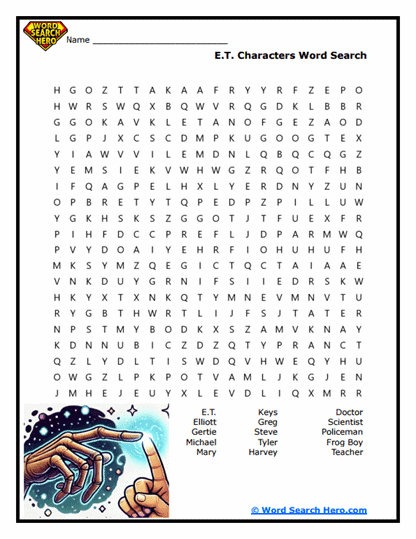
Packed with aliens, BMX bikes, and enough 80s nostalgia to make your scrunchie jealous, this collection is your ticket to out-of-this-world entertainment!
Our Alien Encounter Movie Word Searches take students beyond Earth and into the mysterious world of extraterrestrial life and first contact stories. These printable puzzles are perfect for classrooms, homeschool settings, or at-home learning, offering an exciting way to build vocabulary while exploring one of the most fascinating themes in science fiction movies.
Students will search for words like “alien,” “spaceship,” “signal,” “encounter,” and “extraterrestrial,” all while strengthening spelling, reading fluency, and concentration. Because alien encounter films often center on discovery, communication, and the unknown, these puzzles introduce vocabulary that sparks curiosity and imagination. Teachers frequently use them as engaging warm-ups, early finisher activities, or as part of units on science fiction and storytelling.
These printables are simple to use with no preparation required, making them a convenient resource for both educators and parents. They can easily be adjusted for different grade levels, with simpler word lists for younger learners and more complex terminology for older students.
Beyond literacy development, these puzzles encourage students to think about big questions-like what life beyond Earth might be like and how humans would respond. This combination of learning and imagination makes the activity both meaningful and memorable.
Alien encounter themes introduce students to a unique set of vocabulary centered around discovery and communication. Words like “transmission,” “abduction,” “orbit,” and “unknown” help expand language skills while connecting to imaginative concepts. Because these words often feel exciting and unusual, students are more likely to stay engaged and remember them.
A helpful activity is to have students group their discovered words into categories such as technology, space, and interaction. For example, they might separate “spaceship” and “galaxy” from words like “communicate” or “observe.” This helps students understand how vocabulary connects to different aspects of a story.
You can extend learning by asking students to create their own alien encounter scenario using several of the words from the puzzle. They might describe how humans first make contact or what kind of message an alien species would send. This reinforces vocabulary while encouraging creative thinking.
Because the theme blends imagination with elements of science, students also begin to think more critically about possibilities and ideas beyond everyday experiences. This makes the learning process both fun and intellectually engaging.

I always found that anything involving aliens instantly grabbed students’ attention. Before handing out the puzzle, I’d ask them what they thought an alien might look like or how it might communicate. That quick conversation got everyone involved and made the activity feel like an adventure instead of just another assignment.
After they finished, I liked to have students pick one word and turn it into part of a “first contact” moment. Maybe it was a signal being received or a spaceship landing. It didn’t have to be long, but it helped them connect the vocabulary to a story. And if someone got stuck, I’d remind them to look for standout letters like “x” or “z”-those tend to point you right to the word.
Alien encounter word searches naturally connect to multiple areas of learning. In science, students can explore real topics like the search for extraterrestrial life, space exploration, and how scientists look for signals from beyond Earth. Vocabulary from the puzzle can serve as a starting point for these discussions.
In language arts, these puzzles support lessons on imaginative storytelling and “what if” scenarios. Students can analyze how alien encounter movies build suspense and explore themes like communication, cooperation, or fear of the unknown.
Technology connections can also be introduced by discussing satellites, space missions, and how signals are sent and received. This helps students see how science fiction ideas often connect to real-world innovation.
Creative activities are a great extension as well. Students might design their own alien species, create a movie poster, or write a short story using words from the puzzle. By combining vocabulary with imagination and real-world concepts, these puzzles become a powerful and engaging learning tool.
Alien encounter movie word searches are printable puzzles that feature vocabulary related to extraterrestrial life, space travel, and first contact scenarios. They combine science fiction themes with word search gameplay to create an engaging learning activity.
Yes, these puzzles typically focus on exploration, communication, and imaginative storytelling rather than anything frightening. Teachers and parents can choose age-appropriate vocabulary to ensure the activity remains fun and comfortable for learners.
Students improve spelling, word recognition, and reading fluency by locating themed vocabulary within the puzzle grid. When paired with writing or discussion activities, they also help build comprehension and critical thinking skills.
Absolutely, they are a great addition to lessons about space exploration, astronomy, and the search for life beyond Earth. The vocabulary provides a natural bridge between language arts and science topics.
Students are naturally curious about space and the unknown, which makes alien encounter themes especially engaging. When learning taps into that curiosity, students are more likely to stay focused, participate actively, and retain what they’ve learned.