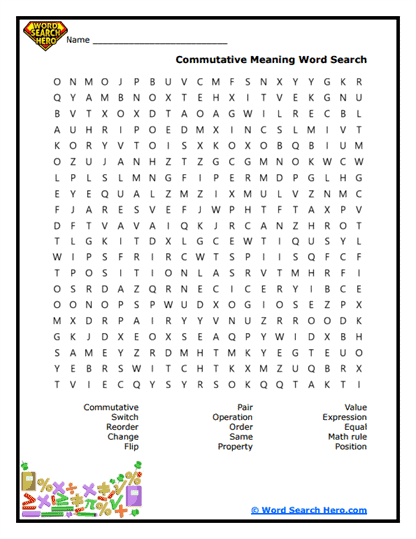
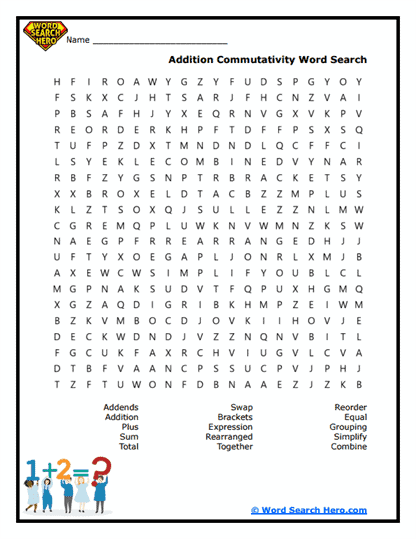
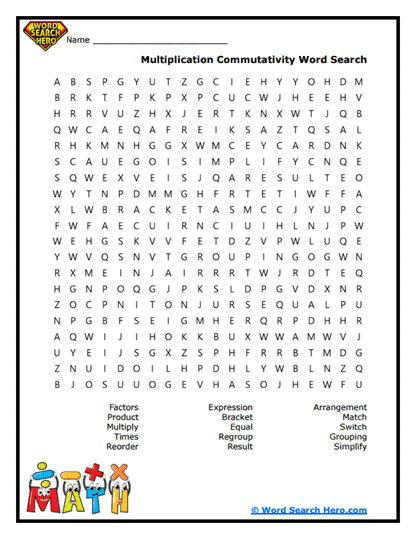
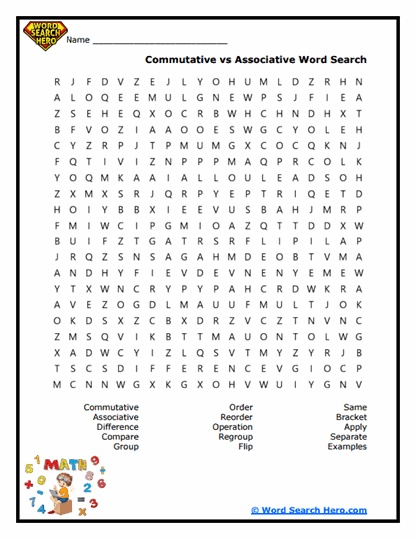
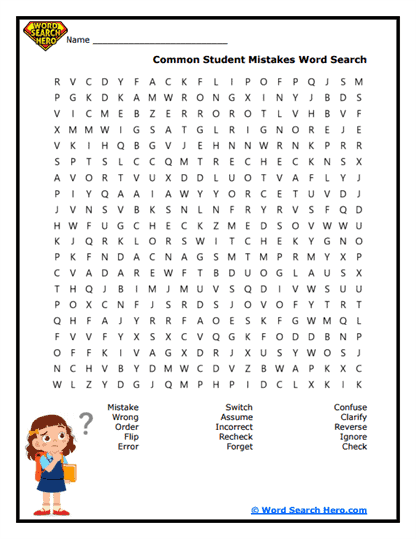
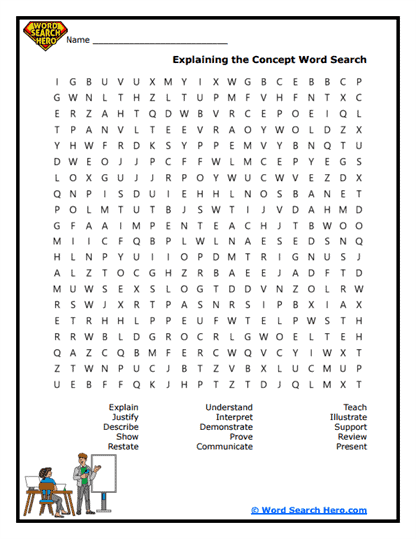
About Our Commutative Property Word Searches
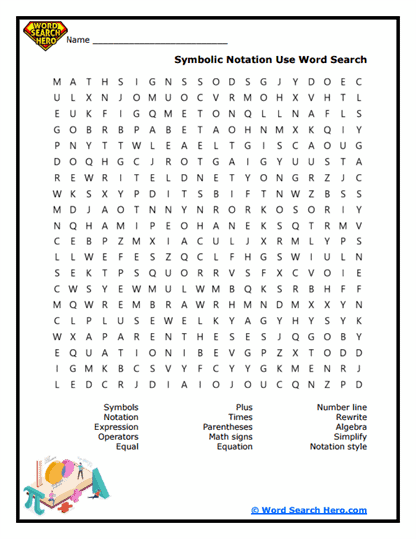
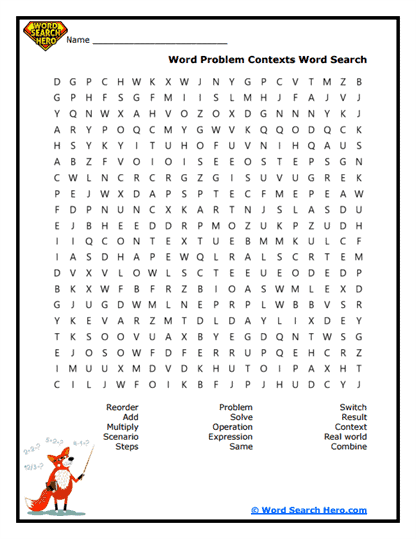
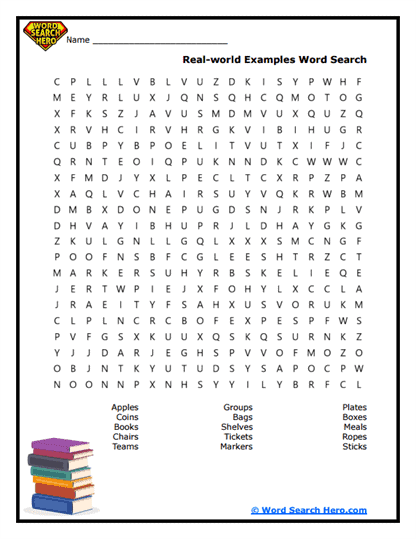
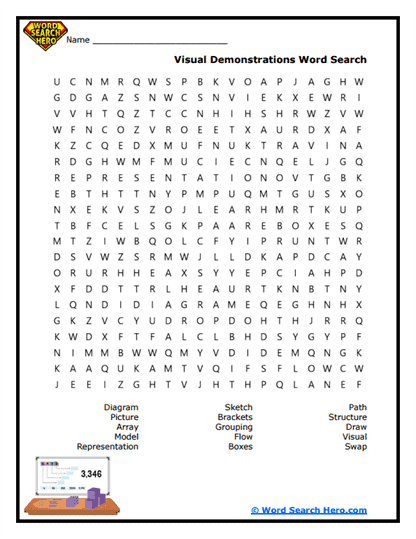
Commutative Property word searches help students become familiar with the vocabulary used to describe how the order of numbers can change in certain operations without changing the result. These printable puzzles introduce and reinforce terms connected to addition, multiplication, order, operations, and number relationships. Before students begin applying number properties in equations or mental math strategies, it often helps to first recognize the language used to explain these patterns.
Students encounter the commutative property early in their math learning, especially when studying addition and multiplication. Words like order, operation, expression, sum, product, and property often appear when teachers explain how numbers can switch places and still produce the same answer. A word search provides a simple and engaging way to build familiarity with these terms before students begin applying the concept in problem-solving.
Because the activity feels like a puzzle rather than a traditional worksheet, it can help reduce anxiety and increase engagement with math vocabulary. Teachers often use these printables as warm-ups, review pages, early finisher work, or math center activities during number properties lessons. Parents and homeschool educators can also include them easily in lessons as a way to reinforce important math vocabulary while keeping learning interactive.
As students search for the words in the puzzle grid, they strengthen concentration, visual scanning skills, and pattern recognition. At the same time, they are building the vocabulary foundation that helps them understand how the order of numbers can affect operations.
Understanding How Order Works in Math
The commutative property explains that for certain operations, changing the order of the numbers does not change the final answer. This idea helps students develop flexibility in how they approach calculations and encourages them to look for easier ways to solve problems.
Students often notice this pattern naturally when adding or multiplying numbers. Recognizing the property gives them a way to describe what they are seeing mathematically. Vocabulary plays an important role in this process. Words such as order, operation, sum, and product help students explain how numbers interact within a problem.
When students become comfortable with these terms, they can follow mathematical explanations more easily and communicate their thinking more clearly. Word searches support this learning by giving students repeated exposure to the vocabulary used in lessons about number properties.
These puzzles work especially well before introducing examples of the commutative property or when reviewing number relationships during arithmetic practice.
Paul’s Pro-Tip
A highly effective way to extend this puzzle is to follow it with a “switch the order” challenge. After students complete the word search, provide several addition or multiplication problems and ask students to rewrite each problem by switching the order of the numbers.
Then have them solve both versions and explain why the answers remain the same. Encourage students to use vocabulary from the puzzle, such as order, operation, sum, and product, when describing what they observe.
This activity adds strong instructional value because it connects vocabulary recognition with mathematical reasoning. For teachers and homeschool educators, it also serves as a quick formative assessment. If students can explain why switching the order does not change the result, it shows they are beginning to understand the commutative property rather than simply memorizing its definition.
Helping Students Develop Flexible Math Thinking
Understanding the commutative property helps students become more flexible problem solvers. Instead of always solving problems in a fixed order, they learn that numbers can sometimes be rearranged to make calculations easier.
This flexibility is especially useful in mental math. Students may notice that switching the order of numbers allows them to combine easier pairs or simplify a calculation. Learning the language of number properties helps them explain these strategies and understand why they work.
A word search can be a helpful introduction to these ideas. After completing the puzzle, educators can encourage students to look for examples of number order changing in the problems they solve during math lessons. Even a short discussion can help students see that the commutative property describes patterns they already use.
When students become comfortable with the language of the commutative property, they are better prepared to recognize number patterns, explain their reasoning, and use flexible strategies when solving math problems.
Frequently Asked Questions
When are commutative property word searches most useful?
They are especially helpful during lessons on number properties, operations, and early algebra concepts where students learn about how the order of numbers affects calculations.
What grade levels benefit most from these puzzles?
They work well for upper elementary and middle school students who are learning addition and multiplication properties.
Can homeschool educators include these puzzles in lessons?
Yes. They are easy to print and pair well with number sentence activities, mental math strategies, and discussions about math properties.
Do word searches help students understand the commutative property?
They can. Repeated exposure to vocabulary related to number properties helps students recognize and understand the language used in math explanations.
What is a good follow-up activity after completing the puzzle?
A helpful next step is asking students to rewrite several addition or multiplication problems by switching the order of the numbers and explaining why the result stays the same.