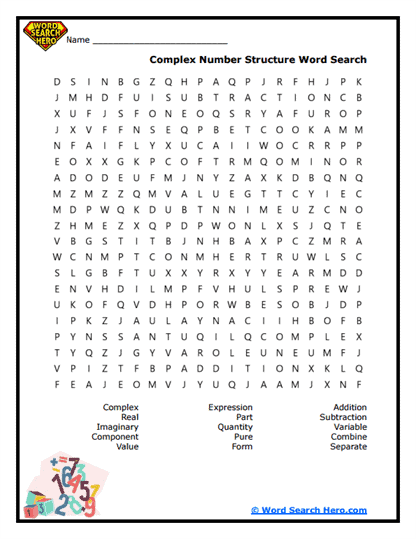
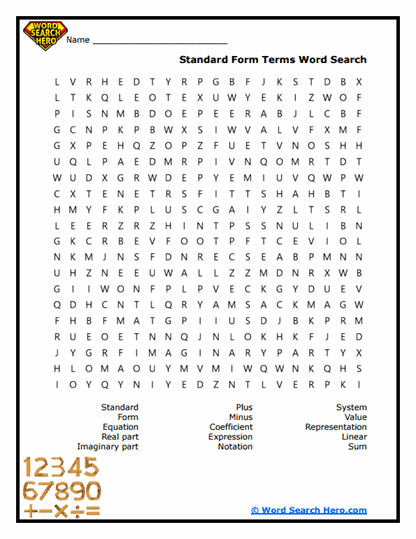
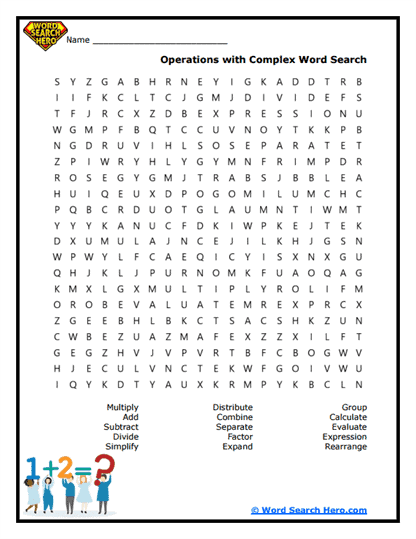
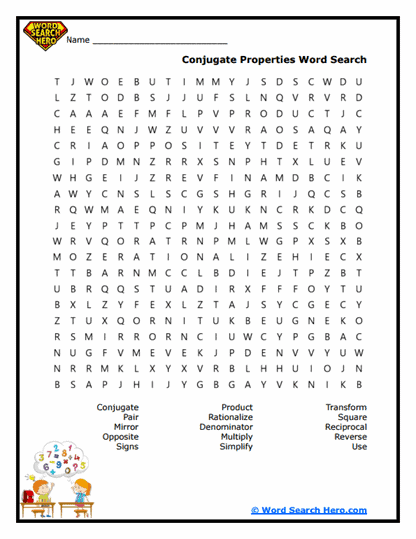
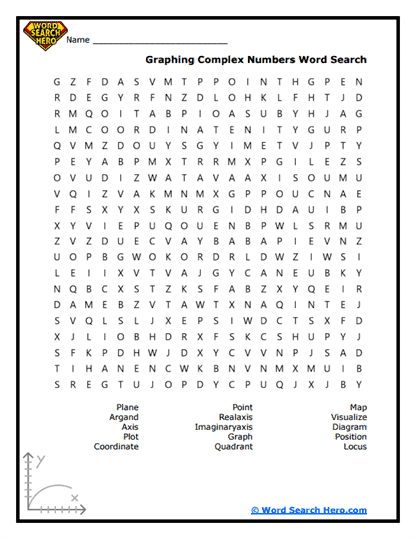
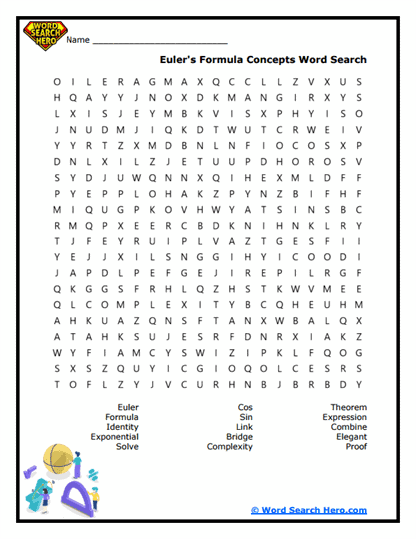
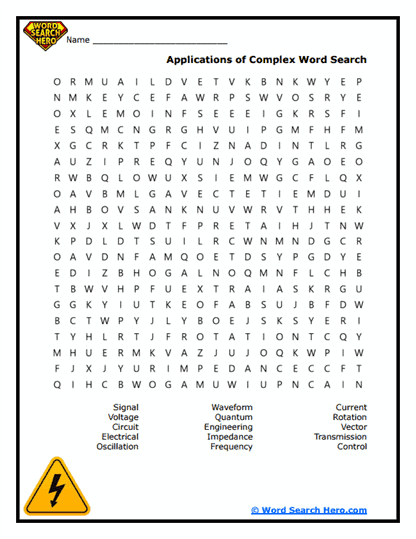
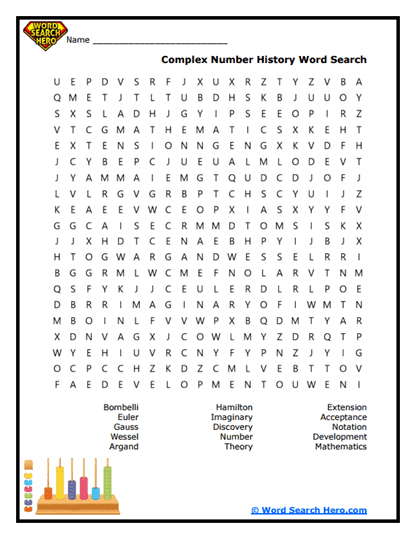
About Our Complex Numbers Word Searches
Our Complex Numbers Word Searches are a creative way to help students get more comfortable with the vocabulary that comes with this important math topic. For many learners, complex numbers feel unfamiliar at first because they introduce brand-new ideas, symbols, and terms that go beyond the number line students already know. A printable puzzle can make that learning process feel much more approachable.
As students begin exploring this topic, they run into words like imaginary, real part, integer, quadratic, modulus, and conjugate. These terms are essential for understanding lessons, reading examples, and following classroom discussions. A word search gives students repeated exposure to that vocabulary in a low-pressure format. Instead of jumping straight into equations, they first build familiarity with the language of the subject.
Teachers often use these printables as bell ringers, review pages, early finisher tasks, or simple enrichment activities during algebra lessons. They are also useful for helping students settle in before class starts or for adding a calmer vocabulary-focused activity after more demanding practice. Because they are easy to print and simple to use, they fit naturally into many classroom routines.
Homeschool families also appreciate puzzles like these because they offer a break from worksheets without stepping away from academic content. Students can reinforce important terms while practicing focus, visual scanning, and persistence.
When learners recognize the vocabulary of a topic more easily, they often feel more confident tackling the math itself. That is what makes these puzzles so helpful. They turn specialized terminology into something familiar, manageable, and even a little fun.
Making Tricky Vocabulary Feel Less Mysterious
One of the biggest challenges with complex numbers is that the vocabulary sounds intimidating before students even understand the ideas behind it. Terms like imaginary unit or conjugate pair can seem strange at first, even to students who are usually confident in math. That is why vocabulary practice matters so much here.
A word search helps students slow down and notice the words themselves. By finding and recognizing terms repeatedly, they begin to feel less foreign. This kind of repetition supports memory, spelling, and word recognition, all of which make future lessons easier to follow. When students later see those same terms in notes or examples, they are not meeting them for the very first time.
This also helps reduce anxiety. Complex numbers already ask students to stretch their thinking, so it helps when the language does not feel like an extra obstacle. A puzzle offers a more relaxed entry point into the topic. Students can engage with the vocabulary without the immediate pressure of solving equations.
Teachers can stretch the activity further by asking students to sort the words they found into categories. Which terms describe parts of a number? Which ones relate to operations? Which ones connect to graphing or equations? That small extra step turns a simple printable into a stronger review tool.
Sometimes the best way to introduce a challenging topic is to let students get comfortable with its language first. Once the words feel familiar, the math often feels a lot less mysterious.
Paul’s Pro-Tip
If a student spots the word imaginary and suddenly looks like math has turned into wizard school, I tell them to relax. The name sounds dramatic, but the strategy is simple: find the word, say it out loud, and connect it to one small idea.
I like to play a quick game called “Word First, Panic Never.” After students find a term, they give a tiny clue about it. Real part? That’s the non-imaginary piece. Conjugate? That’s the number’s sign-switching buddy.
A fancy word becomes much less scary once it has a nickname and a job.
Beyond the Name: Real Uses for Complex Numbers
Complex numbers may sound like a topic that only lives in advanced math classes, but they have important uses in the real world. Once students get beyond the unusual vocabulary, they begin to see that this topic helps describe patterns, systems, and relationships that ordinary real numbers cannot handle as easily.
Engineers use complex numbers in electronics and signal processing. Physicists use them when working with waves, motion, and quantum mechanics. They also appear in computer graphics, control systems, and other fields where patterns repeat or change in ways that are easier to model with both real and imaginary components.
That makes the vocabulary especially worth learning. When students recognize words like imaginary unit, modulus, and conjugate, they are building language that connects classroom math to future study in science, technology, and engineering. Even if they are only beginning with basic operations now, the terms lay the groundwork for more advanced understanding later.
Teachers can make this connection more meaningful by inviting students to pick one puzzle word and explore where it appears outside the classroom. A short class discussion about waves, electricity, or digital technology can make the topic feel much more relevant.
For homeschoolers, this can become a great extension activity. A printable puzzle can lead into a quick research moment, a notebook page, or a conversation about how mathematics supports modern technology.
Sometimes a topic becomes more interesting the moment students realize it is not just theoretical. Complex numbers may have an unusual name, but they play a very real role in the world around us.
Frequently Asked Questions
What are complex numbers word searches used for?
They help students become more familiar with vocabulary related to complex numbers while practicing focus, spelling, and word recognition.
Are these puzzles good for algebra students?
Yes. They fit especially well in algebra and higher-level math classes where students are first learning about imaginary and complex numbers.
Can teachers use these as classroom review?
Absolutely. They work well as bell ringers, review pages, early finisher activities, and calm vocabulary practice.
Do these printables help with understanding math concepts?
They mainly support vocabulary familiarity, but that can make lessons and explanations easier for students to follow.
Can homeschool families use these word searches too?
Yes. They are easy to print and make a useful addition to math lessons, enrichment time, or independent practice at home.