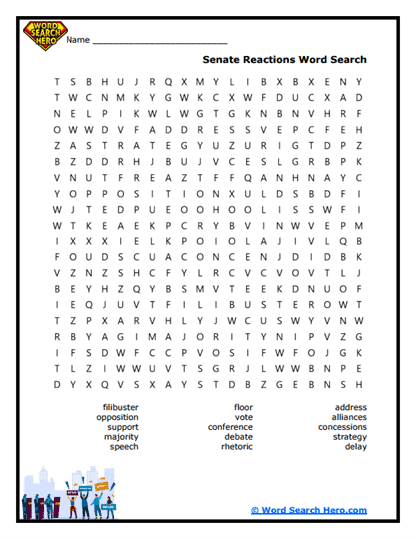
About Our Compromise of 1850 Word Searches
The Compromise of 1850 was a series of laws passed by the United States Congress to address growing tensions between Northern and Southern states. These laws attempted to settle disagreements over slavery and the expansion of new territories in the United States. Our Compromise of 1850 Word Searches help students explore vocabulary connected to this important political moment while strengthening reading and recognition skills.
These printable puzzles introduce learners to key historical terms such as compromise, territory, congress, slavery, and union. Instead of simply reading about these ideas in textbooks, students actively search for the words hidden inside puzzle grids. This hands-on activity reinforces important social studies vocabulary while making history lessons more interactive.
Teachers often use these puzzles during units on pre-Civil War America, U.S. government, or sectional tensions in the 1800s. They work well as classroom warm-ups, literacy center activities, review exercises, or early finisher tasks. Because they are easy to print and simple for students to complete independently, they fit easily into many classroom routines.
Parents and homeschool educators also appreciate how word searches make complex political topics more approachable. Puzzles can spark curiosity about how lawmakers attempted to solve national disagreements through negotiation and legislation.
Another benefit is the development of concentration and visual scanning skills. As students search rows, columns, and diagonals to locate words, they strengthen focus while becoming more familiar with vocabulary connected to American government and political history.
Our Compromise of 1850 Word Searches turn key historical and political terms into an engaging puzzle activity that encourages learners to explore one of the major compromises that shaped the path toward the Civil War.
Exploring the Purpose of the Compromise of 1850
By the mid-1800s, the United States was expanding westward, and new territories raised difficult questions about whether slavery would be allowed in those areas. Political leaders attempted to reduce tension between the North and the South by creating a compromise that addressed several issues at once.
Word search puzzles help students become familiar with vocabulary connected to these debates. As learners search for words like territory, compromise, congress, law, and union, they begin recognizing terms that frequently appear in lessons about the Compromise of 1850.
Teachers can extend the puzzle activity by connecting vocabulary words to the political process. For example, the word compromise may lead to discussions about how lawmakers sometimes negotiate solutions when groups disagree.
Another engaging activity is to group puzzle words into categories such as government, lawmaking, territory, or political debate. Sorting vocabulary this way helps students understand the different issues involved in the compromise.
Students can also choose several puzzle words and write short explanations about them. For example, they might describe what a compromise means or explain why territories became an important political issue.
Through puzzles and discussion, learners begin to see how political decisions can influence national unity.
Paul’s Pro-Tip
After students complete a Compromise of 1850 word search, ask them to choose one word that seems most connected to solving disagreements.
Maybe it’s compromise, law, or union. Ask learners what they think that word tells us about how leaders tried to keep the country together.
For example, the word compromise can lead to discussions about how groups sometimes make agreements where each side gives up something to reach a solution.
Sometimes one vocabulary word from the puzzle can help students better understand how political leaders tried to manage growing tensions.
Understanding the Impact of the Compromise of 1850
The Compromise of 1850 temporarily eased tensions between Northern and Southern states, but disagreements over slavery and territory continued to grow in the years that followed.
Word search puzzles help introduce vocabulary connected to these historical developments. Words such as union, law, territory, and debate highlight the political challenges facing the nation during this time.
Teachers can use the puzzle as a starting point for discussions about how compromises can sometimes delay conflicts but may not completely solve deeper disagreements.
Reading assignments also benefit from this vocabulary exposure. When students recognize words like congress or territory in a passage, they often understand the historical context more easily.
Families can extend learning at home by discussing how compromises have played a role in many moments of American political history.
Word search puzzles provide a simple introduction to vocabulary connected to the Compromise of 1850, but they often inspire deeper curiosity about the political debates that shaped the United States before the Civil War.
Frequently Asked Questions
What types of words appear in Compromise of 1850 word search puzzles?
These puzzles often include vocabulary such as compromise, territory, congress, union, slavery, and law, which relate to the political debates surrounding the Compromise of 1850.
Are Compromise of 1850 word searches useful during pre-Civil War history lessons?
Yes. Teachers often use them as vocabulary warm-ups, review activities, or literacy center tasks during units on sectional tensions and the events leading up to the Civil War.
Do these puzzles include topics like territories and political compromises?
Many puzzles include words related to government debates, territorial expansion, and the effort to maintain balance between Northern and Southern states.
Can these puzzles help students remember government and history vocabulary?
Repeated exposure to key terms helps students recognize and recall important vocabulary when studying American political history.
What is a good follow-up activity after completing the puzzle?
Students can choose one word from the puzzle and research a quick fact about it, such as why the Compromise of 1850 was created or how it attempted to reduce tensions between different regions of the country.