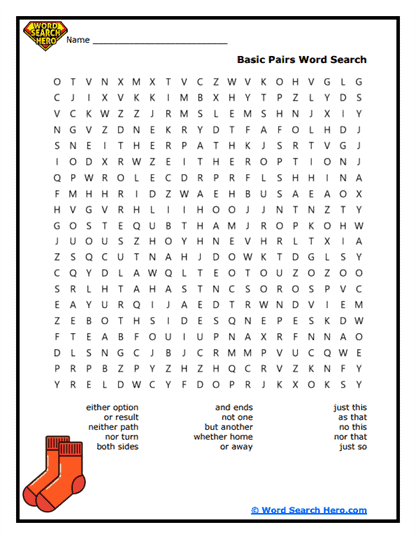
About Our Correlative Conjunctions Word Searches
Correlative conjunctions are all about teamwork. Words like either…or, both…and, and not only…but also don’t work alone-they rely on their partner to complete the idea. This collection of puzzles helps students see how these pairs function together instead of treating them as random vocabulary to memorize.
Each puzzle focuses on real, usable language patterns. Students explore choices, comparisons, outcomes, and relationships through phrases they’re likely to hear and use every day. As they work through examples like options, opposites, and outcomes, they begin to understand how these structures shape meaning in a sentence.
These puzzles are especially helpful because they connect naturally to other grammar topics. Students who practice here will find it easier to understand sentence flow when working with conjunctions or building stronger sentences alongside parts of speech activities. The variety of themes-like actions, people, and places-also helps reinforce vocabulary in a way that feels connected instead of isolated.
The Secret Power of Word Pairs in Everyday Language
Correlative conjunctions show up everywhere once you know how to spot them. Conversations, stories, and even simple instructions often rely on word pairs to express choices, comparisons, or combined ideas. Phrases like “either this or that” or “both this and that” help speakers organize their thoughts clearly and quickly.
What makes these pairs powerful is how they guide meaning. When students see “either,” they begin expecting “or.” That expectation builds a natural sense of structure, almost like recognizing a pattern in music. Over time, this helps learners predict how sentences are formed and understand them faster when reading.
These puzzles make that pattern visible. By working through examples like positive combinations, negative matches, and outcome-based phrases, students start to notice how small word pairs can completely change meaning. This awareness becomes especially useful when they later explore related skills like coordinating conjunctions or more advanced vocabulary from adult vocabulary collections.
Paul’s Pro-Tip

When teaching these pairs, I like to pause mid-sentence on purpose. I’ll say, “You can either…” and wait. Students almost always jump in with “or!” That moment shows they’re starting to feel how the language works, not just memorize it.
Try it after the puzzle-turn it into a quick call-and-response game. It’s simple, but it sticks.
Turning Word Pair Practice Into Real Writing Skills
Once students recognize these pairs, the next step is using them in their own writing. A great way to start is by giving them a few conjunction pairs from the puzzle and asking them to write short sentences for each one. Encourage them to focus on balance-making sure both parts of the sentence match in structure.
You can also turn this into a revision activity. Have students take a basic sentence like “I like apples” and expand it using a pair: “I like both apples and oranges.” This helps them see how these structures add detail and clarity.
Another effective approach is to connect the puzzles to real-life choices and comparisons. Ask students to write about decisions (“either stay home or go out”), preferences, or outcomes. This works especially well when paired with writing-focused topics like writing or simpler reinforcement from easy vocabulary, where students can build confidence before adding complexity.
By moving from puzzle to sentence to real communication, students begin to understand that these word pairs aren’t just grammar rules-they’re tools for expressing ideas clearly and effectively.
Frequently Asked Questions
How can teachers use correlative conjunction word searches in the classroom?
These puzzles are great for starting or reinforcing a lesson without overwhelming students. Many teachers use them as warm-ups to introduce the idea of paired words, or as review activities before moving into sentence writing. They also work well in literacy centers, where students can practice independently while still engaging with meaningful grammar concepts.
Are these puzzles helpful for homeschool lessons?
Yes, they fit naturally into homeschool routines because they’re low-prep and flexible. You can use them as a quick standalone activity or build a full lesson around them by adding sentence-writing or discussion afterward. They’re especially useful for mixing structured grammar practice with something a little more relaxed and enjoyable.
Do word searches help students learn conjunction pairs?
They do, especially because they encourage repeated exposure without feeling repetitive. As students search for the words, they begin to recognize familiar pairings and patterns. That recognition makes it easier to remember how the pairs work together later when reading or writing.
What grade levels are these puzzles appropriate for?
They can be adapted for a wide range of learners. Younger students might focus on spotting and reading the word pairs, while older students can take it further by explaining how the pairs function or using them in more complex sentences. The same puzzle can grow with the student depending on how you use it.
Can these puzzles be paired with other grammar lessons?
Absolutely. They’re a natural fit for lessons on sentence structure, parallel ideas, and other types of conjunctions. You can easily connect them to writing exercises, reading comprehension, or even speaking activities where students practice using paired structures in conversation.