


Medieval Medicine and Plague Doctors
If you’ve ever dreamed of circling your way through the greatest hits of medieval medicine-complete with leeches, herbs, beaked masks, and a whole lot of theories that didn’t age well-this collection delivers.

If you’ve ever dreamed of circling your way through the greatest hits of medieval medicine-complete with leeches, herbs, beaked masks, and a whole lot of theories that didn’t age well-this collection delivers.

From sniffing out “Yersinia pestis” to hunting down “buboes” and “bloodletting” like a medieval epidemiologist with a dictionary, each puzzle serves up a heaping helping of educational mayhem.
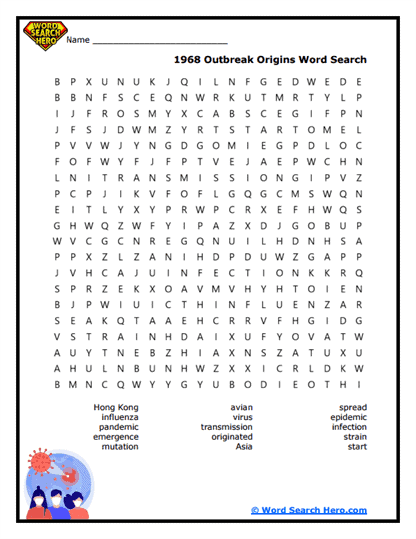
From tracking the mutation of H3N2 like a flu-dunnit mystery to chasing down terms like “ventilator” and “underreport” that really take your breath away, these puzzles pack more punch than a sneeze in a phone booth.

From sneezing soldiers in Kansas to trench-bound doughboys unknowingly playing viral tag, these puzzles cover every cough, coffin, and conspiracy of 1918. You’ll trace flu symptoms like “Delirium” and “Sweat,” visit hotspots like “Barracks” and “Parade,” and even dive into the world of wartime censorship-because nothing says fun like circling “Espionage” while learning about public health disasters.
Throughout history, disease has played a major role in shaping societies, populations, and historical events. Epidemics and pandemics have influenced migration, economic systems, medical practices, and government responses across many civilizations. Our Disease and Society (In History) Word Searches help students explore vocabulary connected to these historical challenges while strengthening reading and recognition skills.
These printable puzzles introduce learners to key historical and public health terms such as epidemic, medicine, quarantine, outbreak, and prevention. Instead of simply reading about these topics in textbooks, students actively search for the words hidden inside puzzle grids. This hands-on activity reinforces important world history vocabulary while making lessons more engaging.
Teachers often use these puzzles during units on world history, historical pandemics, or the development of medicine and public health. They work well as classroom warm-ups, literacy center activities, review exercises, or early finisher tasks. Because they are easy to print and simple for students to complete independently, they fit smoothly into many classroom routines.
Parents and homeschool educators also appreciate how word searches provide an approachable way to introduce complex historical topics. Puzzles can spark curiosity about how communities responded to disease outbreaks and how medical knowledge developed over time.
Another benefit is the development of concentration and visual scanning skills. As students search rows, columns, and diagonals to locate words, they strengthen focus while becoming more familiar with vocabulary connected to health, medicine, and historical events.
Our Disease and Society (In History) Word Searches turn key historical and scientific terms into an engaging puzzle activity that encourages learners to explore how disease has influenced societies throughout history.
Disease outbreaks have affected societies for centuries. Major epidemics have changed population patterns, influenced government policies, and led to new approaches to medicine and public health.
Word search puzzles help students become familiar with vocabulary connected to these historical developments. As learners search for words like epidemic, quarantine, medicine, outbreak, and treatment, they begin recognizing terms that frequently appear in lessons about disease and society.
Teachers can extend the puzzle activity by connecting vocabulary words to historical examples. For example, the word quarantine may lead to discussions about how communities tried to prevent the spread of illness by isolating infected areas.
Another engaging activity is to group puzzle words into categories such as public health measures, medical practices, causes of disease, or societal responses. Sorting vocabulary this way helps students understand how different factors influenced disease outbreaks.
Students can also choose several puzzle words and write short explanations about them. For example, they might describe what an epidemic is or explain why medical knowledge improved over time.
Through puzzles and discussion, learners begin to see how societies have responded to health challenges throughout history.

After students complete a Disease and Society word search, ask them to choose one word that seems most connected to preventing illness.
Maybe it’s quarantine, medicine, or prevention. Ask learners what they think that word tells us about how societies try to protect people during disease outbreaks.
For example, the word quarantine can lead to conversations about how separating infected individuals helped limit the spread of disease in many historical situations.
Sometimes one vocabulary word from the puzzle can help students better understand how public health practices developed over time.
Disease has influenced many important developments in history. Outbreaks have affected population growth, economic activity, and the structure of communities.
Word search puzzles help introduce vocabulary connected to these historical changes. Words such as epidemic, medicine, quarantine, and treatment highlight the themes often discussed when studying disease and society.
Teachers can use the puzzle as a starting point for discussions about how medical knowledge and public health systems evolved to address disease.
Reading assignments also benefit from this vocabulary exposure. When students recognize words like epidemic or treatment in a passage, they often understand historical discussions about disease more easily.
Families can extend learning at home by discussing how advances in medicine and public health have helped protect communities over time.
Word search puzzles provide a simple introduction to vocabulary connected to disease and society in history, but they often inspire deeper curiosity about how societies have faced and overcome health challenges.
What types of words appear in Disease and Society word search puzzles?
These puzzles often include vocabulary such as epidemic, outbreak, quarantine, medicine, treatment, and prevention, which relate to disease and its impact on societies.
Are Disease and Society word searches useful during world history lessons?
Yes. Teachers often use them as vocabulary warm-ups, review activities, or literacy center tasks during units on historical epidemics and the development of public health.
Do these puzzles include topics related to medicine and public health?
Many puzzles include words connected to disease prevention, medical treatment, and how societies responded to outbreaks.
Can these puzzles help students remember vocabulary about historical epidemics?
Repeated exposure to key terms helps students recognize and recall vocabulary commonly used when studying the history of disease and medicine.
What is a good follow-up activity after completing the puzzle?
Students can choose one word from the puzzle and research a quick fact about it, such as how communities used quarantine during past outbreaks or how medical discoveries helped reduce the spread of disease.