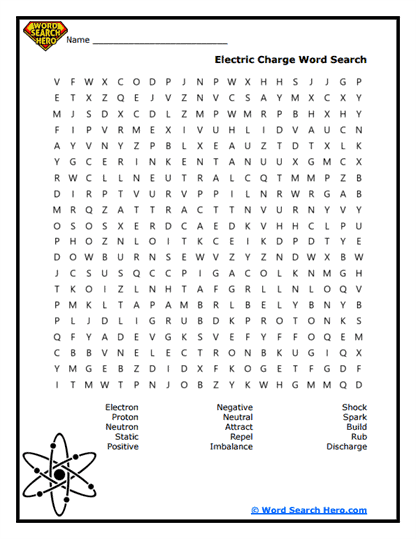
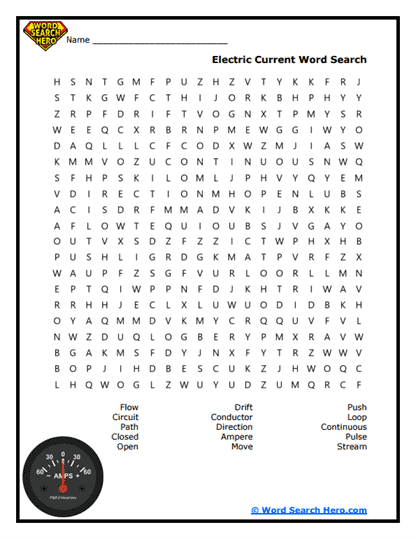
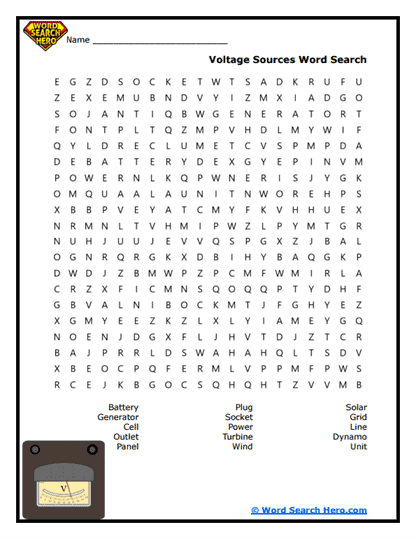
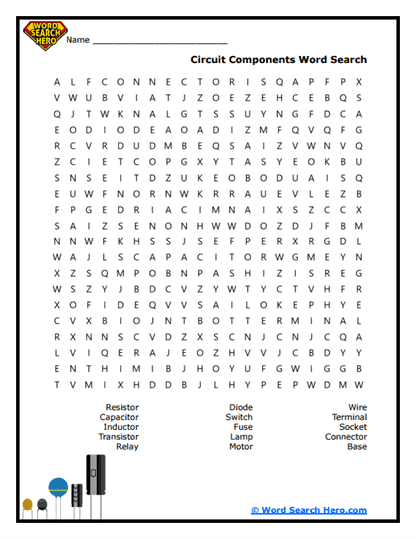
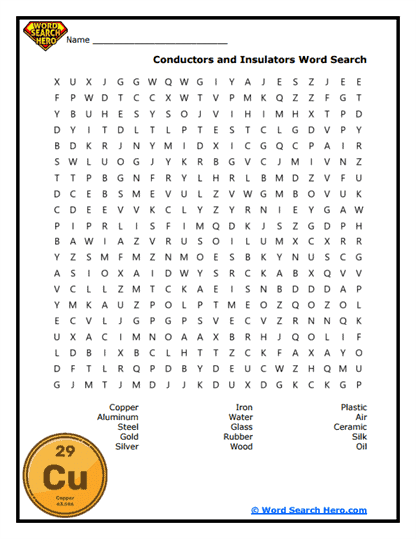
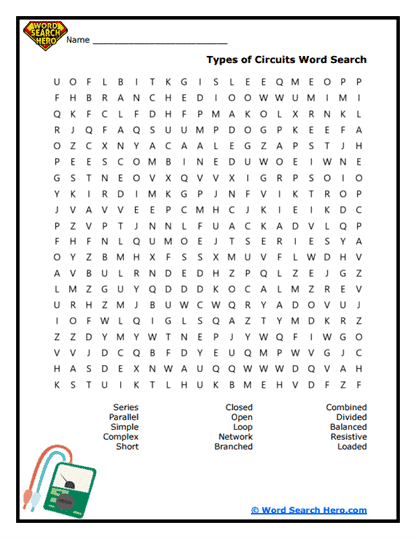
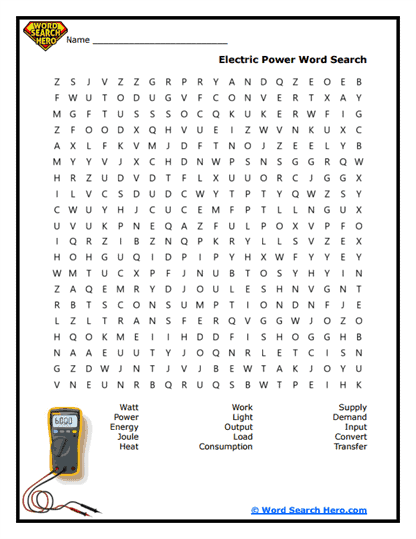
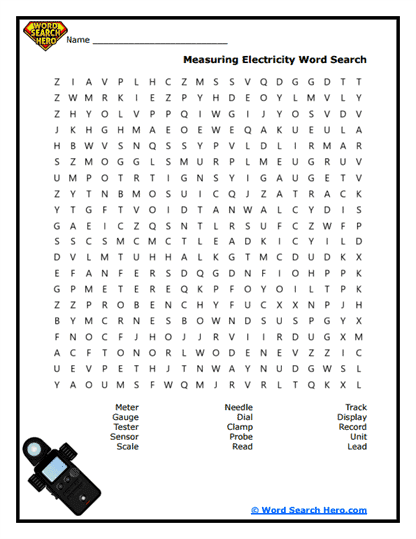
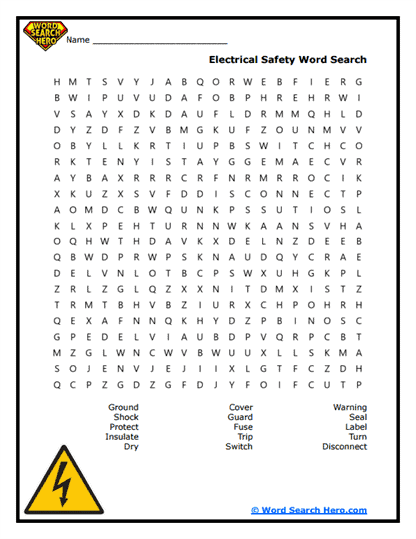
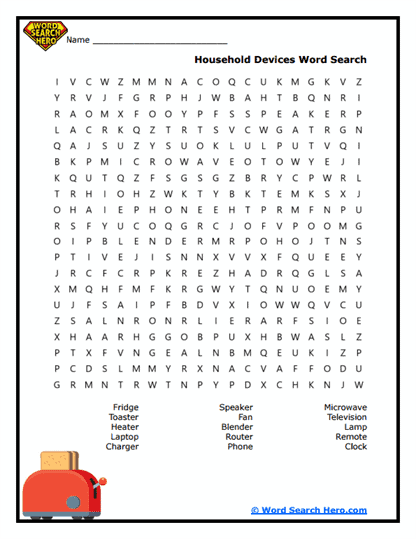
About Our Electricity Word Searches
Electricity word searches introduce students to the vocabulary used to study electrical energy and how it flows through circuits and devices. These printable puzzles help learners become familiar with scientific terms related to electric charge, circuits, current, and the components that allow electricity to power everyday technology. Before students explore electrical systems and energy transfer in depth, it often helps to first recognize the language scientists and engineers use to describe electricity.
Students studying electricity may encounter words such as current, circuit, battery, wire, switch, conductor, and insulator. These terms frequently appear in physics and general science lessons and help students understand how electrical energy moves through materials and powers devices such as lights, computers, and appliances. A word search provides an engaging way to reinforce this vocabulary while strengthening reading, spelling, and observation skills.
Because the activity feels like a puzzle rather than a traditional worksheet, it can make scientific vocabulary easier and more engaging to learn. Teachers often use these printables during science centers, independent practice, review sessions, or early finisher activities. Parents and homeschool educators can also include them in lessons as a way to introduce electricity vocabulary in an interactive format.
As students search for the words in the puzzle grid, they strengthen concentration, visual scanning, and pattern recognition skills. At the same time, they build familiarity with the scientific language used to describe electrical energy and circuits.
Understanding Electricity
Electricity is a form of energy that results from the movement of electric charges. In many systems, electricity flows through circuits made of conductive materials such as metal wires. When a circuit is complete, electrical energy can travel through it and power devices.
Simple electrical systems often include components such as batteries, wires, switches, and loads such as light bulbs or motors. The battery provides energy, wires carry the electric current, and switches control whether the circuit is open or closed.
Electricity is essential in modern life. It powers homes, schools, transportation systems, and communication networks. Scientists and engineers study electricity to develop new technologies and improve the efficiency of electrical systems.
Learning the vocabulary associated with electricity helps students understand how electrical energy flows and how circuits allow devices to function.
Word searches reinforce this learning by giving students repeated exposure to the key terms used when studying electrical systems and energy transfer.
Paul’s Pro-Tip
A powerful extension activity is a “build-a-circuit challenge.” After students complete the word search, provide simple circuit materials such as a battery, wires, and a small light bulb.
Ask students to work in pairs to create a complete circuit that lights the bulb. Encourage them to experiment with adding or removing components such as a switch to control the flow of electricity.
This activity adds strong instructional value because it allows students to see electricity in action while reinforcing vocabulary such as circuit, current, battery, and switch. Teachers and homeschool educators can also challenge students to explain why the circuit works only when it forms a complete path.
Helping Students Understand Electrical Energy
Electricity is one of the most widely used forms of energy in modern society. From lighting and heating to electronics and transportation, electrical energy powers many aspects of everyday life.
Understanding electricity vocabulary helps students interpret diagrams of circuits, science experiments, and discussions about energy use and electrical safety. These ideas also connect to broader topics such as energy transfer, magnetism, engineering, and technology.
A word search can serve as an introduction to a lesson about electrical circuits or as a review after students have studied electricity in class. After completing the puzzle, educators can encourage students to connect the vocabulary with real-world examples such as household electronics or power systems.
When students become familiar with electricity vocabulary, they gain the language and understanding needed to explore how electrical energy flows and how circuits power the devices we use every day.
Frequently Asked Questions
What is electricity?
Electricity is a form of energy created by the movement of electric charges.
What is an electrical circuit?
An electrical circuit is a closed path that allows electricity to flow through wires and components.
What materials allow electricity to flow easily?
Materials that allow electricity to flow easily are called conductors. Metals such as copper are common conductors.
What is the purpose of a switch in a circuit?
A switch opens or closes a circuit, controlling whether electricity can flow.
What classroom activity pairs well with this puzzle?
Students can build a simple circuit using a battery, wires, and a light bulb to observe how electricity flows through a complete circuit.