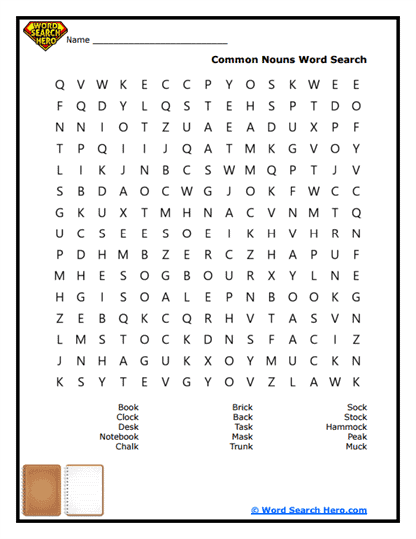
About Our Ends With Letter K Word Searches
Our Ends With Letter K word searches all share one simple rule-every word ends with the letter K. That might sound small, but it completely changes how students interact with the puzzle.
Instead of just scanning randomly, learners start noticing patterns. They begin to expect how words should end, which helps them slow down and read more carefully from start to finish. That’s a big deal, especially for students who tend to guess words after spotting just the first few letters.
What makes this collection especially engaging is the variety of themes. Students might jump from kitchen tools like “cookbook,” to outdoor gear like “backpack,” to sound-based words like “quack” or “clack.” Even though the topics shift, the shared ending keeps everything connected and gives learners a consistent clue to work with.
These puzzles pair nicely with other pattern-focused activities like suffixes or similar collections such as ends with letter a, where students can start comparing how different endings affect spelling and pronunciation. Whether you’re using them in a classroom or at home, they’re an easy way to build stronger word awareness without it feeling like extra work.
The Secret Advantage of Searching for the Last Letter First
Most students start a word search the same way-looking for the first letter and hoping the rest falls into place.
These puzzles flip that idea.
Because every word ends in K, students can start there instead. They scan the grid for K’s first, then work backward to see if the surrounding letters form a real word. It turns the whole activity into something more intentional and way less random.
Once they catch on, you’ll notice a shift. Students stop wandering across the page and start solving with purpose. They’re checking, confirming, and thinking more carefully about each word.
It also helps that K is such a bold, easy-to-spot letter. It stands out visually, which makes it a natural anchor point. And since the puzzles include such a wide mix of vocabulary-from everyday items to travel terms to sound words-students start recognizing that the same pattern can show up across totally different topics.
That kind of pattern recognition is powerful. It’s the same skill they use when working with everyday words or exploring sound-heavy language like onomatopoeia. The more they see it, the more natural it becomes.
Paul’s Pro-Tip

Turn this into a quick challenge-it works every time.
Have students circle every letter K in the grid before they look at the word list. Now each K becomes a possible “end point” for a hidden word.
From there, they test each one. Does it connect to real letters? Does it form a word?
This approach slows down the guessers (in a good way) and gives struggling learners a clear starting point. It also makes longer words like “framework” or “shipwreck” feel a lot less intimidating.
And when students realize they’re finding words faster using this method, they usually stick with it.
Helping Kids Build Their Own K-Ending Word Lists
Once students finish a puzzle, that’s the perfect time to build on what they just learned.
A simple next step is to have them come up with their own list of words that end in K. Start small-maybe three to five words-and then talk about what they notice. Are the words short like “rock” or “deck”? Longer like “backpack”? Do any of them share similar patterns?
This helps shift the activity from finding words to thinking about how words are built.
You can also group the puzzle words together. Compare shorter words like “pack,” “deck,” and “rock,” then look at longer ones like “cookbook” or “framework.” Students start to see how smaller pieces combine to form bigger words, which is a key step in developing stronger spelling skills.
If you want to take it a little further, connect it to phonics topics like cvc words or broader word families. Even though “-k” isn’t a classic word family, it still gives learners a consistent ending to work with-and that’s enough to start noticing patterns.
Frequently Asked Questions
What are Ends With Letter K word searches?
These are printable puzzles where every hidden word shares the same ending-each one finishes with the letter K. That consistent pattern gives learners a helpful clue as they search, making the activity feel more structured than a typical word search. It also encourages students to pay attention to the full word instead of stopping after recognizing just the first few letters.
How can teachers use these puzzles in class?
Teachers often use these as part of literacy centers, morning work, or early finisher activities because students can jump right in without much explanation. What makes them especially useful is the built-in pattern-students can practice spelling awareness while still enjoying the puzzle format. They also work well as a quick reinforcement activity after a phonics or vocabulary lesson.
Are these puzzles helpful for homeschool learning?
Absolutely. They’re easy to print, require almost no prep, and can fit into a lesson or stand alone as a quick learning activity. Many homeschoolers use them as a warm-up before language arts or as a relaxed way to reinforce spelling without turning it into a formal drill.
Do these word searches support reading skills?
Yes, particularly when it comes to reading accuracy and attention to detail. Because every word ends the same way, students are encouraged to scan all the way to the end of each word rather than guessing based on the beginning. That habit can carry over into regular reading, helping reduce mistakes and improve comprehension.
What makes this type of puzzle special?
The shared ending transforms the puzzle into something more strategic. Instead of searching randomly, learners can use the letter K as a visual anchor and work outward from there. That small shift turns the activity into a more thoughtful and engaging experience while still keeping it fun and approachable.