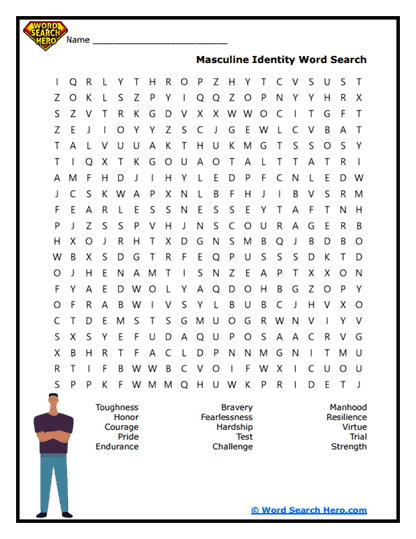
About Our Ernest Hemingway Word Searches
Our Ernest Hemingway Word Searches help students explore the work of one of the most influential American authors of the 20th century while strengthening vocabulary, spelling, and concentration skills. These printable puzzles introduce learners to the themes, characters, and settings connected to Hemingway’s famous stories and novels.
Teachers often look for engaging ways to reinforce literary knowledge, and word searches provide a simple and effective option. As students search for words related to Ernest Hemingway’s works, literary themes, and storytelling ideas, they become more familiar with the vocabulary associated with modern American literature. Repeated exposure to these terms helps learners recognize them more easily during literature studies and classroom discussions.
Parents and homeschool educators also appreciate activities that combine learning with entertainment. Word searches encourage visual scanning, patience, and attention to detail while quietly reinforcing reading-related concepts. Students interact with vocabulary connected to adventure, resilience, nature, and human struggle.
Ernest Hemingway’s writing continues to be widely studied because of its distinctive style and powerful themes. Through these puzzles, students gain an engaging introduction to the vocabulary associated with one of the most respected authors in modern literature.
The Author Known for Simple and Powerful Storytelling
Ernest Hemingway was an American writer born in 1899 who became famous for his clear, direct writing style and stories that explore courage, perseverance, and human endurance. His work often focuses on characters facing difficult situations and responding with determination and strength.
Some of Hemingway’s best-known novels include The Old Man and the Sea, A Farewell to Arms, and For Whom the Bell Tolls. These works often feature characters dealing with personal struggles, war, or challenging environments.
One of his most famous stories, The Old Man and the Sea, tells the story of Santiago, an aging fisherman who struggles to catch a giant marlin in the open sea. The story highlights themes of persistence, pride, and the human spirit.
Hemingway’s writing style is often described as simple and direct, sometimes called the “iceberg theory.” In this approach, the author presents straightforward details on the surface while deeper meanings remain beneath the story.
Students studying Ernest Hemingway often discover how powerful storytelling can emerge from simple language and carefully chosen details.
Paul’s Pro-Tip
After students finish the word search, try a quick “less is more” writing activity.
Ask them to circle one setting word and one action word from the puzzle.
Then challenge them to write a very short story using only two or three sentences.
Hemingway believed that strong writing often comes from saying just enough and letting readers imagine the rest. This exercise helps students see how simple language can still create vivid stories.
Why Ernest Hemingway’s Writing Is Influential
Ernest Hemingway’s work had a major influence on modern literature because of his distinctive writing style and powerful storytelling approach. His use of simple language, short sentences, and understated emotion created a style that many later writers admired and adopted.
Hemingway often wrote about themes such as courage, loss, personal struggle, and resilience. His characters frequently face dangerous or emotionally difficult situations, yet they try to maintain dignity and strength.
Many of his stories were inspired by real-life experiences, including travel, outdoor adventures, and historical events such as wars. This connection to real-world experiences gave his writing a sense of realism and authenticity.
Hemingway received the Nobel Prize in Literature in 1954, recognizing his impact on world literature and his mastery of narrative style.
Word searches featuring vocabulary connected to Ernest Hemingway help reinforce the themes, works, and storytelling ideas students encounter when studying modern American literature. By recognizing these words repeatedly, learners gain a clearer understanding of why Hemingway remains one of the most influential authors of the 20th century.
Frequently Asked Questions
Who was Ernest Hemingway?
Ernest Hemingway was an American novelist and short story writer known for his simple writing style and powerful storytelling.
What are Ernest Hemingway’s most famous works?
Some of his best-known works include The Old Man and the Sea, A Farewell to Arms, and For Whom the Bell Tolls.
What is Hemingway’s “iceberg theory”?
It is a storytelling technique where much of the meaning is implied beneath the surface, while the writing itself remains simple and direct.
How can teachers use Ernest Hemingway word searches in class?
Teachers often use them as warm-up activities, vocabulary reinforcement exercises, or introductions to discussions about modern American literature.
What extension activity works well after completing the puzzle?
Students can write a short paragraph describing a challenging situation faced by a character, using clear and simple language similar to Hemingway’s writing style.