About Our Evolution Word Searches
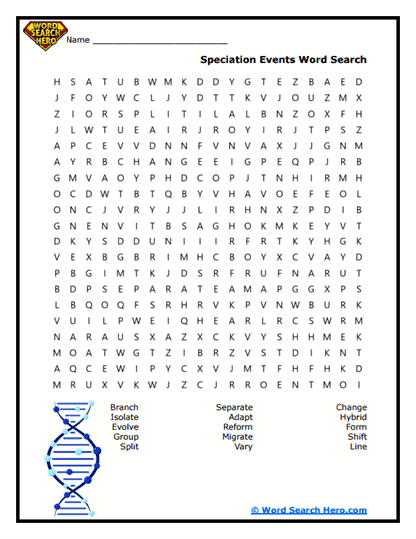
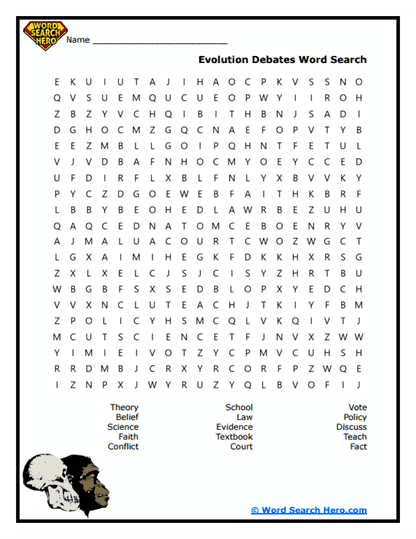
Evolution word searches introduce students to the vocabulary used to describe how living organisms change and adapt over long periods of time. These printable puzzles help learners become familiar with the scientific terms connected to biological change, natural selection, and the diversity of life on Earth. Before students fully explore evolutionary concepts, it often helps to first recognize and understand the language scientists use to explain them.
Evolution is a central idea in biology that explains how species develop new traits and adapt to their environments across generations. Students studying this topic may encounter words such as adaptation, variation, species, fossil, inheritance, and natural selection. These terms frequently appear in life science lessons and textbooks, and becoming familiar with them helps students better understand how scientists study the history and development of life.
A word search provides an engaging way to reinforce these terms while strengthening vocabulary and observation skills. Because the activity feels like a puzzle rather than a traditional worksheet, it can make learning complex scientific language more approachable. Teachers often use these printables during science centers, review sessions, independent practice, or early finisher time. Parents and homeschool educators can also easily include them in lessons as a way to introduce evolution vocabulary in an interactive format.
As students search for the words in the puzzle grid, they strengthen concentration, visual scanning, and pattern recognition skills. At the same time, they are building familiarity with the terminology used to describe how species change over time.
Understanding the Idea of Evolution
Evolution describes the gradual change in populations of organisms over many generations. These changes occur as organisms adapt to their environments and pass beneficial traits to their offspring.
One of the key mechanisms of evolution is natural selection. In this process, individuals with traits that help them survive and reproduce are more likely to pass those traits to the next generation. Over long periods of time, these small changes can lead to the development of new characteristics within a population.
Fossils, genetic evidence, and comparisons among living species help scientists understand how organisms are related and how they have changed through time. Learning the vocabulary associated with evolution helps students follow scientific explanations about biodiversity and the history of life.
Word searches reinforce this learning by giving students repeated exposure to the key terms used when discussing evolutionary biology.
Paul’s Pro-Tip
A powerful way to extend this puzzle is to introduce a quick “adaptation example” discussion. After students complete the word search, ask them to choose a word such as adaptation or trait and connect it to a real example in nature.
For instance, students might discuss how thick fur helps animals survive in cold environments or how certain beak shapes help birds gather specific types of food. Encouraging students to connect vocabulary to real biological examples helps deepen their understanding of the concept.
This activity adds strong instructional value because it moves students beyond recognizing scientific terms and encourages them to apply the ideas behind the vocabulary. Teachers and homeschool educators can quickly see whether students understand how evolutionary processes relate to living organisms.
Helping Students Understand Biological Change
Understanding evolution helps students recognize that life on Earth has a long and complex history. It explains why organisms share similarities, why species adapt to different environments, and how biodiversity develops.
As students become familiar with evolution vocabulary, they are better prepared to interpret scientific explanations about fossils, genetics, and the relationships among species. This knowledge also supports later learning in areas such as ecology, genetics, and conservation biology.
A word search can serve as an introduction to an evolution unit or as a review after students have studied adaptation and natural selection. After completing the puzzle, educators can encourage students to connect the vocabulary with examples from nature, fossil records, or classroom discussions.
When students build confidence with evolution-related vocabulary, they gain the language and understanding needed to explore how life has changed and diversified across Earth’s history.
Frequently Asked Questions
What does evolution mean in biology?
Evolution refers to the gradual change in populations of organisms over many generations.
What evidence supports the study of evolution?
Scientists study fossils, genetic similarities, and comparisons between species to understand evolutionary relationships.
How does natural selection relate to evolution?
Natural selection is a process that helps certain traits become more common in a population when those traits improve survival or reproduction.
Why is adaptation important in evolution?
Adaptations are traits that help organisms survive in their environment, making them more likely to pass those traits to future generations.
What classroom activity pairs well with an evolution word search?
Students can research an animal adaptation and explain how that trait helps the organism survive in its environment.