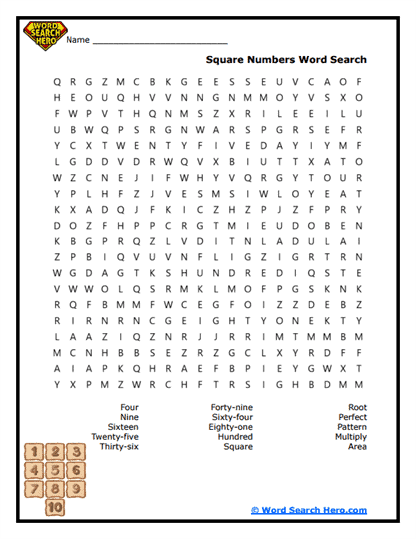
About Our Exponents Word Searches
Exponents word searches help students become more familiar with the vocabulary used to describe repeated multiplication and powers in math. These printable puzzles introduce and reinforce terms connected to base numbers, powers, expanded form, and patterns in multiplication. Before students begin simplifying exponent expressions or comparing powers, it often helps to first recognize the language used to explain these ideas.
For many learners, exponents can feel like a big jump because the notation looks different from the math they are used to seeing. Students may understand multiplication, but words like exponent, power, base, and squared can still feel unfamiliar at first. A word search offers a simple and approachable way to build comfort with this vocabulary before students apply it in lessons and practice problems.
Because the activity feels more like a puzzle than a worksheet, it can lower resistance and make math vocabulary practice feel more manageable. Teachers often use these printables as warm-ups, review pages, early finisher work, or sub plans during pre-algebra and algebra units. Parents and homeschool educators can also add them to lessons as an easy way to reinforce key terminology while keeping the work varied and engaging.
As students search for the words, they are also strengthening concentration, visual scanning, and pattern recognition. At the same time, they are building the vocabulary foundation that helps them understand how exponents represent repeated multiplication.
Building the Vocabulary of Powers and Repeated Multiplication
Exponents introduce students to a more efficient way of representing multiplication. Instead of writing the same factor again and again, students learn to use exponent language to show how many times a number is multiplied by itself. That shift is much easier when the vocabulary already feels familiar.
Words like base, exponent, power, factor, and expanded form appear often in classroom instruction and written practice. Students may also encounter terms like squared and cubed as they begin working with common powers. When these words are unfamiliar, the lesson can feel harder than it really is. Word searches help reduce that barrier by giving students repeated exposure to the important language before they are expected to use it in context.
As students locate the words in the puzzle, they become more comfortable with spelling and recognition. That familiarity matters when the same vocabulary shows up in directions, examples, and class discussions. Instead of slowing down to decode the terms, students can focus more fully on understanding the math concept itself.
These puzzles are especially useful at the beginning of an exponents unit or as a review tool before independent practice. They help students approach the topic with more confidence and less hesitation.
Paul’s Pro-Tip
One of the most effective ways to extend an exponents word search is to follow it with a “name it, build it, explain it” routine. After students finish the puzzle, choose a few vocabulary words such as base, exponent, power, and expanded form. Then give students a few simple exponent examples and ask them to identify each part, rewrite the example in expanded form, and explain what the exponent is telling them to do.
This adds a lot of value because many students can copy exponent problems without fully understanding the roles of the base and exponent. Asking them to label the parts and describe the repeated multiplication helps reveal whether they truly understand the structure of the expression. For teachers and homeschoolers, this makes the puzzle a useful formative check rather than just a vocabulary activity. It quickly shows who is ready to move on and who still needs more concrete examples and guided discussion.
Helping Students See Patterns in Math
Exponents are not just a new notation. They also help students notice patterns and efficiency in math. As numbers are multiplied repeatedly, students begin to see how quickly values can grow and how exponents provide a shorter, clearer way to write that repeated work.
That pattern-based thinking is important because it supports future learning in algebra, scientific notation, and beyond. When students understand the vocabulary of exponents, they are better able to describe those patterns and explain what they notice. Instead of saying that a number is being multiplied “a bunch of times,” they can use precise math language to talk about powers and repeated factors.
A word search can be a simple first step in building that confidence. After the puzzle, educators can ask students to connect a few vocabulary words to sample exponent expressions or to explain how exponent notation saves time compared to writing out repeated multiplication. Even a brief discussion can help students see that exponents are not just symbols to memorize. They are tools for organizing mathematical ideas more clearly.
When students become more comfortable with the language of exponents, they are better prepared to interpret expressions, explain their reasoning, and build a stronger foundation for future math work.
Frequently Asked Questions
When are exponents word searches most useful?
They are especially helpful before or during units on exponents, powers, repeated multiplication, and early algebra concepts. Many educators also use them as warm-ups or review activities.
What grade levels are these puzzles best for?
They work well for upper elementary, middle school, and early algebra students, depending on the vocabulary included and the level of instruction.
Can homeschool educators use these printables in lessons?
Yes. They are easy to print and pair well with sample exponent problems, math notebooks, and short vocabulary discussions.
Do these puzzles help students understand exponents?
They can. When students are more familiar with the vocabulary, they are better able to follow explanations, identify the parts of an expression, and describe what exponents mean.
What is a good follow-up activity after completing the puzzle?
A strong next step is to have students label the parts of a few exponent examples, rewrite them in expanded form, and explain what the exponent tells them to do.