About Our Famous Mathematicians Word Searches
There’s something deeply satisfying about circling a hidden word in a puzzle. It’s the grown-up version of a treasure hunt-one where the bounty isn’t gold doubloons or dragon eggs, but vocabulary, pattern recognition, and the joyful click of “Aha! Found it!” When that puzzle also leads students down a historical rabbit hole of mathematical revolutionaries, the result is something even richer: a tactile, brain-boosting, curiosity-sparking activity disguised as a simple word search.
This isn’t a collection of random names tossed into a grid. These puzzles are carefully curated to walk students through time-starting with the thinkers of Ancient Greece, passing through the intellectual explosions of the Islamic Golden Age and Renaissance Europe, and landing smack in the world of algebra, computer science, and quantum mechanics. Each worksheet stands alone, but together, they form a chronological and thematic journey through the history of human thought-one name at a time.
Let’s not pretend this is just about spelling. Sure, your students will sharpen their orthographic memory, hone visual scanning skills, and improve pattern recognition. But they’ll also gain something rarer: context. By associating these names with the ideas and eras they helped define, learners begin to see math not as a set of isolated rules, but as a vast, connected conversation-a conversation that stretches across centuries and cultures.
Let’s break down this journey of numerical nobility by examining the thematic paths carved out by each worksheet.
We begin, appropriately, with the “Thinker Trail“, which features the original problem-solvers of the Western world. There’s Pythagoras, whose name is now synonymous with the triangle theorem you probably met in middle school, but whose philosophical worldview mixed numbers with mysticism. He believed the cosmos was built on mathematical harmony-think of him as the original “math is music” guy. Then there’s Euclid, whose Elements is one of the most influential textbooks in human history, shaping how geometry has been taught for over two millennia. Archimedes, often hailed as the greatest mathematician of antiquity, did everything from calculating pi to inventing war machines-legend has it he shouted “Eureka!” in the bath and ran naked through the streets of Syracuse. Zeno gave us paradoxes that still challenge logicians. And Diophantus is sometimes called the “father of algebra,” though his methods were more rhetorical than symbolic. This puzzle doesn’t just introduce students to names-it invites them into a legacy of thought that blends math, logic, astronomy, and philosophy.
Next, we voyage eastward with “Scholar Search“, a tribute to the dazzling intellectual achievements of the Islamic Golden Age. Here’s Al-Khwarizmi, whose name gives us both “algebra” and “algorithm.” He compiled foundational texts on solving linear and quadratic equations-work that would eventually power everything from banking systems to rocket science. Omar Khayyam, known in the West for his poetry, was also a brilliant mathematician who classified cubic equations and questioned the limitations of Euclidean geometry centuries before it became fashionable. Al Tusi revolutionized trigonometry. Ibn Sina (Avicenna) wrote encyclopedic texts that integrated logic, medicine, and mathematics. Al Haytham, or Alhazen, pioneered the scientific method and optics, while Al Kindi helped translate Greek texts and added original theories on numbers. These thinkers didn’t just preserve Greek mathematics-they critiqued, enhanced, and globalized it. The word search format offers a tactile, memorable way for students to connect with these monumental figures, especially those whose contributions are too often sidelined in Western curricula.
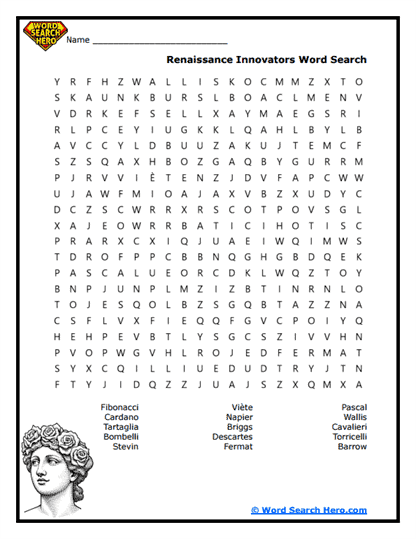
Then comes “Renaissance Riddlers“, capturing the moment when curiosity burst back onto the European stage. Fibonacci, whose famous sequence still crops up in everything from sunflower seeds to shell spirals, reintroduced Indo-Arabic numerals to Europe, transforming European commerce and science. Cardano, a flamboyant polymath and gambler, published solutions to cubic equations while living a life that would make a great HBO series. Tartaglia and Bombelli advanced algebra further, while Viรจte was one of the first to use letters to represent variables-a shift that changed math forever. Then there’s Descartes, who decided to blend algebra and geometry, thus giving us the Cartesian plane and launching analytical geometry (also: “I think, therefore I am”-yes, that guy). And let’s not forget Fermat, whose “Last Theorem” went unsolved for over 350 years. This worksheet shows students that Renaissance thinkers weren’t just dabbling-they were redesigning the entire intellectual toolkit.
From there, we enter the big leagues with “Calculus Creators“, which includes names like Newton and Leibniz, who famously-some would say ferociously-disputed who invented calculus first. Newton gave us laws of motion and gravitation; Leibniz gifted us elegant notation still used today. Euler made nearly every branch of math bend to his will, producing over 800 papers and giving us the famous Euler’s identity, often described as “the most beautiful equation.” Cauchy formalized analysis. Riemann, whose work underpins Einstein’s theory of relativity, helped us understand curved space. This puzzle reinforces not just the spelling of these names, but the awe we should all feel when confronting the minds that invented the tools we use to describe the universe.
For a change of shape, we turn to “Geometry Giants“, where we meet Hilbert, whose famous list of 23 problems shaped 20th-century mathematics, and Lobachevsky and Bolyai, who dared to imagine a geometry where parallel lines behave… differently. This wasn’t heresy-it was the dawn of non-Euclidean geometry, which would later prove essential to understanding space-time. Klein and Poincarรฉ revolutionized topology. Hausdorff gave us a new way to understand space’s structure. These are the explorers of pure abstraction, and this worksheet makes their towering legacy approachable through pattern recognition and contextual storytelling.
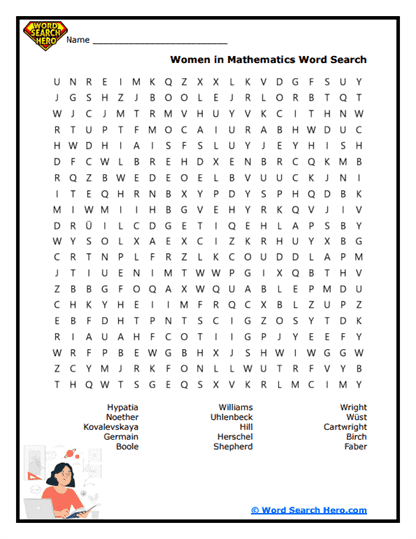
Of course, no collection would be complete without representation, which is why “Math Women“ takes center stage. Hypatia, one of the first recorded female mathematicians, taught in Alexandria until she was brutally murdered by a mob-proof that math, like politics, can be dangerously radical. Emmy Noether, whose work in abstract algebra and theoretical physics was so groundbreaking that Einstein himself sang her praises, revolutionized our understanding of symmetry and conservation laws. Sophie Germain worked under a male pseudonym to study number theory. Kovalevskaya was the first woman in Europe to earn a Ph.D. in mathematics. Every name in this puzzle represents both mathematical genius and personal tenacity-a lesson in history, empathy, and resilience.
We then explore the backbone of modern decision-making with “Stats Sleuths“. Bayes gave us Bayesian probability, the backbone of modern AI. Chebyshev and Kolmogorov helped formalize statistical theory. Gauss, ever the overachiever, also made foundational contributions to probability. These names are essential to understanding everything from insurance models to scientific experiments. The worksheet isn’t just about spelling Poisson correctly-it’s about learning to appreciate the math that drives the world’s data.
And let’s not forget the “Algebra Architects“. Galois, who died in a duel at age 20, essentially founded group theory while writing a mathematical manifesto the night before his death. Hamilton created quaternions, expanding complex numbers into four dimensions. Noether appears again because one worksheet simply isn’t enough to contain her genius. Grothendieck, Frobenius, Zariski-these names are the scaffolding behind modern abstract algebra. This worksheet is like a secret handshake into the inner sanctum of math sophistication.
Speaking of modernity, “Code Founders“ propels students into the digital age. Turing, the father of computer science, cracked the Enigma code and imagined the concept of a universal machine. Shannon invented information theory. Knuth literally wrote The Art of Computer Programming. Hopper, a Rear Admiral and a pioneer in programming languages, even coined the term “debugging.” Students searching for these names also discover how deeply math and logic are embedded in our technological lives.
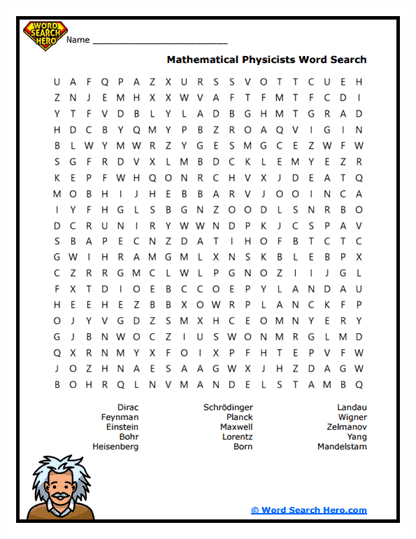
We zoom toward the quantum strangeness of the 20th century with “Physics Minds“. Dirac predicted antimatter. Feynman made quantum electrodynamics understandable-and fun. Einstein transformed our understanding of time and space. Heisenberg reminded us we can’t know everything at once. These thinkers didn’t just use math-they lived it, pushing boundaries and flipping our assumptions upside down.