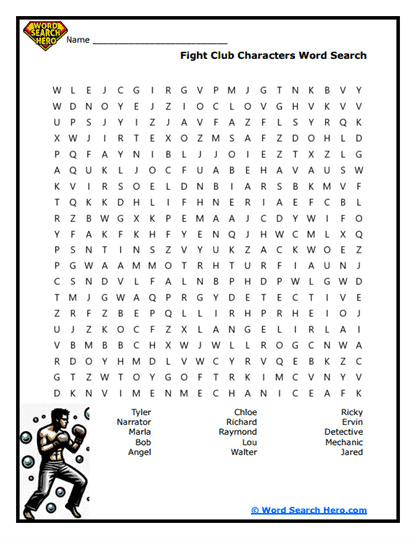
About Our Fight Club Word Searches
Our Fight Club Word Searches bring the intensity, themes, and cultural impact of this iconic film into a structured and educational activity. Designed for classrooms, homeschool environments, or independent learners, these printable puzzles offer a unique way to explore vocabulary while engaging with ideas around identity, conflict, and personal change.
Students will encounter words like “identity,” “rebellion,” “control,” “chaos,” “choice,” and “transformation,” all while strengthening spelling, reading fluency, and concentration. Because Fight Club explores deeper psychological and societal themes, these puzzles introduce vocabulary that encourages reflection and critical thinking. Teachers often use them as part of film studies, writing prompts, or discussions about character development and internal conflict.
These printables are simple to use with no preparation required, making them a practical option for both educators and parents. They can be adapted for different grade levels, allowing younger learners to focus on basic terms while older students explore more abstract concepts.
Beyond literacy skills, these puzzles help students connect language to deeper ideas about storytelling and perspective. By engaging with meaningful vocabulary, learners develop stronger comprehension and a more thoughtful approach to reading.
Exploring Identity, Conflict, and Meaning
Fight Club-themed puzzles introduce students to vocabulary centered around identity, decision-making, and personal struggle. Words like “illusion,” “choice,” “freedom,” and “control” help learners understand how language reflects internal conflict and transformation. Because these words carry strong conceptual meaning, they encourage deeper thinking and discussion.
A helpful classroom strategy is to have students group words into categories such as emotions, actions, and themes. For example, they might separate “anger” and “confusion” from words like “change” or “challenge.” This helps students see how vocabulary contributes to both character development and overall story structure.
You can extend the activity by asking students to write a short reflection or scene using several of the words from the puzzle. They might describe a character facing a difficult decision or experiencing a major change. This reinforces vocabulary while encouraging thoughtful writing.
Because the theme focuses on perspective and personal growth, these puzzles naturally support critical thinking. Students begin to connect words to larger ideas, making the learning experience more meaningful.
Paul’s Pro-Tip

I always found that when students were given a topic that made them think a little deeper, they became much more invested. With themes like identity and choice, I’d start by asking, “What makes someone who they are?” That question alone sparked some really interesting conversations and helped students approach the puzzle with more curiosity.
After they finished, I liked to have students pick one word and connect it to a decision a character might make. It didn’t have to be long, but it helped them think beyond just finding the word. And if someone got stuck, I’d remind them to look for patterns or familiar chunks in longer words-it’s often the fastest way to make progress and build confidence.
Connecting Themes to Real-World Thinking
Fight Club word searches offer strong opportunities for deeper learning connections. In language arts, they support lessons on character development, internal conflict, and theme. Students can explore how characters change over time and how their decisions shape the story.
These puzzles also connect well to discussions about perspective and critical thinking. Students can reflect on how different viewpoints influence actions and outcomes, helping them develop analytical skills.
Creative extensions are especially effective with this theme. Students might write a short story about a character facing a major decision, create a symbolic poster, or explore how different choices lead to different outcomes using words from the puzzle. These activities reinforce vocabulary while encouraging imagination and reflection.
Real-world connections can also be explored by discussing how choices, identity, and personal growth play a role in everyday life. By linking vocabulary to both storytelling and real experiences, these puzzles become a meaningful and engaging educational tool.
Frequently Asked Questions
What are Fight Club word searches?
Fight Club word searches are printable puzzles that include vocabulary inspired by themes, characters, and ideas from the film. They help students engage with deeper concepts while improving spelling, reading fluency, and word recognition.
Are Fight Club-themed word searches appropriate for students?
Yes, when adapted appropriately, the focus is on themes like identity, decision-making, and personal growth rather than mature content. Teachers and parents can guide discussions to ensure the activity remains educational and age-appropriate.
How do these word searches support learning and critical thinking?
They help students build vocabulary while also encouraging them to think about meaning, perspective, and character decisions. When paired with writing or discussion activities, they promote deeper comprehension and analysis.
Can these puzzles be used in literature or film studies lessons?
Absolutely, they are a great addition to lessons on storytelling, theme, and character development. The vocabulary provides a strong foundation for exploring complex ideas in an accessible way.
Why do students engage with deeper-themed activities like this?
Students often enjoy activities that challenge them to think and reflect. When learning goes beyond simple answers and connects to bigger ideas, it becomes more interesting, memorable, and meaningful.