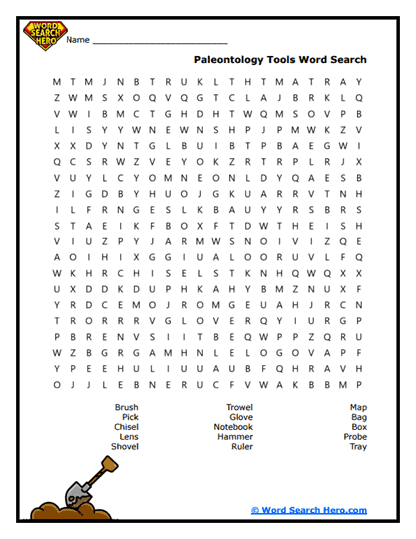
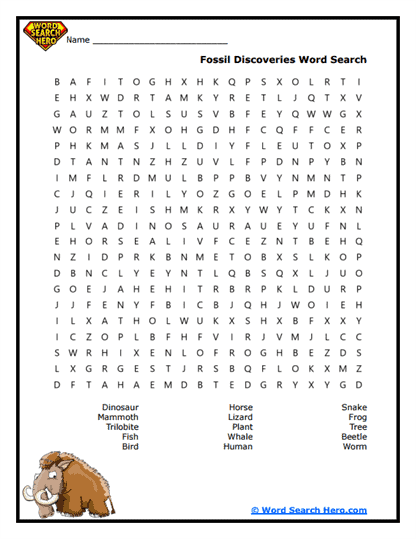
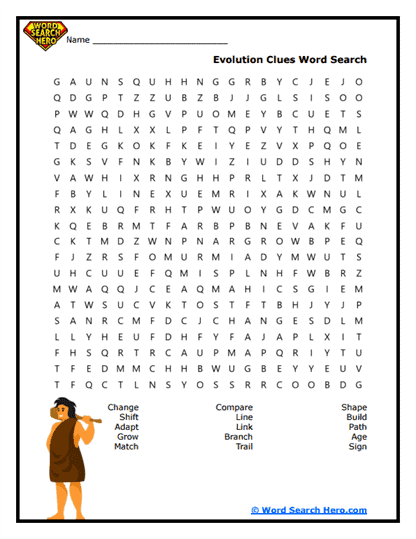
About Our Fossil Record Word Searches
Fossil Record word searches introduce students to the vocabulary used to study the preserved remains and traces of ancient life. These printable puzzles help learners become familiar with the scientific terms used to describe fossils, geological layers, and the evidence scientists use to understand Earth’s biological history. Before students explore how fossils reveal information about ancient organisms, it often helps to first recognize the language used in paleontology and Earth science.
The fossil record is the collection of fossils that scientists have discovered and studied over time. It provides clues about what life looked like millions of years ago and how organisms have changed across long periods of history. Students studying this topic may encounter words such as fossil, sediment, extinction, paleontologist, imprint, and preservation. Recognizing these terms helps students better understand how fossils are discovered and what they can reveal about past environments.
A word search provides an engaging way to reinforce this vocabulary while strengthening spelling and observation skills. Because the activity feels like a puzzle rather than a traditional worksheet, it can make learning scientific language more approachable. Teachers often use these printables during science centers, review sessions, independent practice, or early finisher time. Parents and homeschool educators can also include them in lessons as a way to introduce fossil-related vocabulary in an interactive format.
As students search for the words in the puzzle grid, they strengthen concentration, visual scanning, and pattern recognition skills. At the same time, they are building familiarity with the scientific language used to describe ancient life and geological history.
Understanding the Fossil Record
Fossils form when the remains or traces of organisms are preserved in rock or sediment over long periods of time. These preserved materials may include bones, shells, footprints, or imprints of plants and animals. Over millions of years, layers of sediment build up and eventually harden into rock, protecting these remains.
Scientists study fossils to learn about organisms that lived long before humans appeared on Earth. By examining where fossils are found within rock layers, scientists can estimate the relative age of organisms and understand how life has changed through time.
The fossil record provides valuable evidence about extinct species, ancient ecosystems, and major changes in Earth’s history. Learning the vocabulary associated with fossils helps students better understand how scientists interpret these clues from the past.
Word searches reinforce this learning by giving students repeated exposure to the key terms used when studying fossils and geological layers.
Paul’s Pro-Tip
A powerful way to extend this puzzle is to create a simple “fossil discovery” activity. After students complete the word search, ask them to imagine they are paleontologists discovering a fossil for the first time.
Students can draw a fossil they might find and describe what type of organism it may have belonged to. Encourage them to use vocabulary from the puzzle, such as sediment, imprint, or extinct, when describing their discovery.
This activity adds strong instructional value because it encourages students to apply scientific vocabulary in a creative context. Teachers and homeschool educators can also see whether students understand how fossils form and how scientists study them.
Helping Students Explore Earth’s Ancient History
The fossil record offers a window into Earth’s distant past. By studying fossils, scientists can reconstruct ancient environments, identify species that no longer exist, and understand how life has evolved across millions of years.
Familiarity with fossil-related vocabulary helps students interpret science readings, diagrams, and museum exhibits that explain prehistoric life. It also supports deeper understanding of related topics such as evolution, geology, and extinction.
A word search can serve as an introduction to a fossil or prehistoric life unit or as a review after students have studied fossils in class. After completing the puzzle, educators can encourage students to explore images of fossils, watch demonstrations of fossil formation, or visit museum exhibits that display ancient specimens.
When students build confidence with fossil record vocabulary, they gain the language and understanding needed to explore the fascinating history of life on Earth.
Frequently Asked Questions
What is the fossil record?
The fossil record is the collection of all known fossils and the information they provide about life throughout Earth’s history.
Who studies fossils?
Scientists called paleontologists study fossils to learn about ancient organisms and environments.
How do fossils form?
Fossils typically form when an organism’s remains or traces become buried in sediment and are preserved over long periods of time.
What kinds of things can become fossils?
Bones, shells, footprints, plant impressions, and even traces of animal activity can become fossils under the right conditions.
What activity works well alongside a fossil record word search?
Students can create a simple layered drawing showing how fossils are found in different rock layers and explain what each layer might represent in Earth’s history.