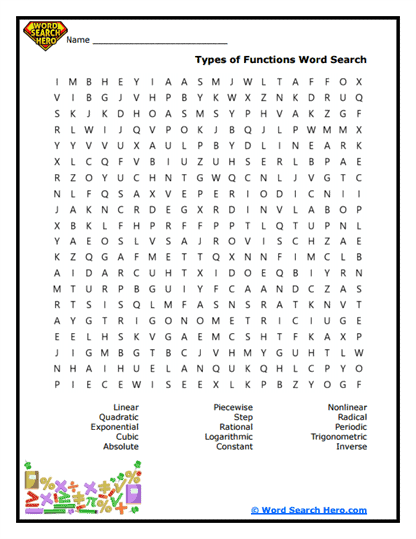
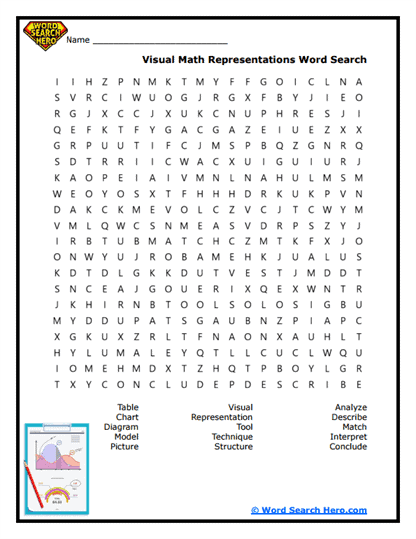
About Our Functions and Graphs Word Searches
Functions and Graphs word searches help students become more comfortable with the vocabulary used to describe one of the most visual and important parts of math. These printable puzzles introduce and reinforce terms connected to inputs and outputs, coordinate planes, graphing, variables, slopes, intercepts, and the relationships between quantities. Before students can confidently analyze or draw graphs, it often helps to first understand the language that explains what they are seeing.
For many learners, functions and graphs are where math starts to feel more connected and more abstract at the same time. Students are asked to look at patterns, describe how one quantity changes compared to another, and interpret what a graph is showing. Along the way, they encounter terms like function, domain, range, axis, coordinate, slope, and intercept. A word search offers a simple way to build familiarity with these words before students are expected to use them in deeper problem solving.
Because the activity feels like a puzzle, it can reduce some of the pressure students feel when approaching graphing lessons. Instead of beginning with a dense page of definitions or a set of graphing exercises, learners start by recognizing the words themselves. That makes these printables useful for warm-ups, review days, early finisher work, centers, sub plans, and homeschool lessons.
These puzzles also support focus, pattern recognition, and visual attention. While students search for important terms, they are strengthening the vocabulary that will help them understand tables, graphs, equations, and the relationships those representations show.
Strengthening the Vocabulary Behind Graphing and Relationships
Functions and graphs depend on language that is both precise and interconnected. Students need to understand not only what each word means on its own, but also how terms relate to one another. A coordinate belongs on a plane. A function connects inputs and outputs. A slope describes change. A graph represents a relationship. When students begin recognizing those connections, graphing becomes more meaningful and less mechanical.
Word searches help by giving students repeated visual exposure to these terms. As they locate each word in the grid, they become more familiar with spelling, structure, and appearance. That matters because math vocabulary can quickly become a barrier if students are still struggling to recognize the words in directions, class notes, or examples.
These printables also work well as a preview tool. Before beginning a unit on graphing, an educator can use the puzzle to introduce key vocabulary in a low-pressure format. Later, when students hear the same terms during instruction, the language already feels more familiar. That familiarity helps free up attention for understanding the underlying concepts.
Over time, repeated exposure to graphing vocabulary can improve both confidence and clarity. Students are better able to describe what they notice, explain how a graph behaves, and connect mathematical terms to visual representations.
Paul’s Pro-Tip
A highly effective follow-up is to have students sort the puzzle words into four categories: parts of a graph, types of relationships, descriptions of change, and function vocabulary. This turns a simple word search into a concept-mapping activity.
For example, students might place axis, coordinate, and intercept under parts of a graph; linear or increasing under types of relationships or descriptions of change; and domain, range, and function under function vocabulary. Then ask students to explain why they placed each word where they did.
This adds real instructional value because it reveals whether students understand how the terms are used, not just whether they can find them in a puzzle. It is especially useful for teachers and homeschoolers because it creates a quick formative check. If students struggle to sort words like range or slope, that signals exactly where a mini-lesson or extra example would help. In a small amount of time, the activity reinforces vocabulary, builds conceptual connections, and helps you see what students truly understand.
Helping Students Read Math as a Story of Change
Functions and graphs are powerful because they show how quantities relate and change. A graph can tell the story of distance over time, temperature during the day, population growth, or the cost of items in a store. When students understand the vocabulary behind graphs, they are better able to interpret that story and explain what it means.
That is why vocabulary matters so much in this topic. A student who knows words like increase, decrease, intercept, and coordinate can describe what is happening instead of just pointing to lines and dots. A student who understands domain and range can talk about what values make sense in a situation. These are not just math terms to memorize. They are tools for interpreting information.
A word search can open the door to these conversations. After the puzzle, educators might ask students to choose a few words and connect them to a simple graph or real-life example. Even a brief discussion helps students see that graphing is not only about plotting points. It is about understanding relationships, patterns, and change.
When students become more fluent in the language of functions and graphs, they are often more confident reading diagrams, interpreting data, and explaining mathematical ideas. A printable puzzle may seem simple, but it can be a meaningful first step toward stronger graphing skills and deeper mathematical thinking.
Frequently Asked Questions
When are functions and graphs word searches most useful?
They are especially helpful before or during units on graphing, coordinate planes, linear relationships, and functions. Many educators use them as warm-ups, review pages, or early finisher activities.
What grade levels are these puzzles best for?
They are often useful for upper elementary, middle school, and early high school students, depending on the vocabulary included and the level of graphing being taught.
Can homeschool educators use these as part of a lesson?
Yes. They work well as printable lesson starters, review activities, or quiet practice that can be paired with graph examples, short discussions, or notebook work.
Do these puzzles help students understand graphing concepts?
They can support understanding by making important vocabulary more familiar. When students recognize the language of graphing more easily, they are better able to follow instruction and explain what they see.
What is a strong follow-up activity after the puzzle?
A great next step is asking students to sort the words by category, match them to parts of a sample graph, or explain how a few of the terms apply to a real-world situation.