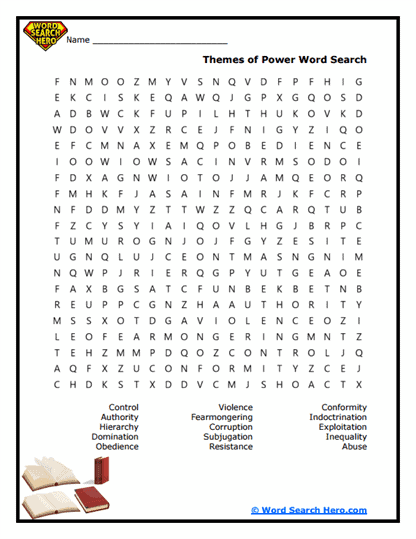
About Our George Orwell Word Searches
Our George Orwell Word Searches help students explore the work of one of the most influential authors of the 20th century while strengthening vocabulary, spelling, and concentration skills. These printable puzzles introduce learners to the themes, ideas, and literary concepts connected to Orwell’s powerful novels and essays.
Teachers often look for engaging ways to reinforce literary knowledge, and word searches provide a simple and effective option. As students search for words related to George Orwell’s works, political themes, and literary ideas, they become more familiar with the vocabulary associated with modern dystopian literature and social commentary. Repeated exposure to these terms helps learners recognize them more easily during literature studies and classroom discussions.
Parents and homeschool educators also appreciate activities that combine learning with entertainment. Word searches encourage visual scanning, patience, and attention to detail while quietly reinforcing reading-related concepts. Students interact with vocabulary connected to society, freedom, power, and government systems.
George Orwell’s writing remains widely studied because his stories explore the relationship between individuals, governments, and society. Through these puzzles, students gain an engaging introduction to the vocabulary associated with one of the most thought-provoking authors in modern literature.
The Author of 1984 and Animal Farm
George Orwell was the pen name of Eric Arthur Blair, a British writer born in 1903. He became famous for writing novels and essays that examine political power, social control, and the importance of individual freedom.
Two of Orwell’s most famous works are 1984 and Animal Farm. The novel 1984 presents a fictional society where the government closely monitors citizens and controls information. The story introduces concepts such as Big Brother, constant surveillance, and the manipulation of truth.
Animal Farm uses a group of farm animals to tell an allegorical story about leadership, power, and political change. The novel explores how ideals can shift over time and how authority can be used in different ways.
Orwell’s writing often uses fictional settings to explore real-world ideas about politics, truth, and the responsibilities of citizens. His stories encourage readers to think critically about how information is shared and how power can influence society.
Students studying George Orwell often discover how literature can use imaginative scenarios to explore serious ideas about freedom, authority, and human behavior.
Paul’s Pro-Tip
After students finish the word search, try a quick “words and power” discussion.
Ask them to circle one government-related word and one idea-related word from the puzzle.
Then ask: Why might controlling information be powerful in a society?
Students often realize that whoever controls information can influence how people think or understand events. This opens the door to discussing how authors like Orwell use stories to explore big political and social ideas.
A simple puzzle can become the starting point for a thoughtful conversation.
Why George Orwell’s Writing Is So Influential
George Orwell’s work has had a lasting impact on literature and political thought. His novels introduced powerful ideas about surveillance, propaganda, and the manipulation of information.
The term “Orwellian” is often used today to describe situations where governments or institutions attempt to control information or monitor people’s actions closely. This shows how deeply Orwell’s ideas have entered everyday language and cultural discussion.
Orwell’s writing style is also notable for its clarity and directness. He believed that language should communicate ideas clearly, especially when discussing important social or political issues.
Because his novels explore themes such as freedom, truth, authority, and responsibility, they continue to be widely read and discussed in classrooms around the world.
Word searches featuring vocabulary connected to George Orwell help reinforce the themes, ideas, and literary concepts students encounter when studying modern dystopian literature. By recognizing these words repeatedly, learners gain a clearer understanding of why Orwell’s writing remains so relevant and influential today.
Frequently Asked Questions
Who was George Orwell?
George Orwell was a British author known for writing influential novels such as 1984 and Animal Farm.
What themes appear in George Orwell’s writing?
His works often explore themes such as government power, propaganda, freedom, truth, and the impact of authority on society.
What does the word “Orwellian” mean?
“Orwellian” describes situations where information is controlled, surveillance is widespread, or authority limits personal freedom.
How can teachers use George Orwell word searches in class?
Teachers often use them as warm-up activities, vocabulary reinforcement exercises, or introductions to discussions about dystopian literature and political themes.
What extension activity works well after completing the puzzle?
Students can discuss how a fictional society in a story might control information or communication and how that might affect the people living there.