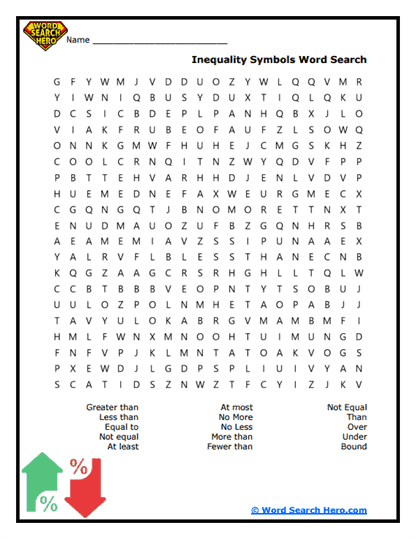
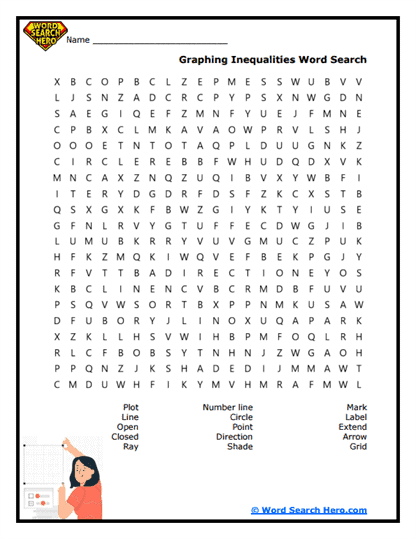
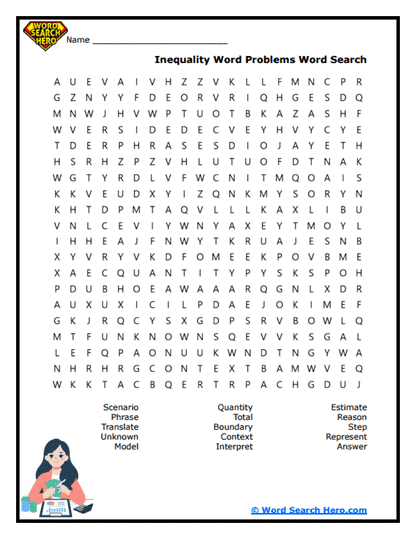
About Our Inequalities Word Searches
Inequalities word searches help students become more comfortable with the vocabulary used to describe mathematical comparisons and relationships. These printable puzzles introduce and reinforce terms connected to greater than, less than, solutions, number lines, variables, and algebraic inequalities. Before students begin solving inequality problems, it helps to first recognize and understand the language that explains how these comparisons work.
For many learners, inequalities feel similar to equations at first-but with a few important differences. Instead of finding one exact solution, students often explore ranges of possible values that make a statement true. Along the way, they encounter terms like inequality, solution set, boundary, graph, and interval. A word search gives students a relaxed way to become familiar with this vocabulary before applying it during problem solving.
Because the activity feels more like a puzzle than a worksheet, it can help lower anxiety around new math topics. Students practice recognizing key terms while building focus and attention to detail. Teachers often include these printables as warm-ups, quick reviews, early finisher work, or quiet activities during algebra units. Parents and homeschool educators can easily add them to lessons as a simple way to reinforce math vocabulary.
These puzzles also support pattern recognition and concentration. While students search for important inequality terms, they are becoming more comfortable with the language that will appear in instructions, examples, and explanations throughout the unit.
Building Understanding of Mathematical Comparisons
Inequalities are all about describing how quantities compare. Instead of showing that two expressions are equal, an inequality shows that one value is greater than, less than, greater than or equal to, or less than or equal to another. Understanding the vocabulary behind these ideas is an important step toward mastering the concept.
Students will often see words like variable, inequality, solution set, graph, interval, and boundary point when learning how to solve and represent inequalities. If these terms feel unfamiliar, it can slow down the learning process. Word searches help by giving students repeated visual exposure to the words before they encounter them in more complex problems.
As students scan the puzzle grid and locate each word, they begin to recognize spelling patterns and structures. This recognition makes it easier to understand instructions later in lessons. When students already recognize the vocabulary, they can focus their attention on understanding the mathematical reasoning instead of decoding unfamiliar language.
Using a word search at the beginning of a unit can be especially effective. It gives students an early introduction to the terminology and creates a sense of familiarity before formal instruction begins.
Paul’s Pro-Tip
After students finish the puzzle, use the vocabulary to build a quick “true or false” reasoning activity. Write a few simple inequality statements on the board, such as:
Then give students a number and ask whether it belongs in the solution set for each inequality. Students must explain their reasoning using vocabulary from the puzzle, such as greater than, less than, or boundary.
For example, if the number is 6, students might explain that 6 is part of the solution set for x>5x > 5x>5 because it is greater than 5. This short follow-up turns vocabulary recognition into mathematical reasoning. It also encourages students to speak using the correct terms, which strengthens both understanding and communication skills.
This approach works well in classrooms and homeschool lessons because it only takes a few minutes but connects language directly to problem-solving thinking.
Connecting Inequalities to Real-Life Situations
Inequalities appear frequently in real-world situations where limits, ranges, or comparisons matter. For example, a budget might require spending less than a certain amount, a speed limit tells drivers to stay below a specific number, and temperature forecasts may describe values above or below certain thresholds.
When students recognize the vocabulary of inequalities, they are better able to understand and describe these situations mathematically. Instead of simply saying “the number has to be smaller,” they can describe the relationship using clear mathematical language.
A word search can be the starting point for these conversations. After completing the puzzle, educators might ask students to choose a few words and think about where they might appear in everyday situations. Even short discussions can help students see that inequalities are not just symbols on a page-they are a way of describing real limits and possibilities.
When students become comfortable with the language of inequalities, they are often more confident solving problems, graphing solutions, and explaining their reasoning.
Frequently Asked Questions
When are inequalities word searches most useful?
They are especially helpful before starting a unit on solving or graphing inequalities. Many educators use them as warm-ups, vocabulary reviews, or early finisher activities.
What grade levels benefit from these puzzles?
They are commonly used in upper elementary and middle school when students first encounter inequalities, but they can also support early high school algebra review.
Can homeschool educators use these puzzles during math lessons?
Yes. They are easy to print and work well as lesson starters, review activities, or quiet independent practice paired with examples and explanations.
Do word searches help students understand inequalities better?
They support learning by making key vocabulary more familiar. When students recognize the terms used in lessons and instructions, they can focus more easily on the mathematical reasoning.
What is a good follow-up activity after completing the puzzle?
A helpful next step is asking students to test numbers in simple inequalities, graph solutions on a number line, or explain the meaning of a few vocabulary words they found in the puzzle.