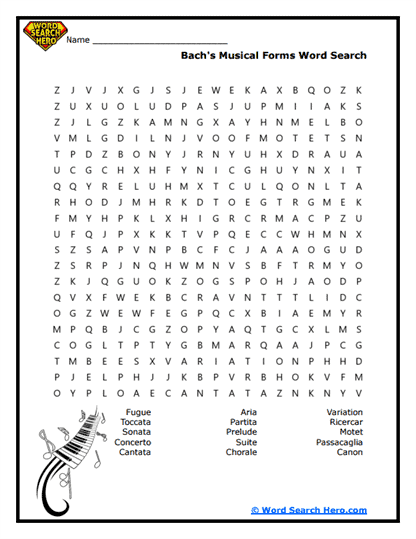
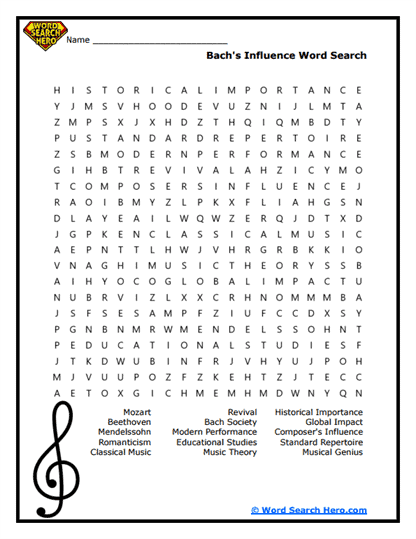
About Our Johann Sebastian Bach Word Searches
Our Johann Sebastian Bach Word Searches explore the life and music of one of the greatest composers in history while turning his work into an engaging and educational activity. These printable puzzles are perfect for classrooms, homeschool settings, or music-focused learning, offering a fun way to build vocabulary while diving into the structure, complexity, and beauty of Bach’s compositions.
Students will search for words like “Bach,” “fugue,” “counterpoint,” “organ,” “chorale,” “harpsichord,” and “composition,” all while strengthening spelling, reading fluency, and concentration. Because Bach’s music is known for its intricate design and layered melodies, these puzzles emphasize how musical ideas are built and developed. Teachers often use them in music appreciation, theory lessons, or studies of classical composition.
These printables are easy to use with no preparation required and can be adapted for different age levels. Younger learners can focus on key terms and instruments, while older students explore more advanced vocabulary tied to musical structure and technique.
Beyond literacy skills, these puzzles help students understand how music can be both highly structured and deeply expressive. Bach’s work is a perfect example of how precision and creativity come together to create timeless music.
The Structure and Genius of Bach’s Music
Johann Sebastian Bach’s music is famous for its complexity and balance, and these puzzles introduce students to the vocabulary behind that brilliance. Words like “counterpoint,” “fugue,” “harmony,” “melody,” and “voice” help learners understand how multiple musical lines interact at the same time. Bach’s compositions often feel like a conversation between different parts, each with its own role.
A helpful classroom strategy is to have students group words into categories such as musical techniques, instruments, and forms. For example, they might separate “fugue” and “chorale” from words like “organ” or “keyboard.” This helps students see how Bach used both structure and instrumentation to shape his sound.
You can extend the activity by asking students to imagine a Bach-style piece using several of the words from the puzzle. Would it have multiple layers playing together? Would it feel steady and precise or flowing and expressive? This reinforces vocabulary while encouraging musical thinking.
Because Bach’s music is often described as mathematical yet emotional, these puzzles help students recognize how patterns, repetition, and variation create a rich listening experience.
Paul’s Pro-Tip

I always found that Bach became much more interesting to students when they realized how organized his music really is. I’d start by asking, “What would it sound like if two or three different songs played at the same time but still worked together?” That question got them thinking about counterpoint right away, even before introducing the term.
After they finished, I liked to have students pick one word and imagine how it would fit into a layered piece of music. Maybe it’s a steady background line on the organ or a moving melody on top. That extra step helped them connect vocabulary directly to sound. And if someone got stuck, I’d remind them to look for distinctive words like “fugue” or “Bach”-those are usually easier to spot and help build confidence quickly.
Connecting Bach to Music Theory and Creativity
Johann Sebastian Bach word searches offer strong connections to music theory, history, and creative expression. In music lessons, they support understanding of key concepts like harmony, counterpoint, and musical form. Students can explore how Bach structured his compositions and why his techniques are still studied today.
In history, these puzzles introduce students to the Baroque era and the role Bach played in shaping it. This helps learners understand how music evolves over time and how certain composers influence generations of musicians.
Creative extensions are especially effective with this theme. Students might try to create a simple repeating melody, layer rhythms together, or describe a piece of music using words from the puzzle. These activities reinforce vocabulary while encouraging deeper musical thinking.
These puzzles also highlight how music can be both logical and expressive. By focusing heavily on Bach’s musical style, students gain a clearer understanding of how composition, structure, and creativity all come together to create lasting works of art.
Frequently Asked Questions
What are Johann Sebastian Bach word searches?
Johann Sebastian Bach word searches are printable puzzles that include vocabulary related to Bach’s life, music, and compositional techniques. They help students explore classical music while improving spelling and reading skills.
What makes Bach’s music unique?
Bach’s music is known for its use of counterpoint, where multiple melodies are played at the same time in a structured and balanced way. His compositions are both highly organized and deeply expressive, making them important in music education.
How do these word searches help students understand music theory?
They introduce key terms like fugue, harmony, and counterpoint, which are essential for understanding how music is constructed. When paired with listening or creative activities, they help students connect vocabulary to real musical examples.
Can these puzzles be used in music lessons or history classes?
Yes, they are a great addition to both subjects. They help students learn about Bach’s contributions while reinforcing important musical concepts and historical context.
Why do students enjoy Bach-themed activities?
Students often enjoy discovering how music can be built like a puzzle with patterns and layers. When they begin to understand how the pieces fit together, it makes the learning experience more engaging and rewarding.