Choose a topic !

Leo Tolstoy Word Searches

Peaceful Origins Word Search

Peaceful Origins

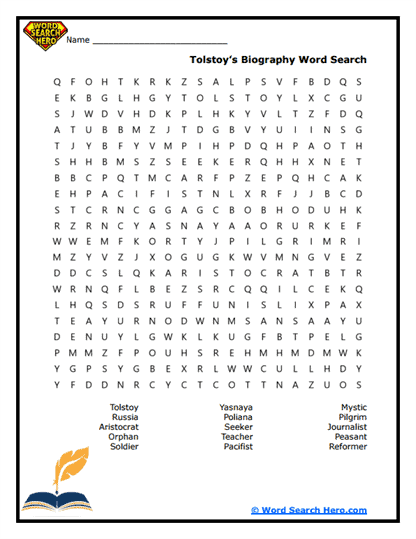
The “Tolstoy’s Biography Word Search” introduces students to the major events and influences in Leo Tolstoy’s life. Words like “Russia,” “Aristocrat,” and “Soldier” reflect his early social standing and experiences in the military. “Yasnaya Polyana,” “Teacher,” and “Reformer” show his later transformation into a moral and spiritual leader. “Mystic,” “Seeker,” and “Pacifist” highlight his philosophical […]

View More
Epic Warfare Word Search

Epic Warfare

The “War and Peace Word Search” features characters, settings, and themes from Tolstoy’s grand historical novel. Names like “Napoleon,” “Pierre,” and “Kutuzov” capture the human and political dimensions of the Napoleonic wars. Words such as “Empire,” “Patriot,” and “Ballroom” evoke the contrast between war’s brutality and aristocratic society. Students explore how Tolstoy combined intimate emotion […]

View More
Tragic Passions Word Search

Tragic Passions

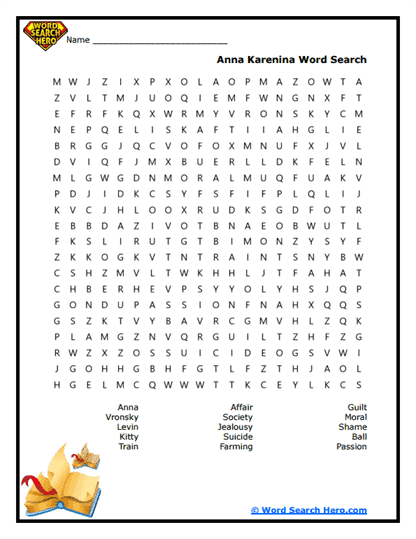
The “Anna Karenina Word Search” explores the emotional and social tensions in Tolstoy’s most famous domestic novel. Words like “Anna,” “Vronsky,” and “Levin” identify central figures whose lives intertwine through love and moral conflict. Terms such as “Affair,” “Jealousy,” and “Suicide” capture the story’s psychological depth. “Guilt,” “Shame,” and “Society” highlight the consequences of moral […]

View More
Sacred Principles Word Search

Sacred Principles

The “Tolstoy’s Faith Word Search” presents the moral and spiritual beliefs that guided Tolstoy’s later years. Words like “Christ,” “Prayer,” and “Gospel” represent his search for divine truth. “Nonviolence,” “Peace,” and “Love” reflect his emphasis on ethical living. The inclusion of “Sin,” “Redemption,” and “Conscience” shows his preoccupation with morality and self-discipline. Students learn about […]

View More
Moral Vision Word Search

Moral Vision

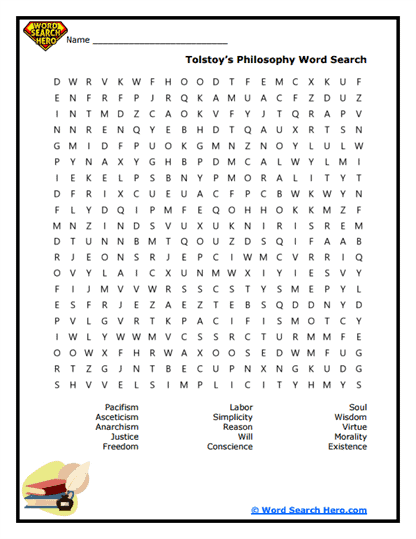
The “Tolstoy’s Philosophy Word Search” explores the author’s ideas about human purpose, ethics, and simplicity. Words such as “Pacifism,” “Anarchism,” and “Asceticism” show his rejection of materialism. “Labor,” “Simplicity,” and “Freedom” reflect his emphasis on moral clarity and honest living. “Conscience,” “Reason,” and “Existence” reveal his existential curiosity. Students gain understanding of how Tolstoy’s ideas […]

View More
Enduring Legacy Word Search

Enduring Legacy

The “Tolstoy’s Legacy Word Search” examines how Tolstoy’s works and ideas have endured through literature and philosophy. Words like “Masterpiece,” “Influence,” and “Adaptation” show his creative impact. “Canon,” “Thinker,” and “Critique” reflect his intellectual authority. “Global,” “Depth,” and “Endurance” capture his timeless relevance. Students discover how Tolstoy’s writing continues to inspire cultural and moral reflection. […]

View More
Moral Dilemmas Word Search

Moral Dilemmas

The “Moral Conflict Word Search” explores ethical struggles central to Tolstoy’s fiction. Words such as “Guilt,” “Desire,” and “Law” represent human weakness and social order. “Forgiveness,” “Redemption,” and “Virtue” express spiritual resolution. The terms embody the psychological and religious themes Tolstoy wove into his characters’ experiences. Students analyze the language of moral tension and transformation. […]

View More
Imperial Society Word Search

Imperial Society

The “Russian Society Word Search” immerses students in the cultural backdrop of Tolstoy’s novels. Words like “Czar,” “Estate,” and “Serf” evoke class divisions in 19th-century Russia. “Ball,” “Court,” and “Banquet” show aristocratic life, while “Village” and “Peasant” reveal rural simplicity. The vocabulary contrasts privilege and poverty, reflecting Tolstoy’s social awareness. Students gain insight into the […]

View More
Human Truths Word Search

Human Truths

The “Tolstoy’s Themes Word Search” explores the universal ideas found across Tolstoy’s works. Words like “Love,” “Death,” and “Freedom” reveal the emotional depth of his writing. “War,” “Faith,” and “Family” show his concern with moral and social unity. “Isolation,” “Forgiveness,” and “Duty” emphasize inner conflict and reconciliation. Students examine how Tolstoy portrayed the human condition […]

View More
Narrative Depth Word Search

Narrative Depth

The “Tolstoy’s Style Word Search” highlights the narrative techniques that define his realism. Words like “Realism,” “Dialogue,” and “Perspective” illustrate his attention to everyday life. “Reflection,” “Emotion,” and “Subtext” reveal the introspective nature of his prose. “Chronicle,” “Structure,” and “Language” capture his mastery of form and detail. This puzzle introduces students to the artistry behind […]

View More

About Our Leo Tolstoy Collection

Enter the sweeping world of Leo Tolstoy, where grand battles stand beside quiet moments of conscience, and love, duty, and faith pull at the human heart in equal measure. This set of printable activities turns Tolstoy’s life and literature into an engaging journey across 19th-century Russia – from glittering ballrooms to snow-covered villages, from the chaos of war to the stillness of spiritual awakening. Every grid is designed to build vocabulary, sharpen attention, and invite thoughtful reflection on the ideas that shaped one of the greatest novelists of all time.

What makes this collection special is the way it balances rich historical context with approachable discovery. You’ll draw connections between Tolstoy’s biography and his books, between social upheaval and personal transformation, and between moral questions and everyday choices. As you locate terms like Yasnaya Polyana, Redemption, Napoleon, and Realism, you’ll feel how Tolstoy’s stories live simultaneously in the public square and in the private soul.

Perfect for classrooms, book clubs, and independent learners, these activities reinforce reading fluency and cultural literacy while opening doors to ethical inquiry. Whether you’re encountering Tolstoy for the first time or revisiting him with new curiosity, this collection makes the journey vivid, memorable, and meaningful.

What’s Inside?

This ten-part series highlights Tolstoy’s life, signature novels, spiritual convictions, and artistic craft. Each activity focuses on a distinct theme so learners can experience the writer as a soldier, a reformer, a philosopher, and a master storyteller – all within the same expansive world.

Peaceful Origins
Trace the arc of Tolstoy’s remarkable life from privileged beginnings to moral reformer and seeker of truth. Words like Russia, Aristocrat, Soldier, Yasnaya Polyana, Teacher, and Pacifist map his transformation from restless nobleman to outspoken advocate for conscience and compassion. By connecting biographical moments with ethical ideas, this activity shows how one man’s inner struggle reshaped his art – and his century.

Epic Warfare
Step into the vast panorama of War and Peace, where private hopes collide with public history. You’ll encounter Napoleon, Kutuzov, Pierre, Natasha, Moscow, Invasion, and Retreat, alongside social scenes like the Ballroom that reveal the era’s glitter and fragility. The vocabulary underscores Tolstoy’s genius for weaving strategy, chance, and destiny with intimate character growth – a living portrait of courage, loss, and meaning in a time of upheaval.

Tragic Passions
Enter the charged atmosphere of Anna Karenina, a world of desire, duty, and the high cost of reputation. Names and ideas such as Anna, Vronsky, Levin, Affair, Jealousy, Guilt, and Society capture the novel’s psychological depth and social scrutiny. As you move through this set, you’ll feel how shame and compassion, judgment and forgiveness, press upon Tolstoy’s characters until their choices shape destiny.

Sacred Principles
Explore the spiritual forces that guided Tolstoy’s later years. Terms like Christ, Prayer, Gospel, Nonviolence, Conscience, Grace, and Peace illuminate his search for universal moral truth beyond institutions. This reflective activity invites learners to consider love, integrity, and simplicity as daily practices – themes that echo through Tolstoy’s essays, letters, and fiction.

Moral Vision
Focus on Tolstoy’s philosophy of life: rigorous, humane, and defiantly anti-materialist. You’ll discover Pacifism, Asceticism, Anarchism, Justice, Freedom, Labor, Simplicity, Reason, and Virtue, a vocabulary of purpose that guided his later writing and activism. By linking abstract ideas to language, the activity strengthens critical thinking and shows how principles become lived choices.

Enduring Legacy
See how Tolstoy’s ideas traveled across continents and centuries. Words including Masterpiece, Influence, Adaptation, Canon, Thinker, Critique, Endurance, Global, and Literature chart his impact on novels, theater, film, and philosophy. Each term points to the way his work keeps provoking debate and inspiring renewal – a legacy as restless and generous as the author himself.

Moral Dilemmas
Examine the inner courtroom where Tolstoy’s characters argue with their own hearts. With terms like Guilt, Desire, Law, Forgiveness, Redemption, Virtue, Choice, and Sacrifice, this activity highlights the struggle between impulse and duty. As you uncover each word, the language of conscience becomes visible – and the path from temptation to transformation comes into focus.

Imperial Society
Travel through salons, estates, barracks, and churches to see the social fabric that Tolstoy both inhabited and questioned. Vocabulary such as Czar, Serf, Estate, Court, Banquet, Peasant, Village, Uniform, and Carriage reveals class boundaries and cultural rituals. The grid turns setting into insight, showing how environment shapes character – and how empathy can cross the widest divides.

Human Truths
Gather the themes that make Tolstoy universal: Love, Death, Freedom, War, Faith, Family, Duty, Forgiveness, and Hope. This activity collects the emotional and ethical constants that recur across his novels and stories. By seeing these ideas side by side, learners grasp how Tolstoy pairs intimacy with enormity – the household with history, the single decision with the fate of a nation.

Narrative Depth
Appreciate the craft behind the compassion. Terms like Realism, Detail, Dialogue, Perspective, Omniscient, Subtext, Flashback, Structure, and Language reveal how Tolstoy built scenes that feel lived rather than merely described. This activity turns technique into discovery, demonstrating how narrative choices carry moral weight and emotional precision.

Fascinating Facts About Leo Tolstoy

Leo Tolstoy was born at Yasnaya Polyana, the family estate that would remain the wellspring of his imagination. He lost his parents young and often felt divided between privilege and an inner call to humility, a tension that later drove his criticism of wealth and social status. As a young man he gambled, served in the army, and kept restless journals – habits of scrutiny and discipline that matured into an exacting moral vision.

His experiences in the Crimean War fueled a deep skepticism of violence and authority. That skepticism eventually blossomed into a philosophy of nonviolence that would inspire figures like Mahatma Gandhi and Martin Luther King Jr. Tolstoy’s correspondence about love, truth, and civil disobedience helped translate his private convictions into public movements for justice.

Though celebrated for War and Peace and Anna Karenina, Tolstoy considered some of his later religious writings central to his purpose. He rejected the trappings of aristocratic life – embracing simplicity, manual labor, and plain dress – to align his daily choices with his conscience. This radical consistency made him both revered and controversial, admired by readers worldwide and criticized by church and state.

The novelist’s relationship with education was equally bold. At Yasnaya Polyana he opened a free school for peasant children, experimenting with progressive methods that centered curiosity, dignity, and moral growth. He believed learning should liberate, not regiment, and that literature could cultivate empathy as powerfully as any sermon or law.

Tolstoy’s realism changed how fiction works. He combined panoramic history with intimate interiority, writing scenes that flow like life itself – interrupted, ambivalent, and charged with meaning. His omniscient narrator invites readers to weigh motives gently rather than judge harshly, creating a moral atmosphere where understanding becomes the first step toward change.

Even the end of Tolstoy’s life reads like a parable. In a final act of renunciation, he left home in winter seeking silence and spiritual clarity, falling ill along the way and dying at a small railway station. The image is haunting: a world-famous writer slipping from the stage with nothing but a wool coat and a fierce desire to live truthfully.

Across time, Tolstoy’s voice remains urgent. He asks what we owe one another, how we should live, and what kind of love heals rather than harms. In these activities, every discovered term – from Conscience to Peace, from Perspective to Forgiveness – becomes an invitation to think more clearly and care more deeply. That is the lasting gift of Tolstoy: not only unforgettable stories, but a way of seeing that makes us braver, kinder, and more awake to the lives around us.