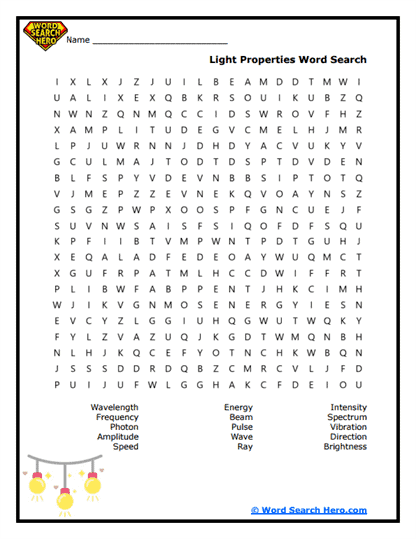
About Our Light and Optics Word Searches
Light and Optics word searches introduce students to the vocabulary used to study how light behaves and interacts with objects. These printable puzzles help learners become familiar with scientific terms related to reflection, refraction, lenses, and the ways light allows us to see the world. Before students explore optical systems and the science of light in depth, it often helps to first recognize the language scientists use to describe these phenomena.
Students studying light and optics may encounter words such as light, reflection, refraction, lens, mirror, prism, and spectrum. These terms frequently appear in physics and general science lessons and help students understand how light travels, bends, and interacts with different materials. A word search provides an engaging way to reinforce this vocabulary while strengthening reading, spelling, and observation skills.
Because the activity feels like a puzzle rather than a traditional worksheet, it can make scientific vocabulary easier and more engaging to learn. Teachers often use these printables during science centers, independent practice, review sessions, or early finisher activities. Parents and homeschool educators can also include them in lessons as a way to introduce optics vocabulary in an interactive format.
As students search for the words in the puzzle grid, they strengthen concentration, visual scanning, and pattern recognition skills. At the same time, they build familiarity with the scientific language used to describe how light behaves.
Understanding Light and Optics
Light is a form of energy that travels in waves and allows us to see objects around us. Optics is the branch of physics that studies how light behaves, including how it travels, reflects off surfaces, and bends when it passes through different materials.
When light strikes a mirror or smooth surface, it reflects, meaning it bounces back. When light passes through materials such as glass or water, it can bend, a process known as refraction. These behaviors explain why lenses in glasses, microscopes, and cameras can focus light to create clear images.
Prisms and other optical tools can also separate light into different colors, creating a visible spectrum. Scientists study these properties to understand how light interacts with matter and how optical devices work.
Learning the vocabulary associated with light and optics helps students understand how light travels and how it allows humans to observe the world.
Word searches reinforce this learning by giving students repeated exposure to the key terms used when studying light and optical systems.
Paul’s Pro-Tip
A powerful extension activity is a “light path investigation.” After students complete the word search, give them a flashlight and several reflective or transparent objects such as mirrors, glass cups, or plastic containers.
Students can shine the light and observe how it reflects off mirrors or changes direction when passing through clear materials. Encourage them to describe what they see using vocabulary from the puzzle, such as reflection, lens, or refraction.
This activity adds strong instructional value because it allows students to directly observe how light behaves. Teachers and homeschool educators can guide students to sketch the path of the light and explain how different materials influence its movement.
Helping Students Understand How We See
Light and optics are central to understanding vision, imaging technology, and many modern scientific tools. Optical principles are used in devices such as cameras, microscopes, telescopes, and eyeglasses.
Understanding optics vocabulary helps students interpret diagrams of light rays, scientific experiments, and discussions about how images are formed. These ideas also connect to broader topics such as energy, electromagnetic waves, and modern technology.
A word search can serve as an introduction to a lesson about light behavior or as a review after students have studied optical systems in class. After completing the puzzle, educators can encourage students to connect the vocabulary with real-world examples such as mirrors, lenses, or rainbows.
When students become familiar with light and optics vocabulary, they gain the language and understanding needed to explore how light travels and how optical systems help us observe and understand the world around us.
Frequently Asked Questions
What is optics?
Optics is the branch of physics that studies how light behaves and interacts with materials.
What is reflection?
Reflection occurs when light bounces off a surface, such as a mirror.
What is refraction?
Refraction is the bending of light as it passes from one material into another, such as from air into water.
What is a lens?
A lens is a transparent object that bends light to focus or spread out light rays.
What classroom activity pairs well with this puzzle?
Students can use a flashlight and mirrors or clear materials to observe how light reflects and bends when it encounters different surfaces.