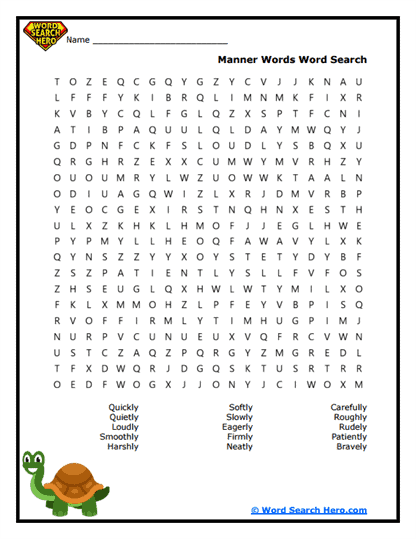
About Our -ly Suffix Word Searches
The -ly suffix is one of the most common word endings students encounter in English. It frequently turns adjectives into adverbs that describe how something happens. Words like quickly, happily, slowly, and carefully help add detail to sentences and make writing more descriptive. Our -ly Suffix Word Searches give students a fun way to explore these words while strengthening vocabulary and reading skills.
These printable puzzles introduce learners to a variety of words that end with -ly. Instead of simply memorizing grammar rules, students interact with the words by searching for them in puzzle grids. This discovery-based activity helps learners become more familiar with adverbs and how they appear in everyday language.
Teachers often use these puzzles during lessons about adverbs or descriptive writing. They also work well as literacy center activities, morning work, or early finisher tasks that keep students engaged while reinforcing language concepts.
Parents and homeschool educators enjoy using word searches because they blend learning with play. Many children approach puzzles with enthusiasm, which makes practicing vocabulary feel less like traditional schoolwork and more like a challenge.
Another benefit is the development of focus and pattern recognition. As students scan rows, columns, and diagonals looking for -ly words, they strengthen visual tracking and careful reading skills.
Our -ly Suffix Word Searches make exploring adverbs enjoyable while helping learners recognize how word endings can add clarity and detail to communication.
Discovering Words That Describe How Things Happen
The -ly suffix is commonly used to form adverbs-words that describe how an action takes place. For example, the adjective quick becomes quickly, and happy becomes happily. Understanding this pattern helps students recognize how small changes to a word can alter its meaning.
Word search puzzles introduce this concept in a relaxed way. As students search for words like softly, loudly, carefully, and brightly, they begin noticing how frequently this ending appears in descriptive language.
Teachers can extend the puzzle activity by asking students to identify the base word within each example. For instance, slowly comes from slow, and neatly comes from neat. Recognizing the connection between the base word and the -ly ending helps learners understand how adverbs are formed.
Another engaging follow-up activity is to have students use the words in short sentences. A student might write, “The turtle moved slowly,” or “She answered the question correctly.” This reinforces both meaning and usage.
Students can also brainstorm additional examples of -ly words they already know. This activity helps learners realize how many descriptive adverbs they use in everyday conversation.
By discovering these patterns through puzzles and practice, students build stronger vocabulary awareness and gain confidence using descriptive language.
Paul’s Pro-Tip
Word searches with -ly endings are a great opportunity to help learners think about how actions happen.
After students finish the puzzle, try asking them to turn a few of the words into short sentences. For example, they might say, “The puppy ran quickly,” or “The student answered carefully.”
You can also challenge learners to act out an action in two different ways-maybe walking slowly and then walking quickly. This helps them see how adverbs change the way an action is described.
When students connect the word ending to how something happens, the idea of adverbs becomes much clearer.
Why Adverbs Matter for Clear Communication
Adverbs play an important role in making language more detailed and expressive. Words that end in -ly often describe how, when, or to what extent an action happens. Without these words, many sentences would feel incomplete or less descriptive.
For example, consider the difference between “The athlete ran” and “The athlete ran quickly.” The second sentence gives the reader a clearer picture of what happened.
Teachers can reinforce this idea by encouraging students to look for -ly words during reading time. Learners might highlight adverbs they find in a short story or informational passage. This helps them recognize how these words add detail to sentences.
Writing activities also benefit from understanding this suffix. Students who recognize -ly words often begin using more descriptive language when writing stories, reports, or journal entries.
Families can support this learning at home by encouraging children to describe actions in more detail. Instead of saying someone walked, a child might say they walked slowly or carefully.
Word search puzzles introduce the pattern in a fun way, but the real benefit appears when students begin recognizing and using -ly words naturally in their reading and writing.
Frequently Asked Questions
Why are -ly suffix word searches helpful when learning adverbs?
These puzzles help students recognize common adverbs and understand how the -ly ending often changes an adjective into a word that describes how an action happens.
What kinds of words usually appear in -ly suffix word searches?
You’ll often see words like quickly, slowly, happily, loudly, and carefully. These examples highlight how adverbs add detail to actions.
Can these puzzles support descriptive writing lessons?
Yes. Teachers often use them to introduce or reinforce adverbs before students begin writing descriptive sentences or stories.
Are -ly word searches appropriate for younger learners?
They can be especially helpful for elementary students because many -ly words appear in everyday conversation and reading materials.
What is a good follow-up activity after finishing the puzzle?
Students can choose several -ly words from the puzzle and write sentences showing how an action happens, helping reinforce the meaning of each word.