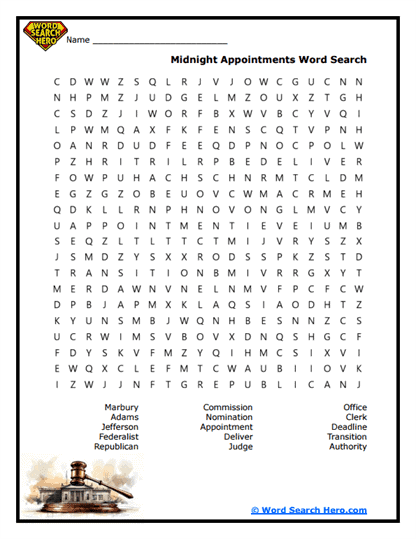
About Our Marbury v. Madison Word Searches
Marbury v. Madison was a landmark Supreme Court case decided in 1803 that established the principle of judicial review in the United States. Judicial review allows the Supreme Court to determine whether laws are consistent with the Constitution. Our Marbury v. Madison Word Searches help students explore vocabulary connected to this important court decision while strengthening reading and recognition skills.
These printable puzzles introduce learners to key civics and legal terms such as constitution, court, justice, law, and review. Instead of simply reading about these ideas in textbooks, students actively search for the words hidden inside puzzle grids. This hands-on activity reinforces important social studies vocabulary while making lessons more engaging.
Teachers often use these puzzles during units on U.S. government, Supreme Court cases, or constitutional law. They work well as classroom warm-ups, literacy center activities, review exercises, or early finisher tasks. Because they are easy to print and simple for students to complete independently, they fit smoothly into many classroom routines.
Parents and homeschool educators also appreciate how word searches make complex government topics easier to explore. Puzzles can spark curiosity about how the Supreme Court works and how court decisions can influence laws in the United States.
Another benefit is the development of concentration and visual scanning skills. As students search rows, columns, and diagonals to locate words, they strengthen focus while becoming more familiar with vocabulary connected to the legal system and constitutional government.
Our Marbury v. Madison Word Searches turn key legal and constitutional terms into an engaging puzzle activity that encourages learners to explore one of the most important Supreme Court decisions in American history.
Exploring the Marbury v. Madison Case
The Marbury v. Madison case involved a dispute about a government appointment that had not been delivered before a new president took office. When the issue reached the Supreme Court, the justices made a decision that had lasting effects on the American legal system.
Word search puzzles help students become familiar with vocabulary connected to this historic case. As learners search for words like court, constitution, justice, review, and law, they begin recognizing terms that frequently appear in lessons about Marbury v. Madison.
Teachers can extend the puzzle activity by connecting vocabulary words to the role of the Supreme Court. For example, the word review may lead to discussions about how courts examine laws to determine whether they follow the Constitution.
Another engaging activity is to group puzzle words into categories such as government branches, legal terms, or constitutional ideas. Sorting vocabulary this way helps students understand how different parts of the government interact.
Students can also choose several puzzle words and write short explanations about them. For example, they might describe what the Supreme Court does or explain what judicial review means.
Through puzzles and discussion, learners begin to see how court decisions can shape the interpretation of the Constitution.
Paul’s Pro-Tip
After students complete a Marbury v. Madison word search, ask them to choose one word that seems most connected to the role of courts.
Maybe it’s constitution, law, or review. Ask learners what they think that word tells us about how courts help interpret the law.
For example, the word review can lead to conversations about how judges carefully examine laws and government actions to ensure they follow the Constitution.
Sometimes one vocabulary word from the puzzle can help students better understand the responsibilities of the judicial branch.
Understanding the Importance of Marbury v. Madison
Marbury v. Madison established the idea that the Supreme Court has the authority to review laws and determine whether they are constitutional. This principle, known as judicial review, became a key part of the American system of checks and balances.
Word search puzzles help introduce vocabulary connected to these important civic concepts. Words such as constitution, court, justice, and law highlight the themes often discussed when studying this landmark case.
Teachers can use the puzzle as a starting point for discussions about how the three branches of government balance each other’s powers.
Reading assignments also benefit from this vocabulary exposure. When students recognize words like constitution or justice in a passage, they often understand the legal context more easily.
Families can extend learning at home by discussing how courts today continue to interpret laws and constitutional rights.
Word search puzzles provide a simple introduction to vocabulary connected to Marbury v. Madison, but they often inspire deeper curiosity about how Supreme Court decisions influence American government.
Frequently Asked Questions
What types of words appear in Marbury v. Madison word search puzzles?
These puzzles often include vocabulary such as constitution, court, justice, law, review, and judicial, which relate to the Marbury v. Madison case and the Supreme Court.
Are Marbury v. Madison word searches useful during civics or government lessons?
Yes. Teachers often use them as vocabulary warm-ups, review activities, or literacy center tasks during units on the Supreme Court and constitutional law.
Do these puzzles include topics like judicial review and the Supreme Court?
Many puzzles include words related to the judicial branch, legal decisions, and constitutional interpretation.
Can these puzzles help students remember government vocabulary?
Repeated exposure to key terms helps students recognize and recall important vocabulary when studying Supreme Court cases and the U.S. Constitution.
What is a good follow-up activity after completing the puzzle?
Students can choose one word from the puzzle and research a quick fact about it, such as what judicial review means or how the Supreme Court decides whether a law follows the Constitution.