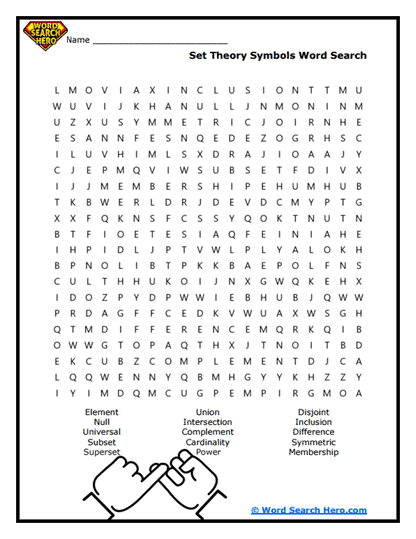
About Our Math Symbols Word Searches
Math Symbols word searches help students become more familiar with the symbols used to represent operations, relationships, and comparisons in mathematics. These printable puzzles introduce and reinforce terms connected to common math symbols and the vocabulary used to describe them. Before students begin interpreting complex equations or expressions, it often helps to first recognize the language associated with these symbols.
Students encounter math symbols throughout their learning, beginning with basic operations and continuing through algebra and beyond. Symbols representing addition, subtraction, multiplication, division, equality, and comparison appear frequently in lessons and problem-solving activities. Words like plus, minus, equal, greater than, less than, product, and difference help students interpret these symbols and understand the meaning behind them.
A word search offers a simple and engaging way to build familiarity with this vocabulary. Instead of focusing only on solving problems, students spend time recognizing and recalling the terms that explain what math symbols represent. This foundation can make it easier for them to interpret instructions and follow mathematical reasoning during lessons.
Teachers often use these printables as warm-ups, review pages, early finisher work, or math center activities during units focused on operations and algebra readiness. Parents and homeschool educators can also include them easily in lessons as a way to reinforce important mathematical language while keeping learning interactive and enjoyable.
As students search for the words in the puzzle grid, they strengthen concentration, visual scanning skills, and pattern recognition. At the same time, they are building the vocabulary foundation that helps them read and interpret mathematical notation more confidently.
Understanding the Meaning Behind Math Symbols
Math symbols act as a shorthand language that allows mathematicians to express ideas clearly and efficiently. Instead of writing long explanations, symbols communicate operations and relationships between numbers in a compact and universal format.
For students, learning the meaning behind these symbols is an important step in developing mathematical literacy. When students recognize words such as sum, difference, product, and quotient, they can more easily interpret instructions and understand how numbers interact within an equation or expression.
Recognizing comparison words like greater than, less than, and equal also helps students interpret relationships between numbers. These terms appear frequently in problem statements, inequalities, and data comparisons.
Word searches support this learning by giving students repeated exposure to the vocabulary associated with math symbols. As students locate each word in the puzzle, they become more comfortable recognizing and remembering the language used when describing mathematical notation.
Paul’s Pro-Tip
A highly effective way to extend this puzzle is to follow it with a “symbol translation” activity. After students complete the word search, give them a short list of math symbols and ask them to write the word that describes each one.
Next, have students create a simple number sentence using that symbol and explain what the symbol means in the context of the problem.
This activity adds strong instructional value because it connects vocabulary recognition with mathematical communication. For teachers and homeschool educators, it also provides a quick formative check. If students can match symbols to their meanings and use them correctly in examples, it shows they are beginning to understand how math notation communicates relationships between numbers.
Helping Students Read Mathematical Language
Math symbols are used in nearly every area of mathematics. Whether students are solving arithmetic problems, working with algebraic expressions, or interpreting data, symbols help organize and communicate mathematical ideas efficiently.
When students understand the vocabulary connected to these symbols, they are better able to read equations, interpret instructions, and explain their reasoning. Instead of seeing unfamiliar marks on a page, they begin to recognize a structured system that represents operations and relationships.
A word search can serve as a helpful starting point for building this familiarity. After completing the puzzle, educators can encourage students to look for math symbols in their textbooks or worksheets and explain what each one represents.
Even a brief discussion about how symbols communicate mathematical ideas can help students feel more confident when approaching equations and expressions.
When students become comfortable with the language of math symbols, they are better prepared to interpret notation, understand operations, and communicate their mathematical thinking clearly.
Frequently Asked Questions
When are math symbols word searches most useful?
They are especially helpful during lessons on basic operations, comparisons, and early algebra where students encounter a variety of mathematical symbols.
What grade levels benefit most from these puzzles?
They work well for upper elementary and middle school students who are learning to interpret and use mathematical notation.
Can homeschool educators include these puzzles in lessons?
Yes. They are easy to print and pair well with symbol-matching activities, example problems, and discussions about math operations.
Do word searches help students learn math symbols?
They can. Repeated exposure to the vocabulary associated with symbols helps students recognize and understand mathematical notation more easily.
What is a good follow-up activity after completing the puzzle?
A helpful next step is asking students to match common math symbols with their corresponding vocabulary words and create simple number sentences that demonstrate how each symbol is used.