Choose a topic !

Mixed Numbers Word Searches

Mixed Number Basics Word Search

Mixed Number Basics

The “Mixed Number Basics” introduces vocabulary focused on understanding and working with mixed numbers. Students search for terms like “whole,” “fraction,” “numerator,” and “denominator,” which are essential when learning about parts of a whole and how numbers combine. The vocabulary reflects both parts of mixed numbers and how they relate to mathematical operations. It supports […]

View More
Improper Fractions Word Search

Improper Fractions

The “Improper Fractions” focuses on understanding and identifying vocabulary associated with improper fractions. Key terms such as “excess,” “greater than one,” “divide,” and “numerator” help students distinguish improper fractions from proper ones. It reinforces the concept of fractions whose numerator is larger than the denominator. The vocabulary also includes terms that relate to comparing and […]

View More
Converting Fractions Word Search

Converting Fractions

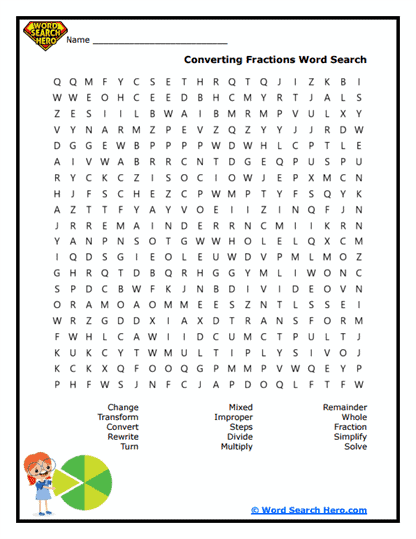
“Converting Fractions” dives into vocabulary needed for transforming fractions into other forms, such as mixed numbers or simplified expressions. It includes terms like “rewrite,” “convert,” “simplify,” and “remainder,” reflecting the various steps in converting one type of fraction to another. This worksheet covers both process and outcome vocabulary used in fraction manipulation. Completing this puzzle […]

View More
Addition Process Word Search

Addition Process

The “Addition Process” emphasizes the vocabulary used when teaching and discussing addition. It includes words like “sum,” “total,” “combine,” and “carry,” which are commonly used during problem-solving and mental math. The terms also reflect strategies and actions involved in the addition process. This word search sharpens language and number skills by reinforcing addition-specific vocabulary. It […]

View More
Subtraction Process Word Search

Subtraction Process

The “Subtraction Process” contains vocabulary related to subtraction concepts and operations. Words such as “takeaway,” “difference,” “remain,” and “decompose” help students understand not only how subtraction works but also how to describe it in multiple ways. This vocabulary encourages flexible thinking around removing and comparing amounts. This activity strengthens comprehension of subtraction by helping students […]

View More
Multiplying Mixed Word Search

Multiplying Mixed

“Multiplying Mixed” presents terms essential to learning multiplication, especially involving mixed numbers and repeated groups. It features words like “factor,” “triple,” and “step-by-step,” which point to both numerical relationships and procedural strategies. The vocabulary bridges conceptual understanding and operational fluency. This search puzzle promotes the recognition and usage of multiplication vocabulary, helping students describe and […]

View More
Dividing Mixed Word Search

Dividing Mixed

The “Dividing Mixed” introduces vocabulary necessary for mastering division, particularly with fractions and mixed numbers. Words like “quotient,” “reciprocal,” “remainder,” and “portion” reflect the division process, including important concepts like flipping fractions and regrouping. It guides students through both the conceptual and procedural aspects of division. Students grow their mathematical language by working with words […]

View More
Visual Models Word Search

Visual Models

The “Visual Models” highlights vocabulary related to visual representations in math, including charts, diagrams, and number lines. Words like “circle,” “block,” “bar,” and “model” are used to describe how information is shown pictorially. This vocabulary helps students connect abstract numbers to tangible images. This worksheet strengthens students’ ability to describe and interpret visual data. It […]

View More
Real-world Problems Word Search

Real-world Problems

The “Real-world Problems” contains vocabulary connecting math to daily life activities, such as cooking, shopping, and gardening. Words like “recipe,” “distance,” “money,” and “planning” show how math is applied in real-world scenarios. This reinforces the relevance of learning math outside of school. Students improve both math and language skills by working with terms that apply […]

View More
Estimation Skills Word Search

Estimation Skills

The “Estimation Skills” focuses on the language of approximating and evaluating numbers. Words like “roughly,” “about,” “evaluate,” and “sense” help students learn how to make smart guesses and check reasonableness. The vocabulary supports skills used in mental math and problem estimation. This worksheet strengthens critical thinking by encouraging students to recognize and understand estimation-related terms. […]

View More

About Our Mixed Numbers Word Searches

If you’ve ever tried to teach someone what a mixed number is while simultaneously convincing them math can be fun, you know the look: that combination of polite skepticism, eyebrow acrobatics, and a quiet mental escape to a place with fewer denominators. Enter this lovingly crafted collection of Mixed Numbers Word Searches-not as a gimmick, but as a genuine pedagogical power-up. These printable gems don’t just hide vocabulary; they spark recognition, clarity, and curiosity in students who might otherwise meet the term “improper fraction” with nothing but dread and a vacant stare. Instead of lecturing through definitions or slogging through textbook drills, these puzzles invite learners to play with the very language of math.

This collection isn’t a sideshow to the main lesson-it is the lesson, cleverly disguised in a grid of letters. Each word search plants seeds of fluency in math vocabulary, reinforcing concepts like “remainder,” “estimate,” or the ever-misunderstood “reciprocal” in a way that sticks. Whether your students are kinesthetic thinkers, visual learners, or just tired of hearing you say “remember what a numerator is,” these puzzles offer a refreshing detour that leads straight back to comprehension. They’re not just about finding words; they’re about making sense of math-piece by piece, word by word, and sometimes fraction by fraction.

We’ve grouped the puzzles across key subtopics that scaffold understanding and connect big-picture concepts in mathematics. Starting with foundational terminology, moving into operations and conversions, then branching out into real-world application and critical thinking, this isn’t just a worksheet packet-it’s a full tour through the mind of a mixed number. Think of it as the Airbnb Experience of the fraction world: deeply local, unexpectedly fun, and full of snacks if you’re a teacher who brings them.

Let’s talk groupings. First, we begin with The Vocabulary Cornerstones: “Mixed Number Basics,” “Improper Fractions,” and “Converting Fractions.” These are your go-to guides for understanding what mixed numbers even are, how they relate to improper fractions (those famously top-heavy rebels), and how to glide between them with the elegance of a math magician. Students confront terms like “numerator,” “convert,” and “rewrite,” reinforcing key differences while gaining the language tools to express what’s happening mathematically. It’s in these puzzles that learners start seeing numbers not just as symbols, but as relationships-between wholes and parts, between forms and functions.

Next, we dive into Operational Fluency, with “Addition Process,” “Subtraction Process,” “Multiplying Mixed,” and “Dividing Mixed.” This quartet of puzzles zeroes in on how mixed numbers behave when asked to play nicely with the basic operations-and yes, sometimes they throw tantrums, especially when you forget to carry, borrow, or flip the second fraction. These puzzles lean into the process language: “carry,” “group,” “expand,” “reciprocal,” and “step-by-step” walk students through not just what to do, but how to talk about doing it. As students scan for terms, they’re also reinforcing procedural memory, slowly absorbing how math sequences unfold like tiny logic stories.

Then we shift from crunching numbers to seeing them differently with Visual Models.” This puzzle is the creative lens of the bunch, where words like “block,” “diagram,” and “shaded” draw attention to the ways we visualize math. It’s a vocabulary gallery that reminds students math isn’t just numbers in columns-it’s pies, bars, and number lines, too. For learners who need more than symbols to grasp a concept, this is where the clouds part. Math becomes less abstract, more tangible. It’s where mixed numbers show up as something you can picture, point to, or shade in.

We end with a double dose of math in the wild: Real-world Problems and Estimation Skills.” These puzzles fling open the classroom door and let math roam free in grocery stores, kitchens, and gardens. “Distance,” “money,” “planning,” and “cutting” turn up in word form, reminding students that mixed numbers aren’t just test fodder-they’re recipe measurements, travel estimates, and DIY projects waiting to be built. With “Estimation Skills,” we take a delightful pivot from precision to practicality. Words like “roughly” and “sense” get their due, teaching that sometimes, “close enough” is more than just acceptable-it’s a skill. These final puzzles bring it all together: vocabulary, application, number sense, and confidence.

What Are Mixed Numbers?

So what exactly is a mixed number? Besides being a term that sounds like it missed its audition for a smoothie shop name, a mixed number is the charming mathematical blend of a whole number and a proper fraction. For example, 2 ยฝ means you have two whole units and one-half of another. It’s like saying you have two cookies and then sneak half of someone else’s cookie when they’re not looking-delicious and educational.

The rules surrounding mixed numbers aren’t particularly scary once you get familiar with them. They’re simply expressions that include a whole number plus a fraction less than one. You’ll often convert between mixed numbers and improper fractions-those are the ones where the numerator (the top number) is bigger than the denominator. Why would we do this? Because arithmetic likes consistency, and math operations like multiplication and division are easier when everything’s in fraction form. So before multiplying 2 ยฝ by 4, we often rewrite it as 5/2 ร— 4 and go from there. Think of it as the mathematical version of putting everyone into the same outfit before they enter the room-neater, more manageable, and no arguments about who wears the denominator better.

One real-life analogy: say you’re baking and the recipe calls for 1 ยพ cups of flour. That’s a mixed number. If you only have a ยผ cup scoop, you’ll need to convert that into a total number of ยผ cups, which is 7/4. (One cup = 4/4, plus ยพ more = 7/4). That way, you can just scoop seven times and get on with your banana muffins. This is exactly why understanding mixed numbers is not just academic-it’s life-saving. Okay, maybe not “saving,” but definitely “banana bread-preserving.”

Common mistakes? Learners often forget to convert before operating, or misplace the whole number when changing an improper fraction back into mixed form. (Pro tip: 11/4 is not “11 and 4,” no matter how earnestly a student writes it.) Another frequent hiccup comes from forgetting that mixed numbers are actually two separate parts. Students might multiply the whole number and the fraction separately instead of converting the whole thing first. That’s where puzzles like “Multiplying Mixed” earn their keep, reinforcing correct strategies with terms like “step-by-step” and “groups.”

Want to practice? Try converting 3 โ…– into an improper fraction. Multiply 3 by 5 (the denominator) = 15, then add the numerator (2), and you get 17/5. Flip it back? Divide 17 by 5: the quotient is 3 with 2 leftover, so back to 3 โ…–. There you go-instant math party trick.

And for context, mixed numbers build beautifully on previous concepts: understanding place value, mastering basic fractions, and knowing how to add and subtract whole numbers. They’re the natural evolution of number sense, like fractions with ambition.