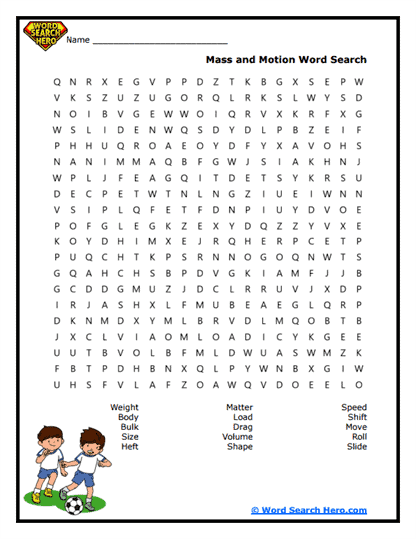
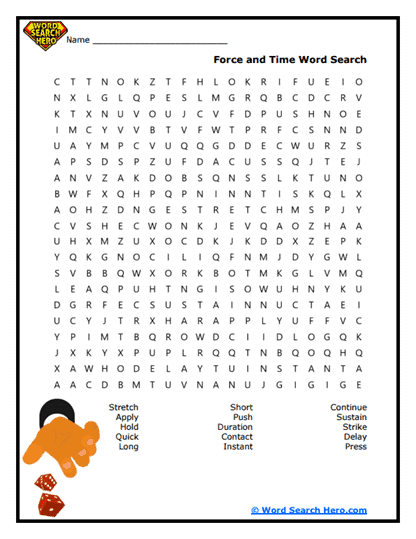
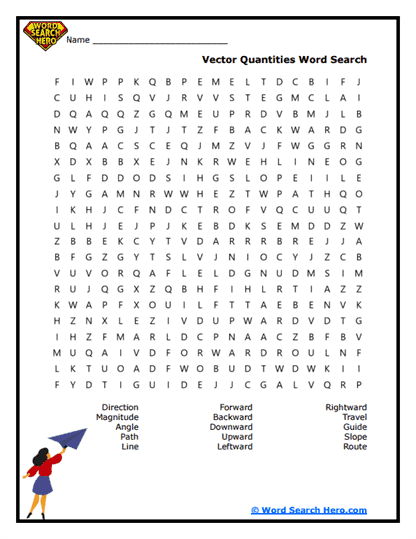
About Our Momentum and Impulse Word Searches
Momentum and Impulse word searches introduce students to the vocabulary used to describe how objects move and how forces can change that motion. These printable puzzles help learners become familiar with scientific terms related to motion, collisions, forces, and changes in movement. Before students explore these physics concepts in depth, it often helps to first recognize the language scientists use to explain how objects interact and transfer motion.
Students studying momentum and impulse may encounter words such as momentum, impulse, collision, force, mass, velocity, and motion. These terms frequently appear in physics lessons and help students understand how moving objects behave and how forces can increase, decrease, or redirect motion. A word search provides an engaging way to reinforce this vocabulary while strengthening reading, spelling, and observation skills.
Because the activity feels like a puzzle rather than a traditional worksheet, it can make physics vocabulary easier and more engaging to learn. Teachers often use these printables during science centers, independent practice, review sessions, or early finisher activities. Parents and homeschool educators can also include them in lessons as a way to introduce momentum and impulse vocabulary in an interactive format.
As students search for the words in the puzzle grid, they strengthen concentration, visual scanning, and pattern recognition skills. At the same time, they build familiarity with the scientific language used to describe motion and force interactions.
Understanding Momentum and Impulse
Momentum describes the motion of an object and depends on both its mass and how fast it is moving. Objects with greater mass or higher speed have greater momentum. For example, a moving truck carries more momentum than a rolling ball because of its larger mass.
Impulse describes how a force acting over a period of time changes the motion of an object. When a force is applied for longer or with greater strength, the change in motion becomes larger.
Momentum and impulse are closely connected in physics. When an object experiences a force during a collision or impact, the impulse applied to the object changes its momentum.
Scientists study these concepts to understand how objects move during collisions, how safety systems reduce injuries, and how forces influence motion in mechanical systems.
Learning the vocabulary associated with momentum and impulse helps students understand how motion changes when forces act on moving objects.
Word searches reinforce this learning by giving students repeated exposure to the key terms used when studying collisions and motion changes.
Paul’s Pro-Tip
A powerful extension activity is a “collision investigation.” After students complete the word search, have them gently roll two objects such as toy cars or marbles toward each other and observe what happens when they collide.
Students can experiment by changing the speed or the size of the objects and observing how the collision changes. Encourage them to describe their observations using vocabulary from the puzzle, including momentum, force, and collision.
This activity adds strong instructional value because it allows students to see how motion changes when objects interact. Teachers and homeschool educators can guide students in discussing how larger or faster objects create greater changes in motion during impacts.
Helping Students Understand Motion and Collisions
Momentum and impulse are important ideas in physics because they help explain how motion changes when forces act on objects. These concepts are used to study car crashes, sports impacts, engineering designs, and many everyday situations involving movement.
Understanding momentum and impulse vocabulary helps students interpret physics experiments, motion diagrams, and classroom discussions about collisions and safety systems. These ideas also connect to broader topics such as forces, energy transfer, and engineering design.
A word search can serve as an introduction to a lesson about motion and collisions or as a review after students have studied force and motion in class. After completing the puzzle, educators can encourage students to connect the vocabulary with real-world examples such as sports, vehicle safety features, or moving machinery.
When students become familiar with momentum and impulse vocabulary, they gain the language and understanding needed to explore how forces change motion and how moving objects interact in the physical world.
Frequently Asked Questions
What is momentum?
Momentum is the motion of an object and depends on both its mass and how fast it is moving.
What is impulse?
Impulse is the effect of a force acting over time that changes an object’s motion.
How are momentum and impulse related?
Impulse causes a change in momentum when a force acts on a moving object.
Where do we see momentum in everyday life?
Momentum can be observed in moving vehicles, sports activities, and objects that collide or bounce.
What classroom activity pairs well with this puzzle?
Students can roll toy cars or marbles toward each other to observe how collisions change the motion of objects.