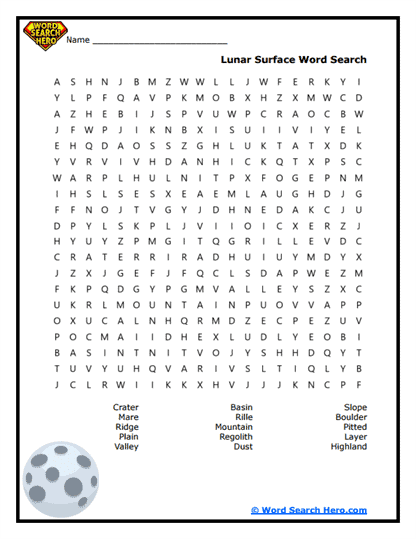
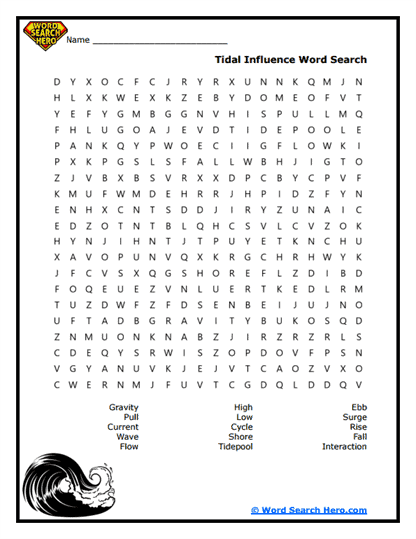
About Our Moons Word Searches
Moons word searches introduce students to the vocabulary used to study the natural satellites that orbit planets throughout our solar system. These printable puzzles help learners become familiar with scientific terms related to lunar features, planetary systems, and the many different moons discovered around planets and dwarf planets. Before students explore planetary science and orbital motion in depth, it often helps to first recognize the language scientists use to describe moons and their characteristics.
Students studying moons may encounter words such as moon, satellite, orbit, crater, surface, gravity, and tidal. These terms frequently appear in astronomy lessons and help students understand how moons move around planets and how their surfaces are shaped by impacts and geological activity. A word search provides an engaging way to reinforce this vocabulary while strengthening reading, spelling, and observation skills.
Because the activity feels like a puzzle rather than a traditional worksheet, it can make astronomy vocabulary easier and more engaging to learn. Teachers often use these printables during science centers, independent practice, review sessions, or early finisher activities. Parents and homeschool educators can also include them in lessons as a way to introduce planetary science vocabulary in an interactive format.
As students search for the words in the puzzle grid, they strengthen concentration, visual scanning, and pattern recognition skills. At the same time, they build familiarity with the terminology used when studying moons and planetary systems.
Understanding Moons
A moon is a natural satellite that orbits a planet or dwarf planet. Many planets in our solar system have multiple moons, each with its own unique features and environment.
Earth has one moon, often simply called the Moon, which influences ocean tides and helps stabilize the planet’s rotation. Other planets have much larger numbers of moons. For example, Jupiter and Saturn each have dozens of known moons, some of which are large enough to have their own atmospheres or underground oceans.
Moons can vary greatly in size, composition, and surface features. Some are covered in craters from impacts with space debris, while others show signs of volcanic activity, icy surfaces, or subsurface oceans.
Scientists study moons to better understand how planetary systems form and evolve. Some moons are considered promising locations for future space exploration because they may contain water or environments that could support certain forms of life.
Learning the vocabulary associated with moons helps students understand how natural satellites move within planetary systems and how they contribute to the dynamics of the solar system.
Word searches reinforce this learning by giving students repeated exposure to the key terms used when studying moons and planetary motion.
Paul’s Pro-Tip
A powerful extension activity is a “moon comparison chart.” After students complete the word search, have them research several moons in our solar system such as Earth’s Moon, Europa, Titan, and Ganymede.
Students can create a chart comparing the size, surface features, atmosphere, and interesting characteristics of each moon. Encourage them to include images and short descriptions explaining what makes each moon unique.
This activity helps students realize that moons are not all the same. Some are rocky, some are icy, and some may even contain oceans beneath their surfaces.
Helping Students Understand Planetary Systems
Moons play an important role in shaping planetary systems. Their gravitational interactions can influence tides, stabilize planetary motion, and reveal important clues about the history of the solar system.
Understanding moon-related vocabulary helps students interpret space images, astronomy diagrams, and discussions about planetary exploration. These ideas also connect to broader topics such as orbital motion, gravity, and planetary geology.
A word search can serve as an introduction to a lesson about natural satellites or as a review after students have studied the solar system in class. After completing the puzzle, educators can encourage students to explore images of famous moons and learn how scientists study these distant worlds.
When students become familiar with moon vocabulary, they gain the language and understanding needed to explore the diverse natural satellites that orbit planets across our solar system.
Frequently Asked Questions
What is a moon?
A moon is a natural satellite that orbits a planet or dwarf planet.
How many moons does Earth have?
Earth has one natural moon.
Do other planets have moons?
Yes. Many planets have multiple moons. Jupiter and Saturn each have dozens of known moons.
Why are moons important to study?
Moons help scientists understand planetary systems and may contain environments that reveal clues about the history of the solar system.
What classroom activity pairs well with this puzzle?
Students can research several moons in the solar system and create a comparison chart highlighting their sizes, surfaces, and unique features.