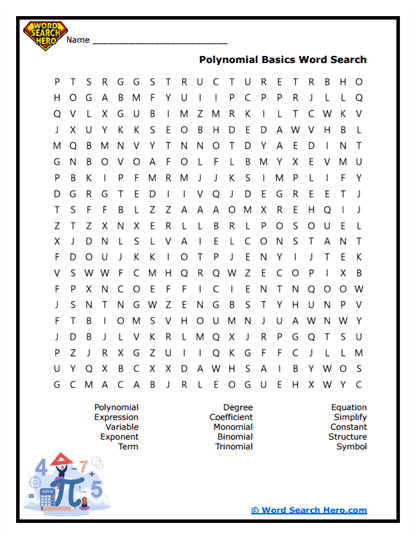
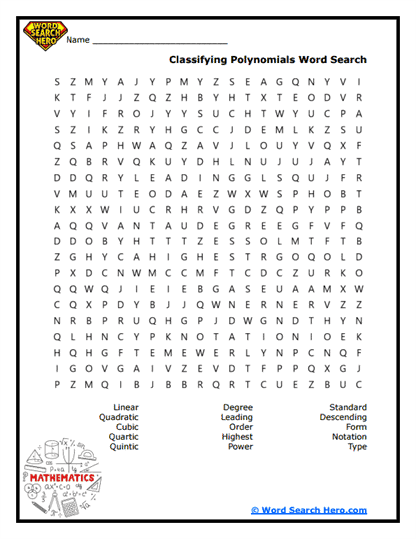
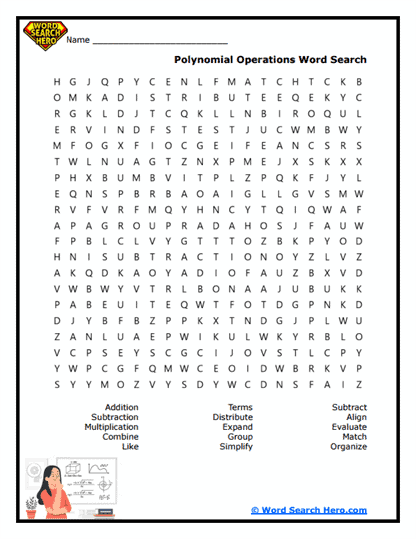
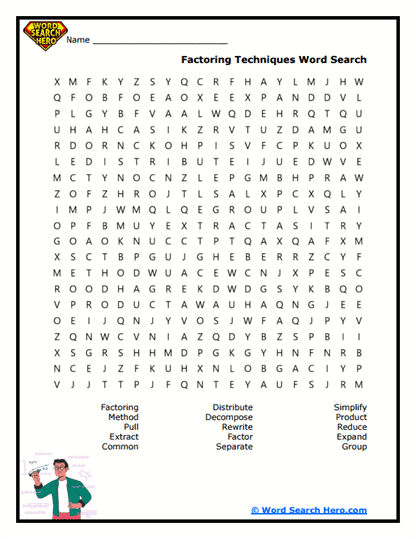
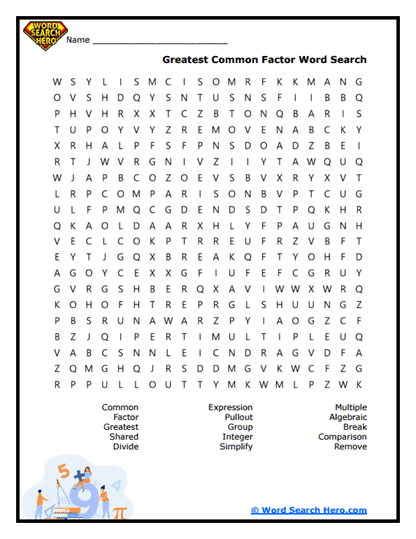
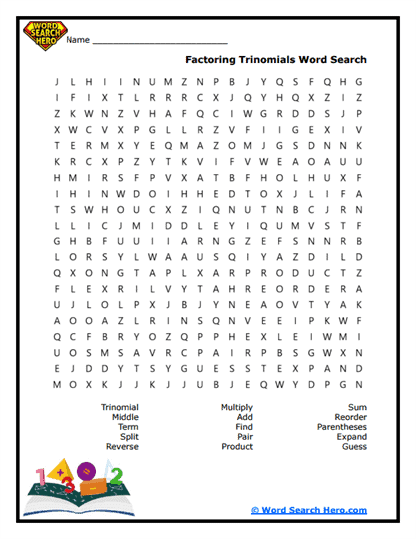
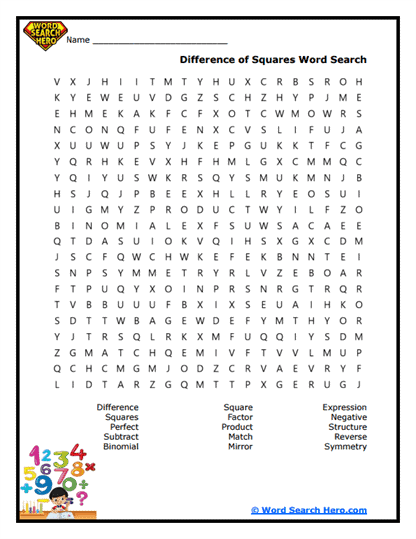
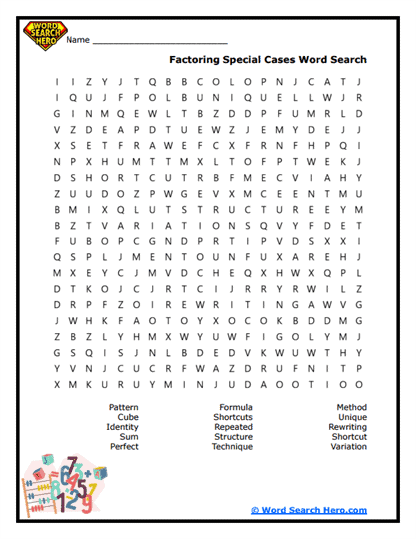
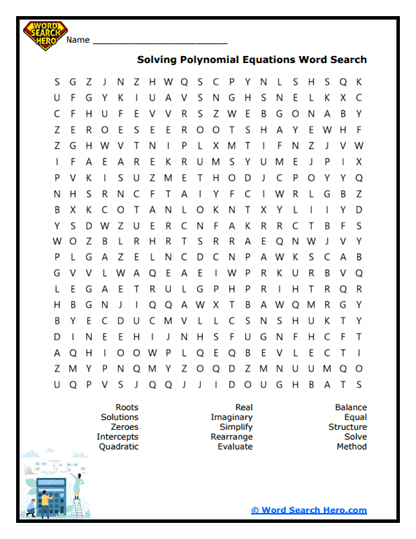
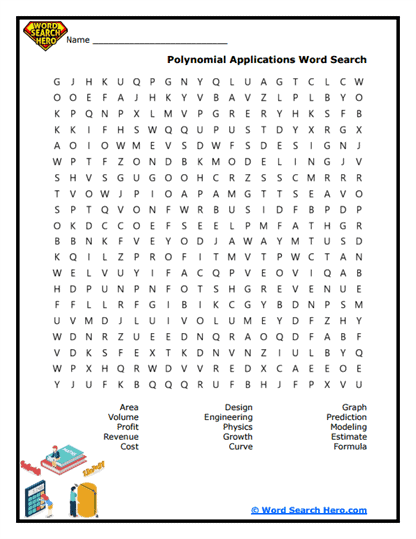
About Our Polynomials and Factoring Word Searches
Polynomials and Factoring word searches help students become familiar with the vocabulary used when working with algebraic expressions that contain multiple terms. These printable puzzles introduce and reinforce terms related to polynomials, factoring methods, variables, coefficients, and operations used to simplify or rewrite expressions. Before students begin factoring complex expressions, it often helps to first recognize the language used to describe the different parts and techniques.
Polynomials appear throughout algebra and higher-level mathematics. Students encounter terms like monomial, binomial, trinomial, coefficient, constant, factor, and product as they learn to break expressions apart and analyze how they are constructed. These words can feel overwhelming at first, especially when they appear alongside new procedures like factoring or expanding expressions.
Word searches offer a simple way to build familiarity with these terms. Because the activity feels like a puzzle rather than traditional math practice, students can engage with important vocabulary in a low-pressure format. Teachers often use these puzzles as warm-ups, review activities, early finisher work, or quiet practice during algebra units. Homeschool educators and parents can also use them to reinforce terminology while keeping lessons engaging.
While students search for the words, they also strengthen focus, visual scanning skills, and pattern recognition. At the same time, they are becoming more comfortable with the language that appears in algebra lessons and problem-solving steps.
Understanding the Structure of Polynomial Expressions
Polynomials are algebraic expressions made up of variables, constants, and coefficients combined using addition, subtraction, and multiplication. As students begin working with these expressions, they learn to identify different types of polynomials and explore ways to simplify or factor them.
One common pattern students learn involves recognizing special products. For example, a trinomial like the following can be factored into two binomials:
x2 + 5x + 6 = (x + 2) (x + 3)
Recognizing vocabulary such as factor, term, coefficient, and product helps students understand what is happening in each step of the factoring process. When students know the meaning of these words, instructions like “factor the trinomial” become much clearer.
Word searches give students repeated visual exposure to these important terms. As they locate each word in the puzzle grid, they become more comfortable with spelling and structure. This familiarity makes it easier to follow explanations and written instructions when they begin solving factoring problems.
Building this vocabulary foundation allows students to approach polynomial work with more confidence and less confusion.
Paul’s Pro-Tip
After students complete the word search, turn the vocabulary into a “build and break” activity to reinforce how polynomials actually work.
Choose several words from the puzzle-such as term, factor, coefficient, and product-and give students a simple expression like:
2x2 + 7x + 3
Ask students to identify each term, point out the coefficients, and then factor the expression if possible. Once they factor it, have them explain how the factors multiply to produce the original product.
This activity helps students see that algebra vocabulary is not just a list of definitions. Each word describes something students actively use while working with expressions. For teachers and homeschoolers, this quick follow-up also reveals whether students truly understand the structure of polynomial expressions or if they need additional clarification.
By connecting vocabulary directly to a mathematical example, students build stronger conceptual understanding alongside procedural skills.
Recognizing Patterns in Algebra
Factoring polynomials often depends on recognizing patterns within expressions. Students learn to identify structures like common factors, perfect square trinomials, and differences of squares. Once they recognize these patterns, factoring becomes much more efficient.
Understanding the vocabulary behind these patterns helps students communicate what they notice. Instead of saying “it looks like something we can break apart,” they can describe it as a difference of squares and explain how it factors.
A word search can be the first step in helping students recognize these patterns. After completing the puzzle, educators might choose a few vocabulary words and ask students to connect them to actual examples. This small discussion reinforces the idea that algebra vocabulary is closely tied to the structure of expressions.
When students become comfortable with the language of polynomials and factoring, they are better prepared to analyze expressions, recognize patterns, and solve more complex algebra problems.
Frequently Asked Questions
When are polynomials and factoring word searches most useful?
They work well before or during algebra units on polynomials, factoring, and simplifying expressions. Teachers often use them as vocabulary previews, warm-ups, or early finisher activities.
What grade levels are these puzzles designed for?
These puzzles are commonly used in middle school and high school algebra courses where students begin working with polynomials and factoring methods.
Can homeschool educators use these puzzles during math lessons?
Yes. They are easy to print and can be paired with simple factoring examples, vocabulary discussions, or notebook activities to reinforce understanding.
Do word searches help students learn algebra vocabulary?
They do. Repeated exposure to terms helps students recognize and remember important words, which makes it easier to follow instructions and understand explanations during algebra lessons.
What is a good follow-up activity after completing the puzzle?
A helpful next step is asking students to identify parts of a polynomial, factor a simple expression, or explain how a few vocabulary words apply to an example problem. This connects vocabulary recognition with real algebra practice.