Choose a topic !

Pre-Algebra Word Searches

Number Explorer Word Search

Number Explorer

This word search introduces foundational vocabulary used in basic number theory and numerical understanding. The terms include types of numbers such as integers, decimals, and fractions, as well as concepts like positive, negative, and place value. Students will become familiar with how numbers are categorized and used in various mathematical contexts. This search is ideal […]

View More
Operation Order Word Search

Operation Order

This worksheet centers on vocabulary related to the order of operations in math. It includes key terms from PEMDAS (Parentheses, Exponents, Multiply, Divide, Add, Subtract) as well as concepts like Evaluate, Sequence, and Expression. Students become familiar with the terms they need to understand and solve multi-step equations correctly. The word search provides an engaging […]

View More
Property Hunt Word Search

Property Hunt

This word search is all about the properties of numbers and mathematical operations. Words include various number properties (Associative, Commutative, Distributive), identity and inverse operations, as well as equality and reciprocity. It also includes broader algebraic concepts like Equation, Operation, and Result. These words help students understand how numbers behave under different conditions. Students enhance […]

View More
Algebra Starter Word Search

Algebra Starter

This worksheet features foundational vocabulary used in pre-algebra. Students encounter terms like Variable, Solve, Equal, Coefficient, Constant, and Simplify. It also includes verbs describing algebraic processes such as Substitute, Check, and Combine. The inclusion of Unknown and Term helps build awareness of algebra’s symbolic nature and structure. Solving this word search strengthens understanding of algebraic […]

View More
Expression Quest Word Search

Expression Quest

This worksheet explores the vocabulary associated with mathematical expressions and terms. Students search for words like Exponent, Power, Base, Multiply, Sum, and Product. It emphasizes how math expressions are structured and simplified. This search also includes terms like Symbol and Group, helping students connect visual and structural aspects of math expressions. Completing this activity deepens […]

View More
Ratio Radar Word Search

Ratio Radar

This search focuses on ratios, rates, and related measurement concepts. Vocabulary includes Ratio, Rate, Unit, Proportion, Convert, Time, Speed, and Percent. Students explore relationships between quantities and how they are measured or compared. It ties in both arithmetic and real-world math applications. The activity enhances math vocabulary comprehension in areas relevant to real-life problem solving, […]

View More
Decimal Detectives Word Search

Decimal Detectives

This word search introduces students to terms related to percents, decimals, and financial math. Key terms include Percent, Decimal, Fraction, Convert, and Tip. It also introduces financial terminology such as Tax, Discount, Estimate, and Dollar. This blend makes it perfect for real-world math application. This activity supports vocabulary growth around financial literacy and decimal operations. […]

View More
Inequality Insight Word Search

Inequality Insight

This worksheet dives into inequality terminology and graphing concepts. Words include Greater, Less, Equal, Compare, Inequality, and Symbol. Students also encounter graphing terms such as Boundary, Open, Closed, and Range. The vocabulary prepares students to solve and graph inequalities effectively. By working on this search, students develop a stronger understanding of comparative and symbolic math […]

View More
Graph Grid Word Search

Graph Grid

The vocabulary in this worksheet revolves around coordinate graphing. It includes foundational terms such as Axis, Plane, Quadrant, and Origin, as well as actions like Plot and Graph. Students also learn location-related words such as Ordered Pair, Table, and Grid. This vocabulary is essential for understanding graphs and coordinate planes. This word search enhances students’ […]

View More
Word Problem Lab Word Search

Word Problem Lab

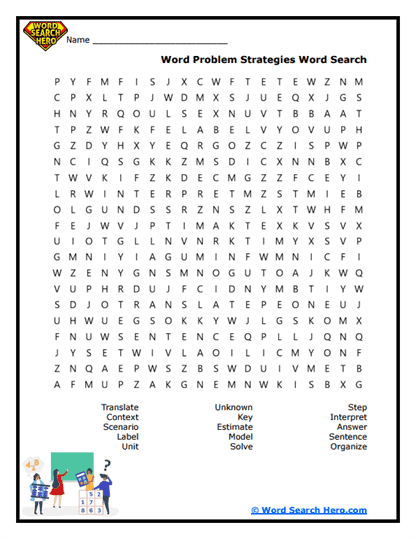
This word search focuses on strategies and vocabulary used to solve word problems. It includes verbs and nouns like Translate, Context, Scenario, Label, and Step. Students also explore terms such as Estimate, Answer, and Organize. These words help students break down and understand math problems more effectively. By engaging with this word search, students gain […]

View More

About Our Pre-Algebra Word Searches

Let’s be honest-Pre-Algebra gets a bit of a bad rap. It sits in that awkward phase of math education, like the prequel no one really watched before the blockbuster. It’s not arithmetic, it’s not “real” algebra, and unless you’re a very enthusiastic mathlete, it might sound like a pit stop on the way to the “good stuff.” But that’s where we come in with a twist: a collection of printable word searches that breathe life into those unsung math heroes-words. These aren’t just any puzzles. They’re carefully constructed vocabulary journeys that help students navigate the vast (and sometimes intimidating) land of Pre-Algebra with a highlighter in one hand and growing confidence in the other.

Each word search in this collection was designed not just to help students pass time or fill a worksheet, but to anchor vital math concepts into long-term memory. Think of them as mathematical maps disguised as games. As students scan the grids, they aren’t just finding words-they’re laying cognitive bricks for future success. The goal is to help them understand not just how to do math, but how to speak its language. Vocabulary in math isn’t decorative-it’s structural. And when kids begin to recognize and recall these terms with ease, they’re not just getting better at puzzles-they’re becoming fluent in the logic and problem-solving power of Pre-Algebra.

Of course, the real magic happens in the way we’ve grouped these word searches. As any good math teacher (or dungeon master) will tell you, organizing a quest is half the fun. So let’s walk through the levels of this vocabulary adventure by theme.

We begin our journey with the Foundations of Numbers. This includes “Number Explorer,” which walks students through the beautiful and sometimes weird taxonomy of numbers-integers, fractions, decimals, and that mystical unicorn of math, irrational numbers. Here, the goal is simple: make students comfortable in the jungle of numeric species. Decimal? Rational? Whole? They’re just names in a family reunion of values that all play by specific rules. This groundwork helps demystify what numbers are, how they behave, and where they fit into a larger numerical system. Think of it as giving students a passport to the math world-and this word search stamps every one.

Next, we leap into Mathematical Mechanics-the nuts and bolts of how numbers interact. “Operation Order” and “Property Hunt” are your go-to grids here. “Operation Order” arms students with the sacred code of PEMDAS, ensuring they know the difference between adding then multiplying and adding then weeping because they multiplied too late. It’s procedural literacy with flair. “Property Hunt” then invites them to a vocabulary safari of mathematical properties-commutative, associative, distributive, and their property pals. This search trains students to spot the structural integrity behind equations. These terms are more than trivia-they’re the physics of math. And understanding them means knowing how numbers behave under pressure (or parentheses).

Then comes Algebra Essentials, with “Algebra Starter” and “Expression Quest” taking center stage. If the earlier searches taught us what math is and how it behaves, these help us learn to speak its language fluently. “Algebra Starter” introduces key characters like Variable, Coefficient, and Constant. These are the actors in the algebraic drama, always shifting roles but never skipping rehearsal. “Expression Quest” gets even deeper, exploring the anatomy of expressions with words like Exponent, Base, Factor, and Quotient. Together, these two searches offer a visual and verbal tour through the building blocks of symbolic math, helping students not just solve problems but read and write math more fluently.

Following closely is our tour through Real-World Math and Measurement. Here, “Ratio Radar” and “Decimal Detectives” give students a solid grip on practical math that shows up in fast food menus, gas station signs, and Instagram analytics. “Ratio Radar” brings out key comparisons and proportions-Percent, Speed, Miles, Hour, and their unit-based friends. Meanwhile, “Decimal Detectives” ventures into financial literacy with terms like Tip, Tax, Discount, and Estimate. This is where math starts whispering, “Hey, I’m useful in the real world, too,” and students finally listen. Word searches in this category train students to decode everyday numerical language and link abstract values to tangible life choices. Will they finally understand how much 20% off really saves them? One can hope.

Then we drift into the realm of Comparison and Structure, where the math gets visual and directional. “Inequality Insight” teaches students the vocabulary of more than/less than and the importance of boundaries, both graphically and logically. Terms like Greater, Less, True, False, and Boundary help build the foundation for solving and graphing inequalities-because understanding that an open circle means “not quite” is surprisingly profound. Following this is “Graph Grid,” which explores coordinate planes with terms like Axis, Quadrant, and Ordered Pair. This isn’t just prep for plotting dots-it’s laying the foundation for data science, engineering, and anywhere else a graph might show up (which is everywhere, by the way).

We end of at the Problem-Solving Toolkit with “Word Problem Lab.” This one might just be the most important of the bunch. If math were a video game, word problems would be the boss level. They demand everything: vocabulary, comprehension, sequencing, and patience. This search gives students the language they need to break down problems into bite-sized clues-Estimate, Label, Interpret, Step, and Scenario. With this puzzle, we don’t just give kids tools. We show them how to build the toolbox.

What Is Pre-Algebra?

Pre-Algebra is the mathematical sweet spot where numbers start wearing costumes. Up until this point, most math problems look like, well, problems. You add, subtract, divide. You get answers. But Pre-Algebra introduces a new cast of characters-letters, symbols, parentheses, and mysterious expressions that look more like secret codes than math homework. At its core, Pre-Algebra is the bridge between arithmetic and algebra. It’s where students learn not just to compute, but to understand how numbers relate to each other in abstract, rule-based ways.

Imagine you’re baking cookies. Arithmetic is measuring out the flour and sugar. Pre-Algebra is realizing that if you triple the recipe, the sugar becomes 3x. That ‘x’? That’s a variable-a placeholder for a value you might not know yet. And with that one symbol, you’ve entered the land of algebra. Pre-Algebra teaches you the rules for handling that variable: how to isolate it, balance equations, and keep your math fair on both sides. You’ll learn to simplify expressions, combine like terms, and substitute known values like a master codebreaker.

A common mistake in Pre-Algebra is treating it like advanced arithmetic-just plug and chug. But Pre-Algebra isn’t about just getting the answer. It’s about understanding the relationships. Why do we isolate the variable? Why does multiplying by a negative flip the inequality? Pre-Algebra rewards curiosity and punishes autopilot. It invites you to ask, “What happens if I do this instead?” and then gives you the tools to figure it out.

Want a quick practice problem? Sure. Let’s say you’ve got this:

3x + 4 = 13

Step one: subtract 4 from both sides โ†’ 3x = 9

Step two: divide both sides by 3 โ†’ x = 3

Boom. You’ve solved for x. And guess what? You’ve also balanced an equation, simplified an expression, and used inverse operations-all Pre-Algebra concepts, and all completely achievable by a middle schooler (or a determined adult with coffee).

Pre-Algebra also ties back to earlier concepts like multiplication, division, fractions, and number lines-but it sets them to music. Suddenly, a fraction isn’t just part of a pizza. It’s a coefficient in an equation. A number line isn’t just a graphic-it’s a visual argument for whether a number is greater or less than another. Pre-Algebra links the concrete and the conceptual with just enough mystery to keep it interesting.