Choose a topic !

Prime Numbers Word Searches

Prime Hunt Word Search

Prime Hunt

The “Prime Hunt” word search introduces students to the concept of prime numbers by listing foundational terms and specific prime numbers. It includes both the general term “prime number” and individual examples such as “two,” “five,” and “thirty-seven.” The objective is to help students recognize and become familiar with common primes and their unique role […]

View More
Composite Quest Word Search

Composite Quest

The “Composite Quest” worksheet focuses on vocabulary related to composite numbers and their characteristics. Students explore terms like “divisible,” “even,” “factor,” and “multiple,” which define the structure of numbers that aren’t prime. These keywords provide a foundation for understanding how numbers can be broken down into factors and how they differ from primes. The word […]

View More
Prime Finder Word Search

Prime Finder

“Prime Finder” leads students through the process of identifying prime numbers, not just by listing them but through the logical strategies used to detect them. The vocabulary includes terms such as “check,” “skip,” “chart,” “pattern,” and “identify,” which describe the steps and tools involved in locating primes. This worksheet turns the mathematical search into a […]

View More
Mini Primes Word Search

Mini Primes

The “Mini Primes” worksheet focuses exclusively on small prime numbers. It includes simple primes like “two,” “three,” and “five” and extends up to “forty-seven.” Students will identify a sequence of numeric vocabulary in word form, helping them become familiar with which numbers are prime through consistent exposure and retrieval practice. This word search promotes number […]

View More
Pattern Primes Word Search

Pattern Primes

The “Pattern Primes” worksheet introduces terms that describe patterns found in prime numbers. Vocabulary like “gap,” “twin,” “pair,” “series,” and “order” suggests that prime numbers follow observable sequences and relationships. Students search for words that highlight how primes appear in structured ways, encouraging them to view math through a pattern-focused lens. Searching for words that […]

View More
Factor Tree Word Search

Factor Tree

“Factor Tree” dives into prime factorization and the structure of numbers. Students encounter words like “product,” “split,” “base,” and “term,” each relevant to breaking down numbers into their prime parts. The vocabulary helps reinforce the fundamental processes involved in understanding multiplication and division through primes. The word search strengthens students’ mathematical language around decomposition and […]

View More
Prime Uses Word Search

Prime Uses

The “Prime Uses” worksheet connects mathematical terms to real-world contexts like banking, coding, and internet safety. Words such as “code,” “key,” “secure,” and “login” show how prime numbers play a critical role in cybersecurity and encryption. It encourages students to see the practical application of abstract math concepts. By linking math vocabulary to everyday contexts, […]

View More
Math Tools Word Search

Math Tools

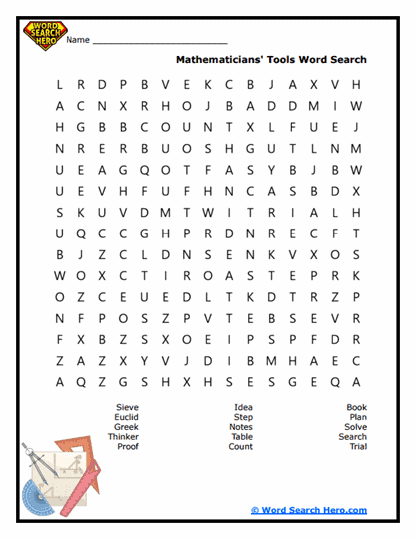
The “Math Tools” worksheet provides students with vocabulary about the tools and people behind mathematics. Words like “Euclid,” “Greek,” “table,” and “proof” reflect the historical and procedural aspects of mathematics. The search celebrates both the thinkers and the thinking involved in understanding numbers. This worksheet builds historical and analytical vocabulary related to math, bridging humanities […]

View More
Prime Traits Word Search

Prime Traits

“Prime Traits” explores the unique properties of prime numbers. Vocabulary includes words like “unique,” “only,” “divide,” “simple,” and “known,” helping students internalize the definition and special nature of primes. These descriptive words build conceptual understanding of what sets primes apart. This worksheet helps students articulate what makes a number prime using accurate descriptive language. The […]

View More
Daily Digits Word Search

Daily Digits

The “Daily Digits” word search connects math to everyday life with vocabulary such as “clock,” “calendar,” “store,” and “data.” These words show where and how numbers-and sometimes primes-are used in routine tasks. The search emphasizes how mathematics supports time management, security, and technology. This word search enhances real-world literacy and vocabulary connected to numeracy. It […]

View More

About Our Prime Numbers Word Searches

Let’s face it: the phrase “prime number” doesn’t usually spark the same visceral joy as, say, “snow day” or “recess,” but we’re here to change that. This collection of printable word searches isn’t just another drill disguised as a worksheet-it’s a treasure hunt in number theory’s greatest hits album. At its core, this set invites students to sharpen their minds and pencils while engaging with the delightfully mysterious world of prime numbers. Whether they’re just discovering that two is the only even prime (gasp!) or learning how primes are used to protect everything from online banking to top-secret spy messages, these puzzles make sure prime numbers get the rockstar treatment they deserve.

Through purposeful repetition and carefully chosen vocabulary, each word search supports not just mathematical knowledge, but the full spectrum of literacy and logic. From decoding “thirty-seven” amid a sea of letters to spotting “Euclid” lurking in a grid like an ancient Greek Easter egg, learners are nudged-often unknowingly-into deeper conceptual understanding. Reading becomes reasoning. Searching becomes sorting. And somewhere between “Factor” and “Code,” students become prime detectives in their own right.

Now, let’s take a closer look at the ten word searches in this collection and explore how they collectively (and cleverly) bring the concept of prime numbers into focus. The puzzles naturally fall into a few thematic categories, each contributing something unique to a student’s mathematical fluency.

We begin, of course, with Prime Basics. “Prime Hunt” and “Mini Primes” make an excellent introductory pair, helping learners spot prime numbers by name and in context. “Prime Hunt” lays the foundation-terms like “five,” “thirty-one,” and “seventeen” appear alongside the concept itself. It’s a primer on primes (pun gloriously intended), offering just enough cognitive friction to promote real learning. “Mini Primes” builds on this by focusing on the smaller prime suspects-those mischievously indivisible numbers that pop up all the way to “forty-seven.” Together, these puzzles offer both recognition and reinforcement, laying essential groundwork for anyone just getting cozy with the idea that some numbers prefer to go it alone.

Then we shift into the Not-Primes-because understanding what something is often begins with knowing what it isn’t. “Composite Quest” is the yang to prime’s yin, turning the spotlight on divisible numbers and their telltale traits. Students wrestle with terms like “multiple,” “factor,” and the subtly snide “nonprime,” giving them the language to articulate the critical differences between prime and composite. This helps solidify the prime-composite binary in a much more tangible way than a list of rules ever could.

Once students have a foothold in prime territory, the next stage is How to Find Them-and that’s where “Prime Finder” and “Factor Tree” come into play. These aren’t your typical number listings; they’re process-oriented, inviting learners into the procedural mindset of mathematicians. “Prime Finder” taps into the logic and strategy behind identifying primes, introducing words like “skip,” “pattern,” and “chart.” Meanwhile, “Factor Tree” drills down-literally-into prime factorization, teaching students to split numbers into their elemental roots using vocabulary like “base,” “product,” and “term.” These activities emphasize method and reasoning, perfect for learners who like knowing how we know what we know.

But primes aren’t just about solitary status or divisibility-they also play starring roles in Patterns and Relationships, which is the focus of “Pattern Primes” and “Prime Traits.” “Pattern Primes” asks students to think relationally, using terms like “pair,” “twin,” and “gap” to highlight intriguing sequences among primes. This builds curiosity and comfort with abstract concepts-students begin to wonder why primes behave the way they do, and what deeper rules might govern their arrangement. “Prime Traits” goes a step further, highlighting the unique descriptive qualities of primes-“unique,” “only,” “exact,” and “limited” are more than just words to find; they’re character sketches for numbers with an attitude.

Then, like all good math educators, we show students that Math Is Everywhere. “Prime Uses” and “Daily Digits” take primes out of the theoretical and drop them squarely into real life. “Prime Uses” connects primes to the world of digital security-“code,” “key,” “login,” “secure”-making the case that without primes, your bank account wouldn’t be nearly as private. “Daily Digits” rounds out this category by embedding math into the everyday, connecting primes to clocks, passwords, stores, and phones. It’s sneaky relevance at its best.

We celebrate The Thinkers and Tools of Math with “Math Tools.” Here, students meet the big ideas and big brains behind number theory, with references to “Euclid,” the “Sieve,” and even “Proof.” It’s a gentle, word-based foray into mathematical history and methodology-essential for connecting today’s learners with math’s timeless tradition of curiosity, rigor, and wonder.

What Are Prime Numbers?

So what exactly is a prime number, anyway? At its most basic, a prime number is a whole number greater than 1 that has exactly two distinct factors: 1 and itself. That means it can’t be evenly divided by any other number. If you try, you’ll be left with remainders and a mildly offended integer.

Let’s take the number 7. Can you divide 7 by 2? No-unless you’re okay with 3.5, which most prime numbers are not. Can you divide it by 3? Still no. Only 1 and 7 do the job. That makes 7 prime. But take 8-divisible by 1, 2, 4, and 8-clearly not prime. It’s got too many friends. Primes are a little antisocial.

The rules are deceptively simple, but the implications are profound. Primes are the “atoms” of the number world-the fundamental building blocks of all other numbers. Every whole number greater than 1 is either a prime or can be factored into primes. This process-called prime factorization-is one of the cornerstones of arithmetic and algebra.

Students often trip up by thinking 1 is prime (it’s not-because it only has one factor, not two), or by assuming all odd numbers are prime (9, 15, and 21 would like a word). These word searches help solidify those distinctions gently but persistently, using language and visual scanning to cement the knowledge in a more lasting way.

A great trick? Ask students to try listing all the primes under 50. Watch as they slowly uncover the weird gaps and surprising twins (like 17 and 19). Or better yet, challenge them to use a sieve-like Eratosthenes did over 2,000 years ago-to discover them the old-fashioned way: through logic, deduction, and a lot of crossing out.