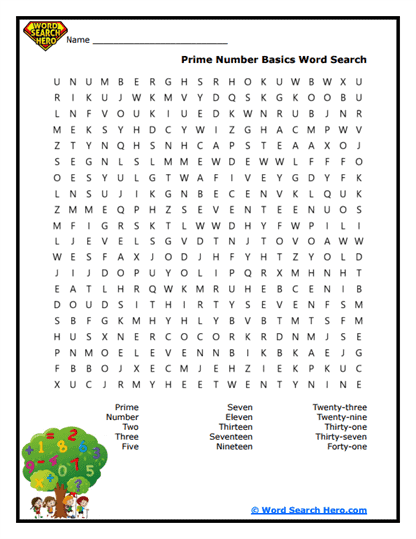
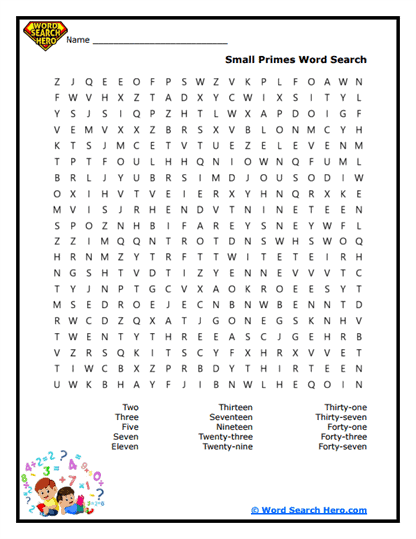
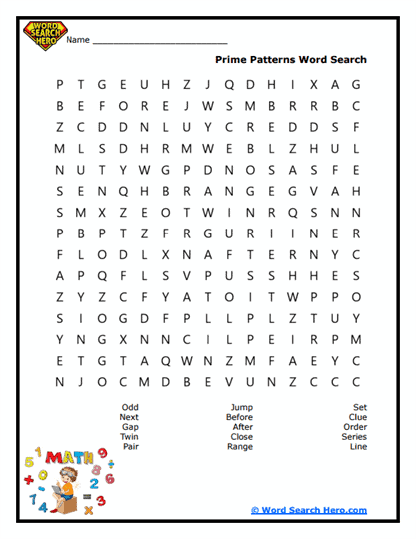
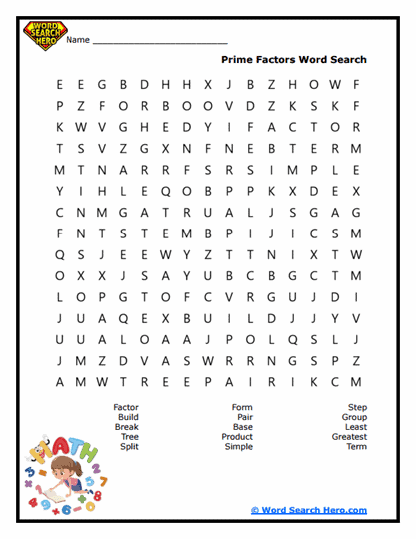
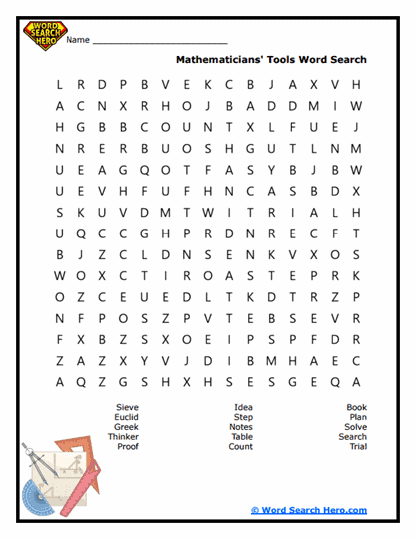
About Our Prime Numbers Word Searches
Prime Numbers word searches help students become familiar with the vocabulary used to describe numbers that have unique factor patterns. These printable puzzles introduce and reinforce terms connected to factors, divisibility, composite numbers, and number classification. Before students begin identifying prime numbers or analyzing factor relationships, it often helps to first recognize the language used to explain these ideas.
Prime numbers are an important part of number theory and appear frequently in middle school math lessons. Students often encounter words like prime, composite, factor, multiple, divisible, and product when learning how numbers relate to one another. A word search provides a simple and engaging way to build familiarity with these terms before students apply them during problem solving and discussion.
Because the activity feels like a puzzle instead of a typical worksheet, it can make math vocabulary practice feel more approachable. Teachers often use these printables as warm-ups, review pages, early finisher work, or math center activities during number sense units. Parents and homeschool educators can also add them easily to lessons as a way to reinforce number vocabulary while keeping practice enjoyable.
As students search for the words in the puzzle grid, they are strengthening focus, visual scanning, and pattern recognition. At the same time, they are building the vocabulary foundation that helps them understand how numbers can be classified and analyzed.
Understanding What Makes a Number Prime
Prime numbers have a special property that makes them different from other numbers. A prime number can be divided evenly by only two numbers: one and itself. This means it has exactly two factors.
Numbers that have more than two factors are called composite numbers. Understanding the difference between prime and composite numbers helps students explore how numbers break apart into factors and how those factors can be used in other mathematical ideas such as factoring and simplifying expressions.
Vocabulary plays an important role in learning these concepts. Words like factor, divisible, multiple, and composite appear often in lessons and problem explanations. When students recognize these terms quickly, they can focus more on identifying patterns and reasoning through number relationships.
Word searches help support this learning by giving students repeated exposure to the vocabulary used in number theory. As students locate each word in the puzzle, they become more comfortable with the spelling and meaning of the terms they will encounter in math lessons.
Paul’s Pro-Tip
One of the most effective ways to extend this puzzle is to follow it with a “factor test” activity. After students complete the word search, give them a list of numbers and ask them to determine whether each number is prime or composite.
Have students explain their reasoning by listing the factors of each number. Encourage them to use vocabulary from the puzzle, such as factor, divisible, and composite, while describing their thinking.
This follow-up activity adds strong instructional value because it connects vocabulary recognition with real mathematical reasoning. For teachers and homeschool educators, it also acts as a quick formative check. If students can correctly identify the factors and explain why a number is prime or composite, it shows that the vocabulary from the puzzle is helping them understand the concept more deeply.
Helping Students See Patterns in Numbers
Prime numbers help students discover patterns and relationships within the number system. While they may appear randomly at first, primes play an important role in many areas of mathematics, including factoring, number theory, and even modern computer security systems.
Learning the vocabulary associated with prime numbers helps students describe these patterns more clearly. Instead of simply memorizing which numbers are prime, students begin to understand how numbers can be broken down and analyzed.
A word search can be a helpful starting point for this learning. After completing the puzzle, educators can encourage students to look for patterns in a number chart and identify which numbers are prime or composite. Even a brief exploration can help students see how mathematical vocabulary helps them describe patterns they observe.
When students become comfortable with the language of prime numbers, they are better prepared to analyze numbers, explore factor relationships, and explain their reasoning clearly.
Frequently Asked Questions
When are prime numbers word searches most useful?
They are especially helpful before or during lessons on factors, divisibility, and number classification.
What grade levels benefit most from these puzzles?
They work well for upper elementary and middle school students who are learning about prime and composite numbers.
Can homeschool educators include these puzzles in lessons?
Yes. They are easy to print and pair well with number charts, factor lists, and hands-on number exploration activities.
Do word searches help students understand prime numbers?
They can. Repeated exposure to key vocabulary helps students recognize and remember the language used when discussing factors and number properties.
What is a good follow-up activity after completing the puzzle?
A helpful next step is asking students to test several numbers, list their factors, and determine whether each number is prime or composite while explaining their reasoning.