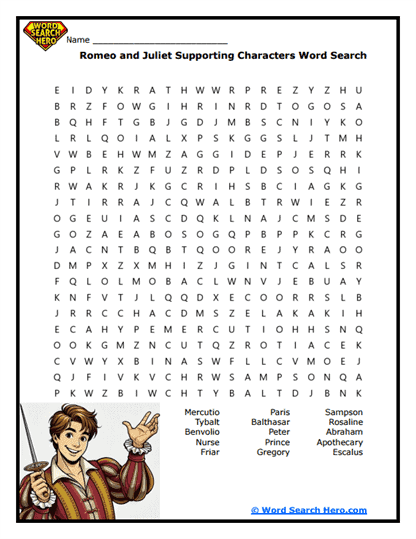
About Our Romeo and Juliet Word Searches
Our Romeo and Juliet Word Searches help students explore one of the most famous plays in all of literature while strengthening vocabulary, spelling, and concentration skills. These printable puzzles introduce learners to the characters, themes, and dramatic ideas connected to William Shakespeare‘s unforgettable tragedy.
Teachers often look for engaging ways to reinforce literary knowledge, and word searches provide a simple and effective option. As students search for words related to Romeo and Juliet, they become more familiar with important names, settings, and concepts that appear throughout the play. Repeated exposure to these terms helps learners recognize them more easily during reading assignments, class discussions, and writing activities.
Parents and homeschool educators also appreciate activities that combine learning with entertainment. Word searches encourage visual scanning, patience, and attention to detail while quietly reinforcing reading-related concepts. Students interact with vocabulary connected to love, conflict, family rivalry, fate, and dramatic storytelling.
Because Romeo and Juliet is often one of the first Shakespeare plays students encounter, these puzzles can make the text feel more approachable. Recognizing names like Romeo, Juliet, Mercutio, Tybalt, and Friar Laurence ahead of time can help students feel more confident when they begin reading.
Whether used as a pre-reading activity, a review tool, or a quiet literature warm-up, these printable puzzles offer a fun and useful way to connect students with a play that continues to spark discussion about love, choices, and consequences.
Love and Conflict in Verona
Romeo and Juliet is one of William Shakespeare’s best-known plays and one of the most famous tragedies ever written. Set in Verona, the story follows two young people from feuding families who fall in love despite the conflict around them.
Romeo belongs to the Montague family, while Juliet is part of the Capulet family. Their families have a long-running rivalry, which creates tension throughout the play and shapes nearly every major event. What begins as a love story quickly becomes a larger drama about loyalty, anger, secrecy, and fate.
Students often find the play especially interesting because it includes so many unforgettable moments. There is a masked party, a balcony scene, a secret marriage, a duel, and a series of rushed decisions that lead to tragic consequences. Shakespeare combines romance with danger in a way that keeps readers engaged from beginning to end.
The play also introduces memorable supporting characters such as Mercutio, whose wit adds energy to the story, and Friar Laurence, who tries to help but becomes part of the chain of events. These characters help students see that the tragedy is shaped not just by the two main characters, but by the people and pressures surrounding them.
A word search built around the play gives students a helpful way to become familiar with these names and ideas before diving deeper into the story.
Paul’s Pro-Tip
Try this after students finish the puzzle: ask them to pick three words that seem like they do not belong in the same story.
Maybe they choose love, duel, and feud. Then ask, How does Shakespeare fit all three into one play?
That question gets students thinking right away. They start noticing that Romeo and Juliet is not just a romance. It is also a story about conflict, bad timing, and the choices people make when emotions run high.
I love this trick because it helps students move from simple word recognition to actual literary thinking without feeling like they just got handed an essay prompt.
Why This Play Still Connects With Students
One reason Romeo and Juliet remains so widely taught is that it combines classic literary elements with emotions students immediately understand. Even though the play was written centuries ago, it still feels familiar because it deals with intense feelings, family pressure, friendship, and impulsive choices.
This makes it especially useful in the classroom. Students can explore how Shakespeare builds tension, how misunderstandings affect the plot, and how emotions can influence decisions. The play also opens the door to discussions about theme, including the role of fate, the danger of hatred, and the consequences of acting too quickly.
It works especially well for introducing tragedy because the structure is clear and the emotional stakes are high. Students can trace how early conflict grows into disaster and begin to understand how a tragic story is built.
A word search supports that learning in a simple way. Before students analyze the language or the themes, they can get comfortable with the essential vocabulary of the play. That small step makes a big difference, especially for readers who are new to Shakespeare.
These puzzles help turn a well-known classic into something more welcoming, interactive, and memorable.
Frequently Asked Questions
How can Romeo and Juliet word searches be used in class?
They work well as bell ringers, pre-reading activities, review exercises, literacy center tasks, or early finisher work during a Shakespeare unit.
Do these puzzles help students prepare for reading Shakespeare?
Yes. They help students recognize important names, places, and ideas before reading the play, which can make the text feel less intimidating.
What literary topics connect especially well to this play?
This play connects well to theme, conflict, characterization, dramatic irony, tragedy, symbolism, and discussions about fate versus choice.
Are these activities useful for homeschool literature study?
Absolutely. They make a great warm-up before reading, a quick review after a chapter or scene, or a light activity during a larger Shakespeare study.
What is a strong follow-up activity after the puzzle?
A great extension is to have students choose one word from the puzzle and explain how it connects to an important scene, character decision, or theme in the play.