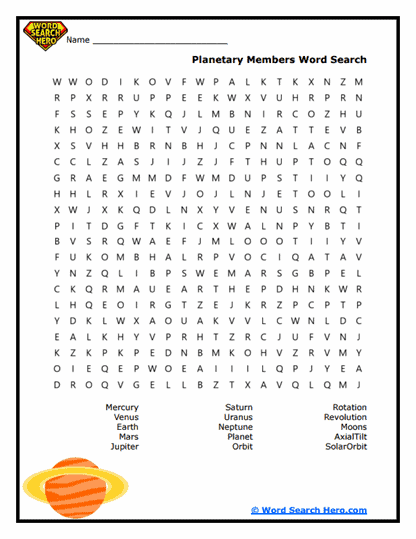
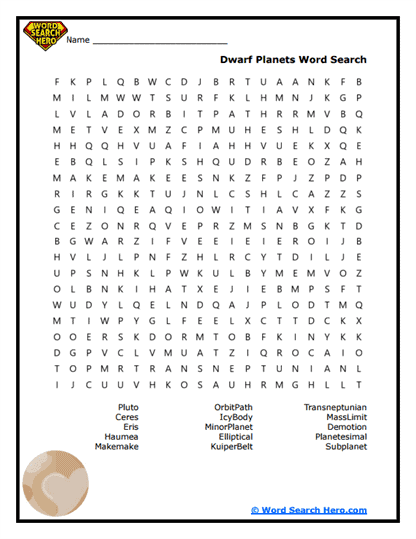
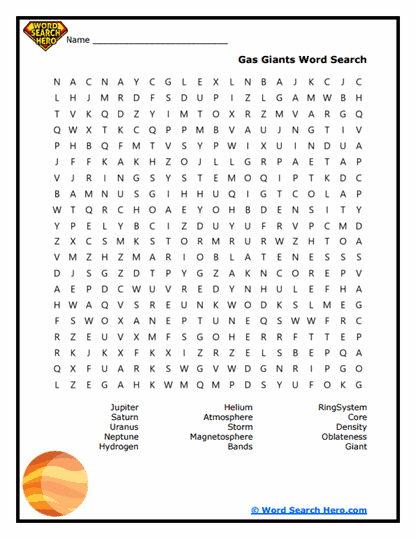
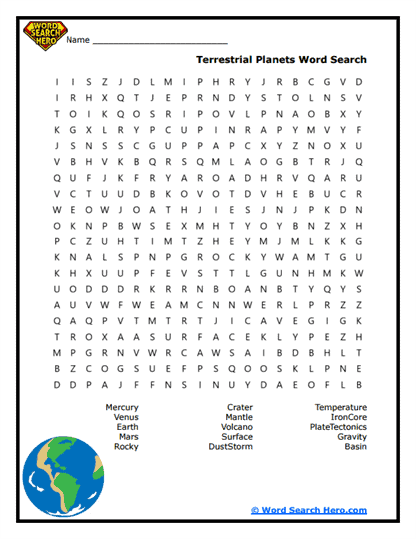
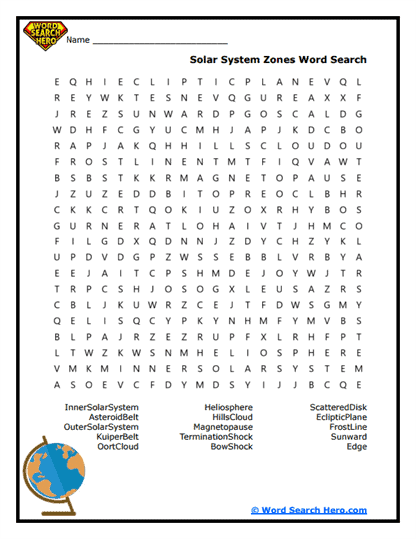
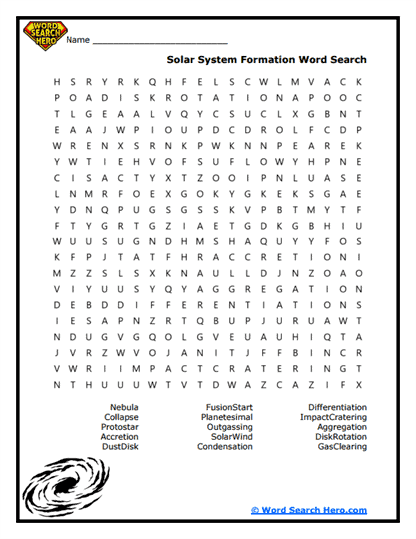
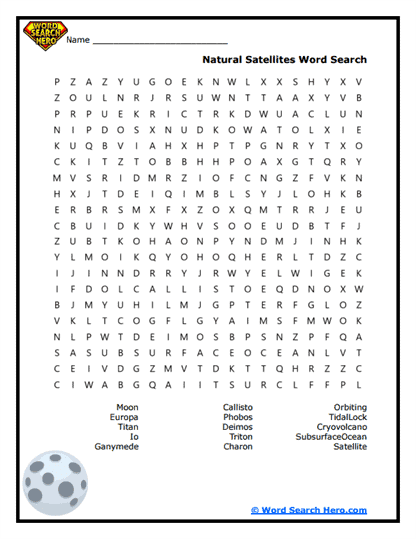
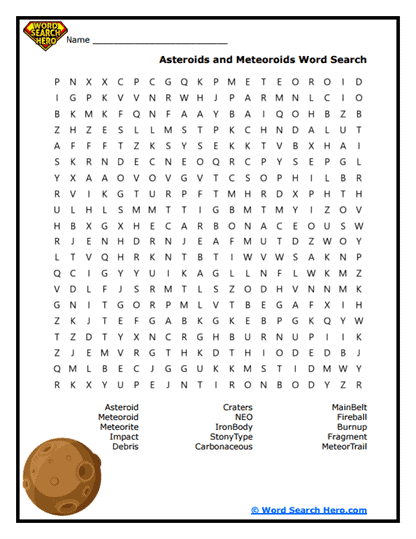
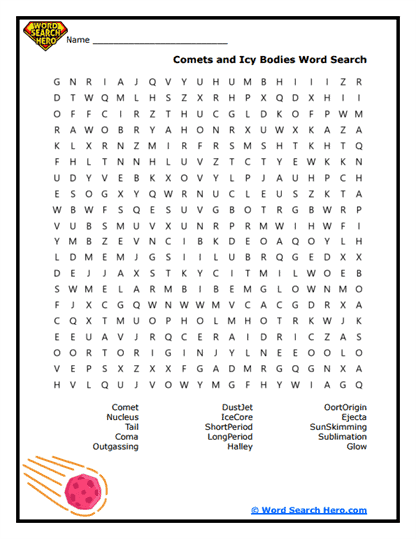
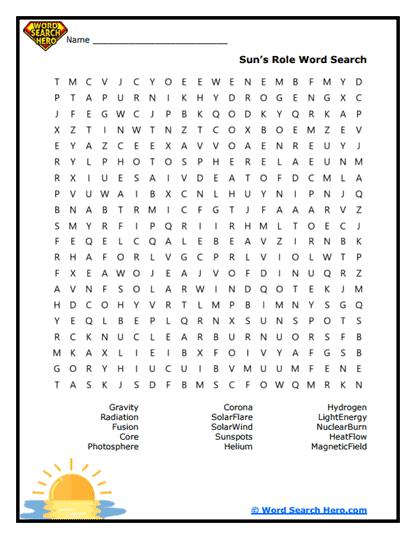
About Our Solar System Word Searches
Solar System word searches introduce students to the vocabulary used to study the group of celestial objects that orbit our Sun. These printable puzzles help learners become familiar with scientific terms related to planets, moons, asteroids, and other objects that make up our local region of space. Before students explore planetary science in depth, it often helps to first recognize the language scientists use to describe the structure and components of the solar system.
Students studying the solar system may encounter words such as planet, orbit, asteroid, comet, dwarf planet, satellite, and gravity. These terms frequently appear in astronomy and earth science lessons and help students understand how objects in space move and interact with each other. A word search provides an engaging way to reinforce this vocabulary while strengthening reading, spelling, and observation skills.
Because the activity feels like a puzzle rather than a traditional worksheet, it can make science vocabulary easier and more engaging to learn. Teachers often use these printables during science centers, independent practice, review sessions, or early finisher activities. Parents and homeschool educators can also include them in lessons as a way to introduce solar system vocabulary in an interactive format.
As students search for the words in the puzzle grid, they strengthen concentration, visual scanning, and pattern recognition skills. At the same time, they build familiarity with the terminology used when studying the solar system and planetary motion.
Understanding the Solar System
The solar system is the collection of objects that orbit the Sun, which is the central star of our planetary system. The Sun’s gravity holds everything together and keeps planets, moons, asteroids, and comets moving along predictable paths.
The solar system includes eight major planets that travel in orbits around the Sun. These planets vary greatly in size, composition, and atmosphere. Some are rocky worlds with solid surfaces, while others are large gas giants made mostly of gases.
In addition to planets, the solar system contains many other objects. Dwarf planets, asteroids, comets, and countless smaller pieces of space debris also travel around the Sun. Many planets have their own moons that orbit them in turn.
Scientists study the solar system to understand how planetary systems form and how they change over time. Space missions and telescopes have revealed a great deal about the planets and other objects that share our cosmic neighborhood.
Learning the vocabulary associated with the solar system helps students understand how celestial bodies interact and move through space.
Word searches reinforce this learning by giving students repeated exposure to the key terms used when studying planets and other objects in our solar system.
Paul’s Pro-Tip
A powerful extension activity is a “scale model solar system” project. After students complete the word search, have them create a classroom model showing the relative distances between the planets.
Students can measure and mark distances along a hallway, playground, or field to represent the spacing between planets. Even a simplified version quickly shows that the planets are much farther apart than many students imagine.
This activity helps students visualize the enormous scale of the solar system and reinforces the vocabulary they encountered in the puzzle.
Helping Students Understand Our Planetary Neighborhood
The solar system is the part of the universe that scientists understand most clearly because it is close enough for detailed observation and exploration. Space missions have visited many planets and moons, sending back valuable information about their environments and history.
Understanding solar system vocabulary helps students interpret planetary diagrams, space mission reports, and educational materials about astronomy. These ideas also connect to broader topics such as gravity, orbital motion, planetary formation, and space exploration.
A word search can serve as an introduction to a lesson about the solar system or as a review after students have studied planets and other celestial objects. After completing the puzzle, educators can encourage students to explore models, maps, or images of the solar system and identify the objects they have learned about.
When students become familiar with solar system vocabulary, they gain the language and understanding needed to explore the fascinating collection of worlds that orbit our Sun.
Frequently Asked Questions
What is the solar system?
The solar system is the group of planets, moons, asteroids, comets, and other objects that orbit the Sun.
How many planets are in the solar system?
There are eight major planets that orbit the Sun.
What keeps the solar system together?
The Sun’s gravity holds the planets and other objects in their orbits.
What else exists in the solar system besides planets?
The solar system also contains dwarf planets, asteroids, comets, and many moons.
What classroom activity pairs well with this puzzle?
Students can create a scaled model showing the distances between planets to better understand the size of the solar system.