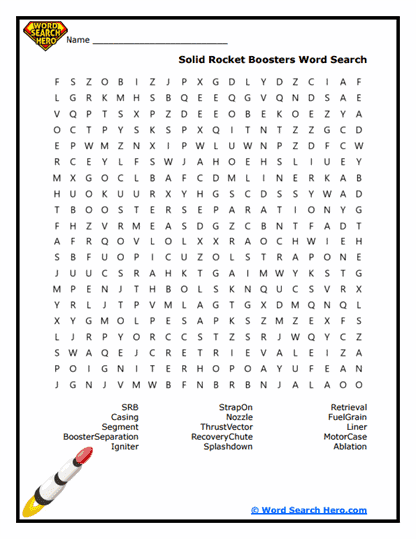
About Our Space Shuttle Word Searches
Space Shuttle word searches introduce students to the vocabulary used to study one of the most important spacecraft programs in the history of space exploration. These printable puzzles help learners become familiar with scientific and engineering terms related to reusable spacecraft, space missions, and the transportation of astronauts and cargo into orbit. Before students explore the history of the Space Shuttle program in depth, it often helps to first recognize the language scientists and engineers use to describe how these spacecraft operated.
Students studying space shuttles may encounter words such as space shuttle, orbiter, launch, booster, payload, mission, and reentry. These terms frequently appear in lessons about space exploration and engineering and help students understand how astronauts traveled to space stations and conducted scientific experiments in orbit. A word search provides an engaging way to reinforce this vocabulary while strengthening reading, spelling, and observation skills.
Because the activity feels like a puzzle rather than a traditional worksheet, it can make science and engineering vocabulary easier and more engaging to learn. Teachers often use these printables during science centers, independent practice, review sessions, or early finisher activities. Parents and homeschool educators can also include them in lessons as a way to introduce spaceflight vocabulary in an interactive format.
As students search for the words in the puzzle grid, they strengthen concentration, visual scanning, and pattern recognition skills. At the same time, they build familiarity with the terminology used when studying spacecraft and space missions.
Understanding the Space Shuttle
The Space Shuttle was a reusable spacecraft developed by NASA that carried astronauts and equipment into orbit for more than thirty years. Unlike earlier spacecraft that were used only once, the shuttle’s orbiter could return to Earth and be prepared for another mission.
A typical Space Shuttle launch included several major components. The orbiter carried the astronauts and mission equipment. Two solid rocket boosters provided powerful thrust during liftoff. A large external tank held fuel used by the orbiter’s engines during the early stages of flight.
Once in orbit, astronauts used the shuttle to deploy satellites, conduct scientific research, and travel to space stations. The shuttle also played a key role in constructing the International Space Station by delivering large modules and equipment.
At the end of a mission, the orbiter returned to Earth by gliding through the atmosphere and landing on a runway like an airplane. This reusable design made the Space Shuttle program unique in the history of human spaceflight.
Learning the vocabulary associated with space shuttles helps students understand how engineers designed spacecraft capable of launching into orbit and safely returning to Earth.
Word searches reinforce this learning by giving students repeated exposure to the key terms used when studying space missions and spacecraft design.
Paul’s Pro-Tip
A powerful extension activity is a “space mission timeline” project. After students complete the word search, have them research several major Space Shuttle missions.
Students can create a timeline showing important milestones such as the first shuttle launch, major satellite deployments, construction of the International Space Station, and the final shuttle mission. Encourage them to include images and short explanations of what happened during each event.
This activity helps students understand how the Space Shuttle program contributed to decades of scientific research and international cooperation in space exploration.
Helping Students Understand Human Spaceflight
The Space Shuttle program played a major role in advancing human space exploration. It allowed astronauts to carry out long-term missions in orbit, conduct experiments in microgravity, and assemble large structures such as space stations.
Understanding space shuttle vocabulary helps students interpret spacecraft diagrams, space mission reports, and documentaries about the history of space exploration. These ideas also connect to broader topics such as rocket engineering, orbital mechanics, and international space cooperation.
A word search can serve as an introduction to a lesson about the history of spaceflight or as a review after students have studied NASA missions in class. After completing the puzzle, educators can encourage students to explore images or videos of real shuttle launches and landings.
When students become familiar with space shuttle vocabulary, they gain the language and understanding needed to explore one of the most important chapters in the story of human space exploration.
Frequently Asked Questions
What was the Space Shuttle?
The Space Shuttle was a reusable spacecraft used by NASA to carry astronauts and equipment into orbit.
What made the Space Shuttle different from earlier spacecraft?
Unlike earlier spacecraft, the shuttle’s orbiter could return to Earth and be reused for multiple missions.
What did astronauts do during shuttle missions?
Astronauts deployed satellites, conducted scientific experiments, and helped build and supply space stations.
How did the Space Shuttle return to Earth?
The orbiter reentered the atmosphere and glided to a runway landing like an airplane.
What classroom activity pairs well with this puzzle?
Students can create a timeline of important Space Shuttle missions and explain the achievements of each mission.