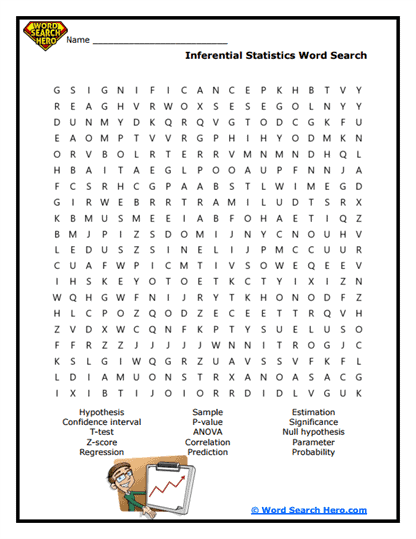
About Our Statistics and Probability Word Searches
Statistics and Probability word searches help students become more familiar with the vocabulary used to describe data, chance, predictions, and outcomes in math. These printable puzzles introduce and reinforce terms connected to likelihood, experiments, results, data collection, and interpretation. Before students begin solving probability questions or analyzing statistical information, it often helps to first understand the language used to explain these ideas.
For many learners, statistics and probability feel different from other areas of math because the focus is not always on finding one exact answer. Instead, students often explore patterns in data, describe possible outcomes, and make informed predictions. Along the way, they encounter words like probability, data, outcome, event, likely, unlikely, survey, and sample. A word search offers a simple and approachable way to build familiarity with these terms before students use them in class discussions and problem solving.
Because the activity feels more like a puzzle than a worksheet, it can increase engagement and lower stress. Teachers often use these printables as warm-ups, review pages, early finisher activities, or quiet practice during math centers. Parents and homeschool educators can also add them to lessons as an easy way to reinforce key vocabulary while keeping the work varied and approachable.
As students search for the words, they are also practicing concentration, pattern recognition, and careful observation. At the same time, they are building the vocabulary foundation that helps them describe data more clearly and think more confidently about chance and prediction.
Building Confidence With the Language of Data and Chance
Statistics and probability rely on precise vocabulary. Students need to understand the words used to talk about collecting information, organizing results, and describing how likely something is to happen. Terms such as experiment, outcome, event, chance, predict, and trend appear often in lessons and activities.
When students are unfamiliar with this vocabulary, the topic can feel more confusing than it needs to be. A learner may understand the situation itself but still struggle to explain it because the language feels new. Word searches help reduce that barrier by giving students repeated visual exposure to the words before they are expected to apply them in context.
As students locate each term in the puzzle, they become more comfortable with spelling and recognition. That familiarity matters when the same words appear in questions, directions, charts, and classroom discussions. Instead of slowing down to figure out what a word means, students can focus on the actual thinking the lesson requires.
This makes word searches especially useful at the start of a unit. They can serve as a gentle introduction that helps students feel more prepared for the lessons that follow.
Paul’s Pro-Tip
A great way to add real value after the puzzle is to use the vocabulary in a quick sort-and-talk activity. Ask students to place the words they found into categories such as data words, probability words, and action words. For example, terms like survey, sample, and graph might fit under data words, while likely, unlikely, event, and outcome belong under probability words.
Once students sort the terms, have them explain why each word belongs in that group and use it in a sentence related to math. This works especially well because it reveals whether students truly understand the vocabulary or are only recognizing the words visually.
For teachers and homeschoolers, this follow-up is valuable because it turns a simple printable into a fast formative check. You can quickly see which words students understand well and which ones need a short mini-lesson, example, or discussion. It also builds stronger academic language, which helps students explain their reasoning more clearly during later probability and statistics work.
Helping Students Make Sense of Real-World Information
Statistics and probability are deeply connected to everyday life. Students see these ideas when they read poll results, hear weather forecasts, compare sports data, or think about the chances of something happening in a game. Learning this vocabulary helps them understand that math is not only about computation. It is also about interpreting information and making reasonable predictions.
When students know words like sample, survey, outcome, and chance, they are better prepared to discuss how information is gathered and what it might mean. They can begin to understand why some predictions are stronger than others and why data should be read carefully.
A word search can be a simple but useful starting point for these conversations. After completing the puzzle, educators can invite students to connect a few words to real-life examples. Even a short discussion can help students see that statistics and probability are practical tools for understanding the world around them.
When students become more comfortable with the language of data and chance, they are often more confident reading information, making predictions, and explaining their thinking.
Frequently Asked Questions
When are statistics and probability word searches most useful?
They are especially helpful before or during units on data analysis, graphing, surveys, chance, and probability. Many educators also use them as warm-ups, review activities, or early finisher work.
What grade levels are these puzzles best for?
They work well for many upper elementary and middle school students, depending on the vocabulary included and the depth of the topic being taught.
Can homeschool educators use these printables in lessons?
Yes. They are easy to print and can be paired with simple experiments, classroom surveys, graphs, or discussion questions to reinforce understanding.
Do these puzzles help students understand statistics and probability?
They can. When students become more familiar with the vocabulary, they are better able to follow directions, interpret information, and explain their reasoning during lessons.
What is a good follow-up activity after completing the puzzle?
A strong next step is to have students sort the words by category, use them in math sentences, or connect them to a simple survey, graph, or probability situation.