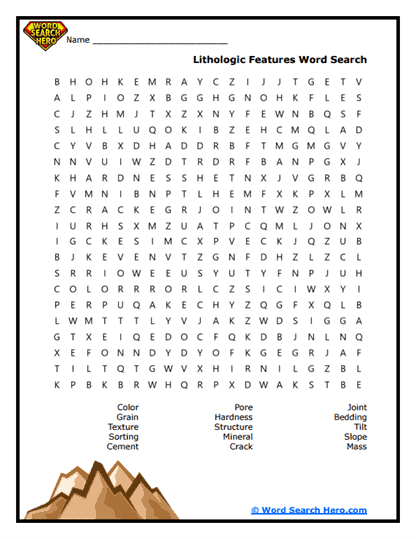
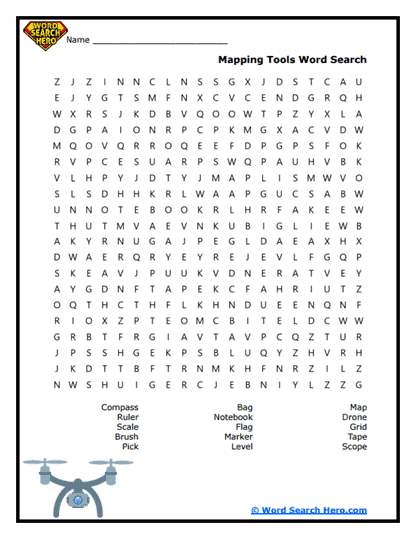
About Our Stratigraphy Word Searches
Stratigraphy word searches introduce students to the vocabulary used to study rock layers and the order in which they formed over time. These printable puzzles help learners become familiar with scientific terms related to sediment, rock formations, fossils, and the layers that record Earth’s geological history. Before students explore geologic timelines and rock formation processes in depth, it often helps to first recognize the language scientists use to describe layered rock structures.
Students studying stratigraphy may encounter words such as layer, sediment, fossil, rock strata, deposition, erosion, and geologic time. These terms frequently appear in earth science and geology lessons and help students understand how layers of rock preserve evidence of Earth’s past environments. A word search provides an engaging way to reinforce this vocabulary while strengthening reading, spelling, and observation skills.
Because the activity feels like a puzzle rather than a traditional worksheet, it can make scientific vocabulary easier and more enjoyable to learn. Teachers often use these printables during science centers, independent practice, review sessions, or early finisher activities. Parents and homeschool educators can also include them in lessons as a way to introduce stratigraphy vocabulary in an interactive format.
As students search for the words in the puzzle grid, they strengthen concentration, visual scanning, and pattern recognition skills. At the same time, they build familiarity with the scientific language used to describe rock layers and the history they reveal.
Understanding Stratigraphy
Stratigraphy is the scientific study of rock layers, also known as strata, and the order in which they formed. Over long periods of time, sediments such as sand, mud, and organic material settle and accumulate, eventually forming layers of rock.
Each layer represents a different period in Earth’s history. By examining the characteristics of these layers, scientists can learn about past environments, climate conditions, and the types of organisms that once lived there.
Fossils found within rock layers provide important clues about ancient life. By studying where fossils appear within the layers, scientists can determine which organisms lived earlier and which appeared later in Earth’s history.
Stratigraphy helps geologists reconstruct the timeline of Earth’s past and understand how landscapes and ecosystems have changed over millions of years.
Learning the vocabulary associated with stratigraphy helps students understand how rock layers serve as a record of Earth’s geological history.
Word searches reinforce this learning by giving students repeated exposure to the key terms used when studying rock formations and geological time.
Paul’s Pro-Tip
A powerful extension activity is a “layered Earth history model.” After students complete the word search, have them create a simple layered model using colored sand, soil, or stacked paper strips.
Each layer can represent a different time period, with students labeling the layers and adding drawings of fossils or environmental conditions that might have existed at that time.
This activity helps students visualize how sediments accumulate over long periods and how scientists read rock layers like pages in a history book. Teachers and homeschool educators can quickly assess whether students understand that deeper layers usually represent older parts of Earth’s history.
Helping Students Understand Earth’s Geological Record
Stratigraphy is an important branch of geology because it allows scientists to study the history of the planet through the layers of rock beneath our feet. These layers preserve evidence of ancient oceans, volcanic eruptions, climate shifts, and extinct life forms.
Understanding stratigraphy vocabulary helps students interpret diagrams, rock samples, and lessons about fossils and geologic time. These concepts also connect to broader topics such as Earth’s history, sedimentary rocks, and paleontology.
A word search can serve as an introduction to a lesson about rock layers or as a review after students have studied fossils and geological timelines in class. After completing the puzzle, educators can encourage students to connect the vocabulary with diagrams showing layered rock formations.
When students become familiar with stratigraphy vocabulary, they gain the language and understanding needed to explore how scientists read Earth’s rocky layers to uncover the story of the planet’s past.
Frequently Asked Questions
What is stratigraphy?
Stratigraphy is the scientific study of rock layers and the order in which they formed over time.
What are rock strata?
Rock strata are layers of sedimentary rock that form as materials accumulate over long periods.
How do fossils help in stratigraphy?
Fossils found in rock layers help scientists determine the age of layers and learn about ancient life.
Why are deeper rock layers usually older?
Over time, new layers of sediment are deposited on top of older layers, placing older rocks deeper underground.
What classroom activity pairs well with this puzzle?
Students can build a layered model using sand, soil, or paper to represent rock strata and label each layer to show how Earth’s history is recorded in rock formations.