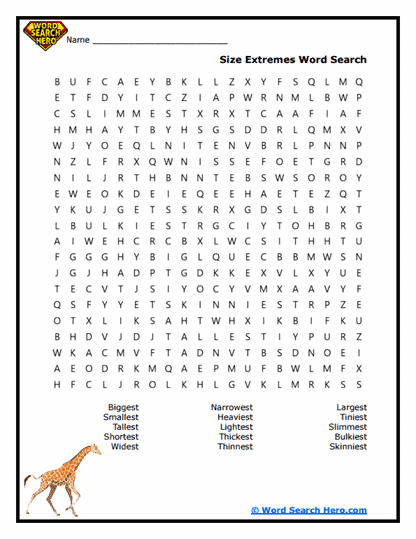
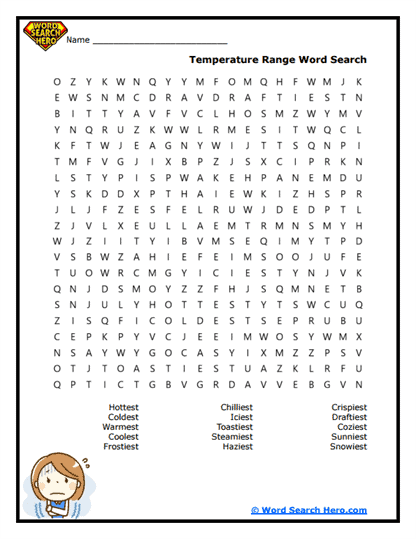
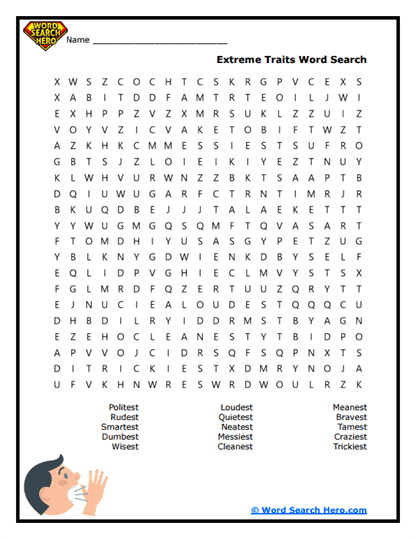
About Our Superlative Adjectives Word Searches
Our Superlative Adjectives Word Searches highlight a group of descriptive words used to show the highest degree of a quality. These printable puzzles help learners practice recognizing superlative adjectives while reinforcing an important grammar concept in a fun and engaging format.
In English, superlative adjectives are used when comparing three or more things and identifying the one with the most or least of a certain quality. Words like tallest, fastest, brightest, and strongest help speakers and writers describe something that stands out above all others. Because these forms appear frequently in everyday communication, they are an essential part of grammar study.
These word searches give students a chance to interact with superlative adjectives in a puzzle format. Instead of only learning the rule for forming them, learners repeatedly see and recognize the words while searching through the grid. This kind of exposure strengthens spelling awareness and helps students become more comfortable with the patterns used in superlative forms.
Teachers often use superlative adjective puzzles during grammar lessons, writing exercises, or literacy centers. Parents and homeschool educators also enjoy them because they provide a simple and enjoyable way to review comparison language at home.
By completing these puzzles, learners develop stronger familiarity with the grammar structures used to describe the highest or lowest degree of a quality.
How Superlative Adjectives Work
Superlative adjectives are used when we compare three or more people, places, or things and identify the one that stands out the most. They help answer questions like Which one is the tallest? Which is the fastest? or Which is the most interesting?
Many superlative adjectives are formed by adding -est to the base adjective. For example:
- tall → tallest
- fast → fastest
- small → smallest
For longer adjectives, English usually uses most before the word instead of adding -est. Examples include:
- beautiful → most beautiful
- interesting → most interesting
- comfortable → most comfortable
These grammar forms are commonly used in everyday conversation, such as when describing sports results, favorite foods, tallest buildings, or most exciting movies. Because they appear so often, learning to recognize them is important for both reading and writing.
Superlative adjective word searches reinforce this concept by helping students become familiar with the words themselves. As learners search for terms like biggest, quickest, or loudest, they begin to notice the patterns that signal the superlative form.
Teachers may expand the activity by asking students to identify the base adjective or create sentences comparing several objects using superlatives.
Paul’s Pro-Tip
When you’re hunting for superlative adjectives in a puzzle, start by scanning for the -est ending.
That pattern appears in many superlative forms, and spotting those letters can quickly lead you to the word you’re looking for. Once you find the -est, simply check the letters before it to confirm the full adjective.
This small trick can make the puzzle much easier to solve.
Why Superlative Adjective Word Searches Are Helpful
Superlative adjective word searches support several key grammar and language skills.
One major benefit is grammar pattern recognition. Students learn to recognize the spelling patterns that signal the highest degree of comparison.
Another advantage is spelling familiarity. Searching for superlative forms helps learners remember how these words are spelled and structured.
These puzzles also support vocabulary development. Learners encounter descriptive words they can later use when comparing objects, people, or experiences in conversation or writing.
Word searches also build visual scanning and concentration skills, as students carefully examine the grid to locate each word from the list.
Because the activity blends grammar learning with puzzle-solving, it keeps students engaged while reinforcing useful language structures.
Frequently Asked Questions
What is a superlative adjective?
A superlative adjective describes the highest or lowest degree of a quality when comparing three or more things.
How are superlative adjectives usually formed?
Short adjectives often add -est, while longer adjectives usually use most before the word.
Why are superlative adjectives important?
They help speakers and writers clearly identify something that stands out among several items.
Are superlative adjective word searches useful for grammar lessons?
Yes. They reinforce the vocabulary and spelling patterns associated with comparisons.
What is a good follow-up activity after finishing the puzzle?
Students can write sentences describing the best, tallest, fastest, or most interesting examples of things they know using the superlative adjectives they found.