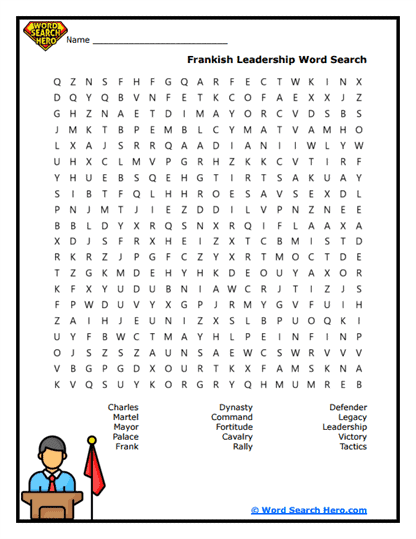
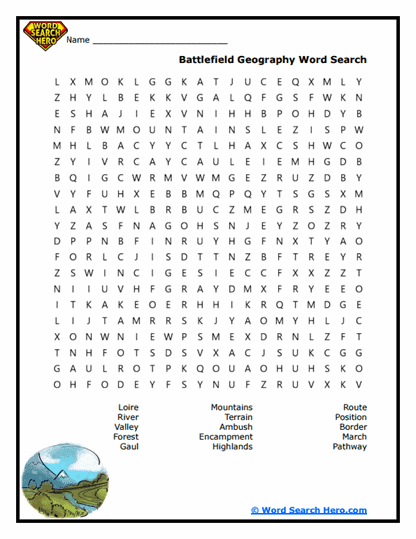
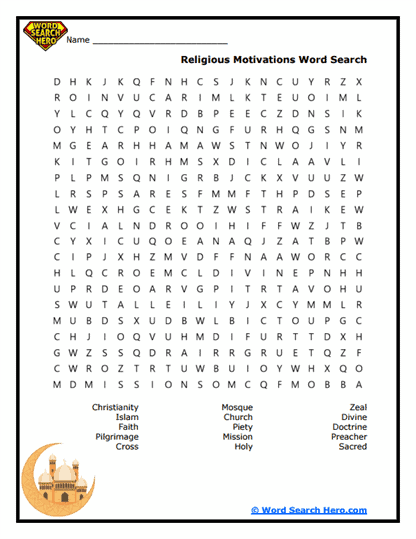
About Our The Battle of Tours Word Searches
Our The Battle of Tours Word Searches introduce students to an important moment in early medieval history while helping them build vocabulary, focus, and reading skills. These printable puzzles highlight key people, places, and ideas connected to the famous battle fought in 732 between Frankish forces and an advancing Umayyad army.
Teachers often use word searches as engaging classroom tools that reinforce historical vocabulary in a relaxed way. As students search for names, locations, and terms related to the battle, they become more familiar with language they may later encounter in textbooks or lessons about medieval Europe. Seeing these terms repeatedly helps students remember them more easily.
Parents and homeschool educators also enjoy using printable puzzles because they combine learning with a fun challenge. Word searches encourage attention to detail, visual scanning, and patience. While students focus on finding hidden words, they are also interacting with meaningful historical vocabulary connected to an important event in European history.
The Battle of Tours is a fascinating topic because it represents a major turning point during the early Middle Ages. Students may encounter names such as Charles Martel, references to the Franks, or mentions of the expanding Islamic caliphates of the time. These words help introduce learners to the political and cultural landscape of eighth-century Europe.
Whether used as classroom warm-ups, review activities, or independent learning tools, these puzzles offer a simple and engaging way for students to explore the story of the Battle of Tours and the historical forces that shaped medieval Europe.
A Turning Point in Early Medieval Europe
The Battle of Tours, sometimes called the Battle of Poitiers, took place in 732 in what is now modern-day France. At the time, Europe was experiencing major political and cultural changes as different kingdoms and empires expanded their influence.
An army led by the Frankish leader Charles Martel faced an advancing force connected to the Umayyad Caliphate, which had already expanded across North Africa and into parts of Spain. As these armies moved northward through the Iberian Peninsula, tensions grew between regional powers.
Charles Martel organized a Frankish army to confront the advancing forces near the city of Tours. His soldiers formed strong defensive positions, relying on disciplined infantry formations to withstand attacks.
Although details of the battle are still debated by historians, the Frankish forces ultimately succeeded in stopping the advance. The victory strengthened Charles Martel’s reputation as a powerful leader and helped solidify Frankish influence in Western Europe.
The battle is often studied because it highlights the interactions between different cultures and political powers during the early medieval period. It also helped set the stage for the rise of the Carolingian dynasty, which later produced leaders like Charlemagne.
When students encounter these names and terms in a puzzle, they begin to recognize the vocabulary connected to this pivotal moment in early European history.
Paul’s Pro-Tip
Here’s a fun classroom twist I used whenever we covered medieval battles.
After students finish the word search, ask them to circle three words they think were most important to the battle-maybe a leader, a place, or a group of people.
Then ask them: Why do you think those words mattered?
You’ll get some great thinking. One student might focus on Charles Martel’s leadership, another might talk about the armies involved, and someone else might notice the location.
It’s a quick way to turn a puzzle into a mini history discussion without adding extra worksheets.
Understanding the Global Context of the Battle
To fully understand the significance of the Battle of Tours, it helps to look at the larger historical context of the early eighth century. At that time, the Umayyad Caliphate was one of the largest empires in the world, stretching across the Middle East, North Africa, and into parts of Europe.
Muslim armies had already conquered much of the Iberian Peninsula, which is present-day Spain and Portugal. From there, some forces moved north across the Pyrenees Mountains into territories controlled by various European kingdoms.
Meanwhile, the Frankish kingdom was growing stronger under the leadership of Charles Martel. His victory at Tours strengthened Frankish political power and helped stabilize the region.
Historians continue to study the battle to better understand how military strategy, political alliances, and geography influenced the outcome. The event also highlights how different civilizations interacted during the medieval period.
For students, exploring this topic introduces important themes such as cultural exchange, empire expansion, and leadership during times of conflict. Word searches that feature these historical terms provide a fun starting point for learning about the broader story of early medieval Europe.
Frequently Asked Questions
How can teachers use Battle of Tours word searches in class?
Teachers often use them as bell ringers, review activities, or vocabulary reinforcement during lessons about medieval Europe or early Islamic expansion.
What grade levels are these puzzles best suited for?
They work well for upper elementary and middle school students studying world history, though older students may also use them as quick review tools.
Can word searches help students remember historical vocabulary?
Yes. Repeated exposure to historical names and terms helps students recognize and recall them more easily during readings and classroom discussions.
Are these puzzles helpful for homeschool history lessons?
Absolutely. Homeschool educators frequently use printable word searches as independent learning activities that reinforce vocabulary and historical understanding.
What is a good follow-up activity after completing the puzzle?
Students can choose a few words they found in the puzzle and research how those people, places, or ideas connect to the Battle of Tours. This encourages deeper exploration of the historical topic.