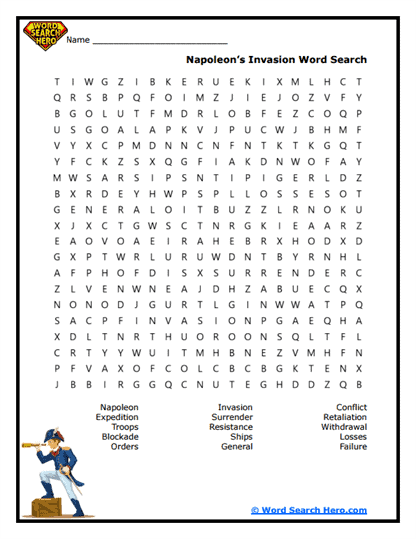
About Our The Haitian Revolution Word Searches
Our The Haitian Revolution Word Searches help students explore one of the most important revolutions in world history while strengthening vocabulary, spelling, and concentration skills. These printable puzzles introduce learners to the people, events, and ideas connected to the uprising that led to Haiti becoming the first independent nation in Latin America and the first nation founded by formerly enslaved people.
Teachers often look for activities that reinforce historical vocabulary in a fun and accessible way. Word searches provide a simple solution by allowing students to interact with key terms connected to revolutionary movements, colonial societies, and political change. As learners search for words related to leaders, colonies, freedom, and independence, they become more familiar with vocabulary that appears in world history lessons.
Parents and homeschool educators also appreciate printable puzzles that combine learning with entertainment. Word searches encourage patience, visual scanning, and attention to detail while quietly reinforcing important historical concepts. Students encounter meaningful vocabulary related to revolution, resistance, and the struggle for independence.
The Haitian Revolution is a particularly powerful topic because it highlights how determined people can reshape history. Students may encounter words connected to leaders, battles, colonies, and the broader fight for freedom that took place in the Caribbean.
By interacting with these terms through puzzles, learners gain an engaging introduction to one of the most influential revolutions of the modern era.
A Revolution That Changed the Caribbean
The Haitian Revolution began in 1791 in the French colony of Saint-Domingue, located on the island of Hispaniola in the Caribbean. At the time, the colony was one of the richest in the world because of its large sugar and coffee plantations.
However, this wealth was built on a system of slavery that forced hundreds of thousands of enslaved Africans to work under extremely harsh conditions. Tensions grew as people demanded freedom and better treatment.
Inspired in part by ideas of liberty and equality that emerged during the French Revolution, enslaved people in Saint-Domingue began a large-scale uprising. Leaders such as Toussaint Louverture played a major role in organizing resistance and leading forces against colonial authorities.
Over time, the conflict expanded into a complex struggle involving enslaved people, free citizens, colonial officials, and foreign powers. After years of fighting, the revolution ultimately led to the creation of Haiti, an independent nation established in 1804.
Students often find this event fascinating because it represents the only successful large-scale slave revolt that resulted in the creation of a new nation. Learning the vocabulary connected to this revolution helps students better understand its global significance.
Paul’s Pro-Tip
When covering revolutions in class, I like to use the puzzle as a quick “freedom timeline” exercise.
After students finish the word search, ask them to circle three words connected to change or freedom.
Then ask: What kinds of events might lead people to fight for independence?
Students often mention unfair treatment, lack of rights, or economic problems. It opens the door to a great conversation about why revolutions happen and how people respond to injustice.
A simple puzzle can quickly turn into a thoughtful discussion about history and human rights.
Why the Haitian Revolution Was So Influential
The Haitian Revolution had major consequences far beyond the island where it began. It challenged existing systems of colonial rule and slavery at a time when many nations depended on those systems for economic power.
The success of the revolution demonstrated that enslaved people could organize, fight, and establish their own independent nation. This outcome surprised and worried many colonial governments throughout the Americas.
The revolution also influenced global politics and economic decisions. Some countries reconsidered colonial policies, while others strengthened their control over territories because they feared similar uprisings.
At the same time, the new nation of Haiti became a powerful symbol of resistance and freedom for many people around the world. Its independence showed that revolutionary ideas about liberty could inspire dramatic political change.
Students studying this event begin to understand how revolutions can reshape societies and influence international history. Word searches featuring vocabulary related to Haiti, colonial rule, and independence help reinforce the language connected to this transformative period.
By recognizing these terms repeatedly, learners gain a clearer understanding of why the Haitian Revolution remains one of the most significant events in global history.
Frequently Asked Questions
What was the Haitian Revolution?
The Haitian Revolution was a major uprising that began in 1791 in the French colony of Saint-Domingue and eventually led to the creation of the independent nation of Haiti in 1804.
Why is the Haitian Revolution important?
It was the only successful large-scale slave revolt in history that resulted in the formation of a new independent nation.
How can teachers use Haitian Revolution word searches in class?
Teachers often use them as bell ringers, vocabulary reinforcement activities, or review tools during lessons about revolutions and global history.
What grade levels are these puzzles best suited for?
They work well for upper elementary and middle school students studying world history, though older learners may also use them as quick review activities.
What extension activity works well after completing the puzzle?
Students can choose several words from the puzzle and explain how those ideas connect to the causes, leaders, or outcomes of the Haitian Revolution.