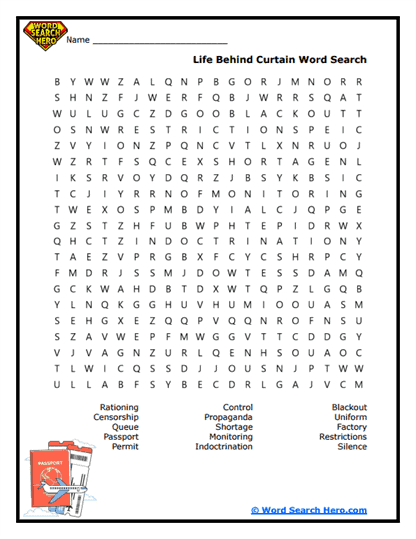
About Our The Iron Curtain Word Searches
Our The Iron Curtain Word Searches help students explore an important concept from Cold War history while strengthening vocabulary, spelling, and concentration skills. These printable puzzles introduce learners to the people, places, and ideas connected to the political division of Europe after World War II.
Teachers often look for engaging ways to reinforce historical vocabulary, and word searches provide a simple and effective tool. As students search for terms related to borders, alliances, governments, and political systems, they become more familiar with the language used when studying the Cold War. Repeated exposure to these words helps students recognize them more easily in classroom discussions and history readings.
Parents and homeschool educators also appreciate activities that combine learning with entertainment. Word searches encourage visual scanning, attention to detail, and persistence while quietly reinforcing important historical concepts. Students interact with vocabulary connected to divided nations, international tensions, and global political rivalry during the twentieth century.
The Iron Curtain became one of the most recognizable symbols of the Cold War. It described the political and ideological boundary that separated Western Europe from Eastern Europe after World War II. By exploring these terms through puzzles, students gain an engaging introduction to the vocabulary and ideas connected to this period of global tension and political division.
A Dividing Line Across Europe
The term Iron Curtain was used to describe the boundary that separated communist-controlled Eastern Europe from democratic Western Europe after World War II. This division emerged as tensions grew between the Soviet Union and the Western Allied nations, particularly the United States and its allies.
Although the Iron Curtain was not always a physical wall, it represented strict political, military, and ideological separation between the two sides. Countries in Eastern Europe were influenced or controlled by the Soviet Union, while Western European nations developed democratic governments and closer relationships with Western powers.
Travel and communication across this divide were often restricted. Governments on the eastern side limited movement and controlled information, while Western countries developed different political and economic systems.
The phrase became widely known after British leader Winston Churchill used it in a famous speech in 1946, describing how an “iron curtain” had descended across the continent. The term quickly became a powerful symbol of Cold War tensions.
Students studying this period often find it helpful to understand the Iron Curtain as both a political boundary and a symbol of the rivalry between different political systems during the Cold War.
Paul’s Pro-Tip
Here’s a quick activity I liked using when teaching Cold War topics.
After students finish the word search, ask them to circle two words related to Western countries and two words related to Eastern countries.
Then ask: Why might these two sides have different political ideas or systems?
Students start discussing alliances, governments, and global tensions. It helps them see that the Iron Curtain wasn’t just a line on a map-it represented a major political divide.
A simple puzzle can quickly lead to a deeper conversation about Cold War history.
Understanding the Global Impact of the Cold War Divide
The Iron Curtain shaped international politics for decades. Countries on each side of the divide developed different economic systems, alliances, and political structures. Western nations often aligned through organizations such as NATO, while many Eastern European countries became part of alliances connected to the Soviet Union.
The division also influenced military strategy, diplomacy, and global competition. Both sides sought to expand their influence through political partnerships, economic support, and technological advancement.
Life in countries on opposite sides of the Iron Curtain often looked very different. Differences in political freedoms, economic opportunities, and international connections shaped daily experiences for millions of people.
The Cold War rivalry lasted for several decades until political changes in the late twentieth century began to reshape Eastern Europe. As reform movements grew and governments changed, many countries moved toward new political systems and greater openness.
Students studying this topic begin to see how powerful ideas and political systems can divide entire regions of the world. Word searches featuring vocabulary related to the Iron Curtain help reinforce the terms students encounter when learning about the Cold War and its lasting global impact.
Frequently Asked Questions
What was the Iron Curtain?
The Iron Curtain was a term used to describe the political and ideological division between Eastern and Western Europe during the Cold War.
Why was the Iron Curtain important?
It symbolized the separation between communist governments in Eastern Europe and democratic governments in Western Europe during a period of global tension.
How can teachers use Iron Curtain word searches in class?
Teachers often use them as bell ringers, vocabulary reinforcement activities, or review tools during units about the Cold War.
What grade levels are these puzzles best suited for?
They work well for upper elementary and middle school students studying modern world history, though older learners may also find them useful for review.
What extension activity works well after completing the puzzle?
Students can locate countries that were on each side of the Iron Curtain using a map of Europe and discuss how the Cold War influenced those regions.