Choose a topic !

The War on Terror Word Searches

Terror Strikes Word Search

Terror Strikes

This word search focuses on vocabulary associated with the September 11 attacks. Students will encounter terms related to the event’s timeline, involved parties, aftermath, and its emotional and historical impact. Words such as “Pentagon,” “Towers,” and “Al-Qaeda” highlight locations and perpetrators, while others like “Rescue,” “Collapse,” and “Passenger” reflect the human stories and chaos. The […]

View More
Afghan Frontline Word Search

Afghan Frontline

This word search explores the vocabulary surrounding the invasion of Afghanistan, a significant military campaign following the 9/11 attacks. Terms such as “Taliban,” “Bunker,” and “Airborne” reference enemies, tactics, and strategies used in the conflict. Words like “Alliance” and “Search” hint at cooperative efforts and ongoing missions. The focus remains military and geographical, drawing attention […]

View More
Iraq Puzzle Word Search

Iraq Puzzle

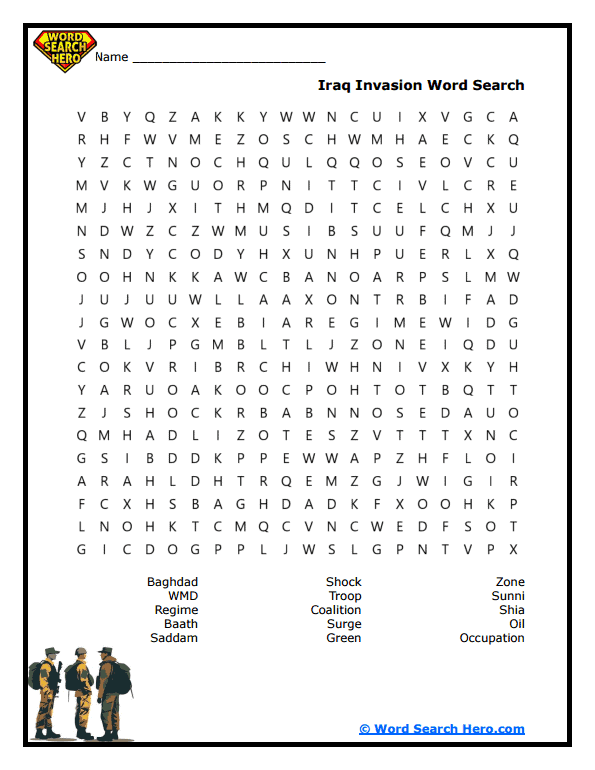
Centered around the 2003 Iraq Invasion, this word search offers a look into the political and military landscape of the time. Students will find words like “Baghdad,” “WMD,” and “Saddam,” linking to major players and controversies. The vocabulary includes both military terms like “Troop” and “Surge,” as well as cultural identifiers like “Sunni” and “Shia.” […]

View More
Gitmo Terms Word Search

Gitmo Terms

This worksheet zeroes in on the terminology associated with Guantanamo Bay. Words such as “Detention,” “Waterboard,” and “Terrorist” highlight the controversial practices and purposes of the facility. Other terms like “Tribunal” and “Custody” bring in the legal aspects, while “Isolation” and “Inmate” focus on the conditions. Together, they paint a picture of the facility’s role […]

View More
Security Sweep Word Search

Security Sweep

Focusing on post-9/11 homeland security measures, this word search includes terms like “Checkpoint,” “Scanner,” and “Watchlist.” These represent tools and processes used to maintain national security. Words like “Surveillance,” “TSA,” and “Patriot” illustrate governmental and public reactions. It’s a vocabulary set that reflects the balance between safety and privacy in modern society. This worksheet enhances […]

View More
Drone Warfare Word Search

Drone Warfare

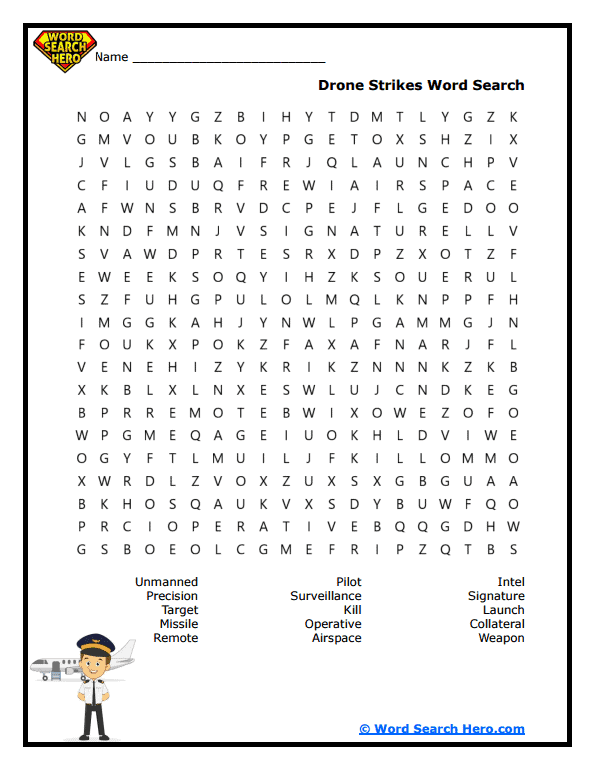
This worksheet delves into the language of drone operations in modern military conflict. Words like “Unmanned,” “Missile,” “Kill,” and “Launch” highlight the technological and tactical nature of drone strikes. Others such as “Collateral,” “Signature,” and “Intel” reflect on the intelligence and ethical dimensions of remote warfare. This word bank offers insight into how warfare has […]

View More
Raid Mission Word Search

Raid Mission

The “Bin Laden Raid Word Search” centers on the operation that led to Osama bin Laden’s death. Words like “Abbottabad,” “Compound,” “Helicopter,” and “SEAL” place students in the heart of this historic military event. Vocabulary such as “Stealth,” “Mission,” and “Operation” reflects the tactics and coordination involved. Other words like “DNA” and “Intel” show the […]

View More
Mind Shift Word Search

Mind Shift

This word search focuses on the radicalization process, offering terms that outline how individuals may become ideologically extreme. Words like “Recruitment,” “Extremist,” and “Brainwash” define key phases of radicalization. “Narrative,” “Influence,” and “Propaganda” point to the tools used to shift thinking. The vocabulary also includes “Forum” and “Messaging,” emphasizing online platforms. This worksheet serves as […]

View More
ISIS Crisis Word Search

ISIS Crisis

Focusing on the rise of ISIS, this word search introduces vocabulary related to the group’s campaigns and tactics. Students will encounter terms such as “Mosul,” “Caliphate,” and “Black Flag,” which are linked to territory and symbolism. “Execution,” “Insurgency,” and “Battle” emphasize the violence associated with the group. Meanwhile, “Reclaim” and “Escape” hint at resistance and […]

View More
Veteran Comeback Word Search

Veteran Comeback

This worksheet is centered on the veteran reintegration process following military service. Students explore terms like “PTSD,” “Therapy,” “Support,” and “Family” that relate to emotional recovery and civilian transition. Words such as “Deployment,” “Discharge,” and “Unit” provide military context. The focus is on healing, adjustment, and finding purpose post-service, providing a humanizing view of veterans’ […]

View More

About Our The War on Terror Word Searches

Welcome, intrepid puzzle‑seekers, to a labyrinth of letters that doubles as a time‑machine through the chaotic decades since September 11, 2001. Our War on Terror Word Search collection is not your run‑of‑the‑mill “find the cat” pastime-this is a high‑stakes romp through modern geopolitics, complete with “Guantanamo,” “Homeland Security,” “NSA,” and yes, even “PRISM.” It’s like doing a CIA briefing, but without the classified stamp or awkward after‑party.

Imagine your students grappling with “USA Patriot Act” while chuckling over “Dick Cheney” hiding somewhere in the grid. They’re not just hunting words-they’re brushing up on recent history while grinning because “Torture” and “Snowden”-two hot potatoes-are cheekily wedged between “Iraq” and “Homeland Security.” It’s part classroom, part eye‑roll‑inducing word hunt, and 100% educational.

We’ve grouped the puzzles cleverly: one PDF dives into “War on Terror” rudiments, featuring foundational terms like “Al Qaeda,” “CIA,” and “George W Bush.” Another focuses on the Post‑9/11 phase, zooming in on “9/11”, “Homeland Security”, “NSA”, “PRISM”, and “Torture”. A separate venture expands into World Post‑9/11, exploring broader global impacts-words like “Germany,” “Russia,” and “Guardian.” And for good measure, our Civil Rights‑themed puzzle tugs at the liberty vs. security tension with clues like “Freedom of Speech,” “Police,” and “Ferguson.”

But whether your class is hunting “PRISM” or puzzling over “Guantanamo,” these word searches serve a dual purpose: teaching vocabulary tied to modern history, and sharpening pattern‑recognition skills as kids zig‑zag across the grid finding words forward, backward, diagonal-yes, even upside‑down.

Let’s dive into the skill‑building behind the fun. Let’s start with, vocabulary acquisition – students encounter terminology they may have only skimmed in news articles-terms like “Ferguson” or “Snowden”, which come alive through puzzle context. Grouped by theme-Post‑9/11, Civil Rights, Global Focus-each puzzle builds discipline-specific lexicons in manageable, playful bites.

Second, historical recall: spotting “9/11” or “Homeland Security” prompts curiosity: Why do we care about these? Teachers can pause the hunt to discuss. These puzzles become launchpads for mid‑lesson history tangents, and they’re designed to spark questions like, “Oh-what’s PRISM again?” then off to a brief internet rabbit hole they go.

Spelling reinforcement – many of the clues-like “Guantanamo” or “Homeland” (yes, double‑L vs single)-are spelling traps. But in the puzzle grid, they’re spelled out clearly, reinforcing orthography in a low‑stress setting. Plus, kids secretly enjoy getting words “right” in the grid-they feel accomplished without realizing they just spelled “Barack Obama” correctly for the millionth time.

Pattern‑recognition and cognitive stamina – long words like “Homeland Security” or “Freedom Of Speech” demand visual pattern-chasing skills. Spotting “I‑R‑A‑Q” is easy; tracking “P‑A‑T‑RIOT ACT” is more like a mini‑marathon. And let’s be candid: there’s a special joy in circling “USA Patriot Act” backward like you’ve cracked an ancient code.

Category grouping and historical layering – each puzzle isn’t random-it’s built around a conceptual theme. The “War on Terror” puzzle is heavy on militant and military terms: “Al Qaeda,” “Taliban,” “Iraq,” “Afghanistan,” “CIA,” “NSA.” The “Post‑9/11” puzzle shifts to homeland vocabulary: “Patriot Act,” “PRISM,” “Snowden,” “Guantanamo,” “Torture.” The “World Post‑9/11” set goes global, referencing “Germany,” “Russia,” “Guardian,” reminding kids that current events aren’t just about America-and puzzles can gently show them why.

What Is The War on Terror?

Let’s shift from word searches to the real-world chaos they depict. Buckle up-The War on Terror wasn’t just a military campaign, it was a global rollercoaster that redefined 21st-century conflict. This wasn’t your typical land-grab or throne-toppling imperial drama-it was a war without a clear battlefield, fighting an enemy without borders, and, often, without a uniform. And it all started with a morning in September that shook the world.

The term “War on Terror” was coined in the aftermath of the September 11, 2001 attacks, when hijackers affiliated with al-Qaeda crashed commercial planes into the World Trade Center and the Pentagon, killing nearly 3,000 people and shocking the globe. Within days, President George W. Bush addressed Congress, announcing a new kind of war-not against a country, but against a strategy: terrorism. Officially known as the Global War on Terrorism (GWOT), the campaign began in late 2001 and stretched on for two decades, outlasting presidents, parliaments, and public patience.

Geographically, this war knew few bounds. It began with U.S.-led military strikes in Afghanistan, aimed at toppling the Taliban regime and rooting out Osama bin Laden’s al-Qaeda network. But by 2003, the U.S. had turned its attention to Iraq, launching an invasion based on claims of weapons of mass destruction and alleged terrorist ties. As the years dragged on, operations spread to Pakistan, Yemen, Somalia, and beyond. Drone strikes became frequent across North Africa and the Middle East. The War on Terror didn’t just take place on battlefields-it played out in embassies, intelligence offices, airports, and even cyberspace.

But how did we get here? At its core, the war was a response to terror tactics that deliberately targeted civilians. Al-Qaeda had already attacked U.S. embassies and the USS Cole, but 9/11 was a scale no one expected. The logic from Washington was simple: stop terrorism at its roots, wherever those might be. That meant dismantling training camps, disrupting financial channels, and-controversially-preemptively striking nations believed to harbor or support extremist groups. In theory, it was about security. In practice, it became something far more sprawling, and murky.

The war’s main players formed strange bedfellows and uneasy alliances. On one side were nations like the United States, the United Kingdom, Australia, and NATO allies. Leaders like Bush, Tony Blair, Barack Obama, and later Donald Trump took the reins. On the opposing side were not just the Taliban and al-Qaeda, but a shifting network of militant factions, warlords, and, eventually, the horrifying rise of ISIS. Countries like Pakistan, Saudi Arabia, and Turkey played ambiguous roles-simultaneously supporting U.S. efforts while occasionally undermining them behind the scenes. Trust was fleeting; motives were layered.

Key milestones kept the world glued to the news cycle. The initial invasion of Afghanistan in October 2001-dubbed Operation Enduring Freedom-saw the rapid fall of the Taliban, though they would bide their time and return. Then came the 2003 invasion of Iraq, triggered by intelligence claims (later proven false) about weapons of mass destruction. The fall of Saddam Hussein didn’t bring peace-it brought insurgency, civil war, and eventually the rise of ISIS. Meanwhile, drone warfare emerged as the quiet face of the conflict, expanding rapidly under Obama. In 2011, U.S. Navy SEALs killed Osama bin Laden in a compound in Pakistan-a symbolic blow, but far from an ending. That came, perhaps unofficially, in 2021, when the U.S. withdrew from Afghanistan in scenes of desperate evacuations and Taliban resurgence.

For civilians, the war was devastating. In countries like Iraq, Afghanistan, Syria, and Yemen, entire generations grew up amid bombings, checkpoints, and refugee camps. One comprehensive estimate places the number of war-related deaths-including indirect casualties from infrastructure collapse-at over 4.5 million. In the U.S., the fear from 9/11 lingered in airports, newsrooms, and legislation. School lockdown drills became normal. Hate crimes spiked. Mental health plummeted. For many, especially in the Middle East, the “War on Terror” felt less like protection and more like occupation.

Ending the war wasn’t as easy as declaring “mission accomplished.” The U.S. withdrawal from Afghanistan in 2021 was seen by some as the official end of the conflict, closing the chapter on Operation Enduring Freedom. But terrorism doesn’t file retirement papers. Drone strikes continue. Surveillance programs remain active. And while ISIS has lost most of its territory, extremist ideologies haven’t exactly packed up and gone home. For these reasons, many call it a “forever war”-a campaign without clear victory or a clean conclusion.