Choose a topic !

Times and Dates Word Searches

Clock Parts Word Search

Clock Parts

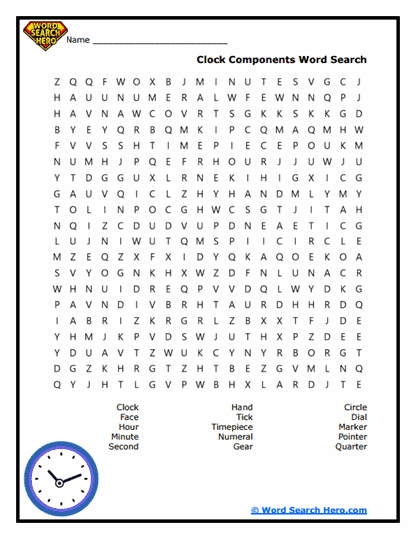
This word search introduces students to components of analog and mechanical clocks. Words like “Gear,” “Minute,” and “Timepiece” give insight into how clocks work. Students locate these terms in a letter grid, reinforcing both spelling and meaning. The theme centers on understanding timekeeping devices and their functional elements. This puzzle sharpens vocabulary related to mechanical […]

View More
Time Measures Word Search

Time Measures

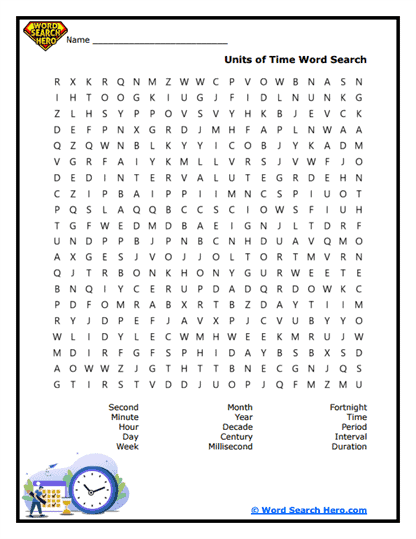
“Time Measures” explores different units used to represent time, such as “Second,” “Month,” and “Millisecond.” Students find these words in a puzzle to deepen their understanding of time intervals. It reinforces knowledge of both everyday and scientific time units. The words are contextually grouped from short durations to long spans. This activity helps learners associate […]

View More
Time Chunks Word Search

Time Chunks

“Time Chunks” introduces phrases for various lengths of time. From short measures like “Five Minutes” to full “One Hour” spans, students gain familiarity with time segmentation. The word bank includes terms like “Countdown” and “Schedule,” making it relevant for planning or elapsed time lessons. Students explore both numeric and event-based time phrases. Students improve recognition […]

View More
Digital Clockwork Word Search

Digital Clockwork

This word search teaches digital time terminology. Students locate words like “Timer,” “Digits,” and “AM/PM,” associated with digital clocks and electronic displays. The puzzle reflects the language seen on devices like alarm clocks and microwaves. It supports practical understanding of how digital time is read and interpreted. It develops literacy around real-world digital tools. By […]

View More
Analog Clocks Word Search

Analog Clocks

“Analog Clocks” centers on vocabulary related to traditional time-telling methods. Students find terms like “Sweep,” “Tick,” and “Rotate,” reflecting how analog clocks operate. The word list includes both motion-related and static clock terms. This worksheet builds descriptive language around clock hands and face positioning. Students enhance reading accuracy by locating action verbs and nouns used […]

View More
Time Actions Word Search

Time Actions

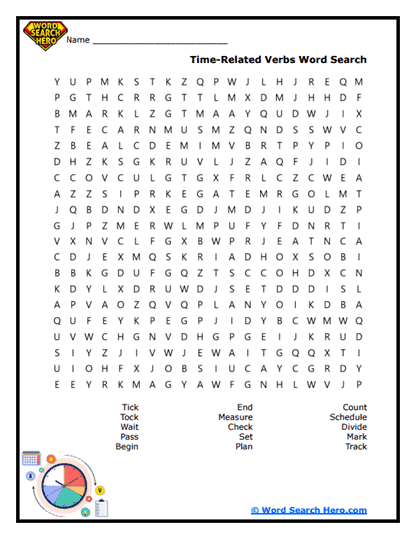
“Time Actions” focuses on verbs that relate to the passage and management of time. Terms like “Schedule,” “Begin,” “Pass,” and “Track” help students articulate actions taken with or through time. It’s a dynamic word search that blends time vocabulary with action verbs commonly used in instructions and planning. This worksheet helps students internalize practical verbs […]

View More
Calendar Words Word Search

Calendar Words

“Calendar Words” explores vocabulary tied to calendars and annual events. Students search for words like “Leap Year,” “Season,” “Anniversary,” and “Weekday.” It gives a comprehensive view of how we organize time over days, months, and years. This worksheet connects abstract concepts like events and grids with concrete calendar structure. It supports calendar literacy and helps […]

View More
Monthly Days Word Search

Monthly Days

“Monthly Days” includes the names of the days of the week and months of the year. Students search for familiar calendar terms like “Monday,” “April,” and “Sunday.” This word search reinforces both spelling and sequencing of calendar vocabulary. It helps build awareness of weekly and monthly time cycles. This activity is perfect for reinforcing days […]

View More
Time Phrases Word Search

Time Phrases

“Time Phrases” highlights expressions used to describe moments during the day or week. Words such as “Morning,” “Noon,” “Sunset,” and “Tomorrow” guide students in learning conversational and descriptive time language. This puzzle integrates poetic and functional time references used in stories, instructions, or casual dialogue. The activity builds vocabulary tied to everyday communication about time. […]

View More
Planner Terms Word Search

Planner Terms

“Planner Terms” introduces vocabulary associated with time management and organization. Students locate words like “Deadline,” “Routine,” and “Appointment.” These terms are frequently used in school, work, and home planning contexts. The word list reflects organizational tools and strategies used to manage tasks and schedules. This worksheet supports executive functioning by teaching words connected to planning […]

View More

About Our Times and Dates Word Searches

Time-whether you’re chasing it, wasting it, or wondering where it went-is the unsung ruler of our lives. We wake up to it, plan our days around it, blame it when we’re late, and celebrate it with cake once a year. And yet, as familiar as it seems, time is a surprisingly slippery concept-equal parts science, habit, and language. That’s where this word search collection comes in. It’s not just a bundle of printable puzzles; it’s a carefully curated journey through the vocabulary of minutes and months, deadlines and dials. Designed for learners who are still wrapping their heads around the mechanics of when and how long, this collection transforms abstract time talk into concrete word play.

At its core, this collection is about anchoring mathematical and temporal concepts in language. Whether students are sorting out the difference between “AM” and “PM,” or puzzling over how long a “fortnight” is (hint: not just a video game), each worksheet gives learners the chance to literally find meaning-hidden, diagonally or backwards-in the grid. These aren’t just idle exercises in spotting letters. They’re tools for building literacy around one of the most essential systems we navigate daily: time. From mechanical gears to metaphysical moments, your students are about to get very cozy with the ticks, tocks, and turns of the clock.

What makes this word search suite so effective is its blend of cross-disciplinary thinking. Math is here, yes, but so is science, reading, even a touch of philosophy. (After all, what is “now”?) Each worksheet offers a different angle on the idea of time-from practical tools to abstract periods-while also strengthening spelling, visual recognition, scanning skills, and even a little existential comfort with the march of hours. Now let’s zoom in and see how these worksheets break down the fabric of time-one cleverly hidden word at a time.

We’ll begin where time begins (or at least where we see it): with the tools we use to tell it. Clock Parts, Digital Clockwork, and Analog Clocks form a mechanical trio that introduces students to the nuts, bolts, beeps, and sweeps of time-telling technology. These puzzles aren’t just about the words-they’re about understanding the infrastructure that makes modern timekeeping possible. “Clock Parts” is like the opening credits of a time-travel movie, introducing key players: the face, the gear, the dial, the hand. With each word, students start to see a clock not as a magical ticking orb on the wall, but as a system-one that obeys physics, math, and design. Then, we shift to “Digital Clockwork,” which transports us from brass gears to blinking digits. The vocabulary here reflects our 21st-century time reality: “Timer,” “Colon,” “AM,” “Readout”-it’s like a cheat sheet for microwave buttons and smartwatch alerts. “Analog Clocks” brings it full circle (literally, there’s a lot of circular motion going on) with words like “Sweep,” “Rotate,” and “Estimate.” It emphasizes the motion of time-how it turns, ticks, and teases us forward. Together, this trio gives students both historical context and technical fluency in time-telling tools. It’s STEM literacy, one puzzle at a time.

Next, we shift our focus from the tools of time to its measurements-how we divide and organize the elusive stuff. Time Measures, Time Chunks, and Time Actionsย dive into the many ways humans have chopped time into manageable, often arbitrary, pieces. “Time Measures” is like the metric system’s long-lost cousin. Students encounter everything from “Millisecond” to “Century,” getting a solid sense of scale, from blink-of-an-eye speed to epic historical span. These aren’t just units-they’re mental containers for experience, milestones, and math problems involving elapsed time. “Time Chunks” gets a bit more colloquial and practical. Here we meet “Quarter hour,” “Countdown,” and “Thirty Minutes”-the kinds of phrases used in classrooms, meetings, and panic-fueled sprint cleaning sessions before guests arrive. Students improve their grasp of compound phrases, while reinforcing number vocabulary and the natural segmentation of time. “Time Actions,” meanwhile, is all verbs and motion. Time doesn’t just exist-it gets scheduled, tracked, and checked off. This puzzle helps students understand time as a process, not just a thing. “Pass,” “Wait,” “Track,” “Begin”-they’re small but mighty words that capture our endless dance with deadlines. Collectively, these worksheets help students not just understand time, but move with it, measure it, and manipulate it. Very empowering stuff.

Moving from measurement to meaning, we meet the next group: Time Phrases and Planner Terms which address how we talk about time in daily life. While some students are comfortable with abstract time language, many struggle with expressions like “Later,” “Soon,” or “Tomorrow,” which can feel like shifting sand depending on who’s speaking. “Time Phrases” demystifies those everyday conversational anchors: “Morning,” “Midnight,” “Yesterday.” They’re the kind of words that help us situate ourselves in narrative, plan our day, or understand a story’s timeline. By engaging with these time-based descriptors, students also learn to decode context-a skill as crucial in reading as it is in scheduling. “Planner Terms” then takes it a step further by introducing the vocabulary of structure and responsibility. Words like “Deadline,” “Routine,” and “Appointment” aren’t just practical-they’re part of the executive functioning toolkit. These words are where math meets life planning, making this worksheet a low-key lesson in productivity. Plus, who doesn’t want to find “Efficient” hidden backwards in a grid and feel like a total boss?

For those seeking a more calendar-based lens on time, Calendar Words and Monthly Days deliver in spades. These puzzles are the bread and butter of schedule literacy, offering foundational knowledge for both academic planning and daily navigation. “Calendar Words” includes more than just “Day” and “Month”-it ventures into cultural territory with terms like “Holiday” and “Anniversary,” anchoring vocabulary to lived experience. “Grid” and “Page” remind students that calendars are visual systems, not just long lists of numbers. This worksheet is particularly great for bridging math with social studies and language arts, as it touches on event planning, seasonality, and even geometry (hello, boxes and rows). “Monthly Days” reinforces the structure of weeks and months, making sure students know their “Mondays” from their “Fridays,” and can place “April” somewhere between “March” and “May” without breaking a mental sweat. It’s especially helpful for young learners or ESL students, offering repetition, familiarity, and a dash of rhythm to calendar language.

These puzzles wouldn’t be complete without a dash of philosophical whimsy, which sneaks in through the layered meanings embedded in every search. Because time, for all its clocks and chunks, is also about emotion, memory, and experience. That’s what makes word searches such a perfect vessel: they force us to pause, focus, scan, and reflect. They make us take time to find time-which is the most poetic twist of all.